
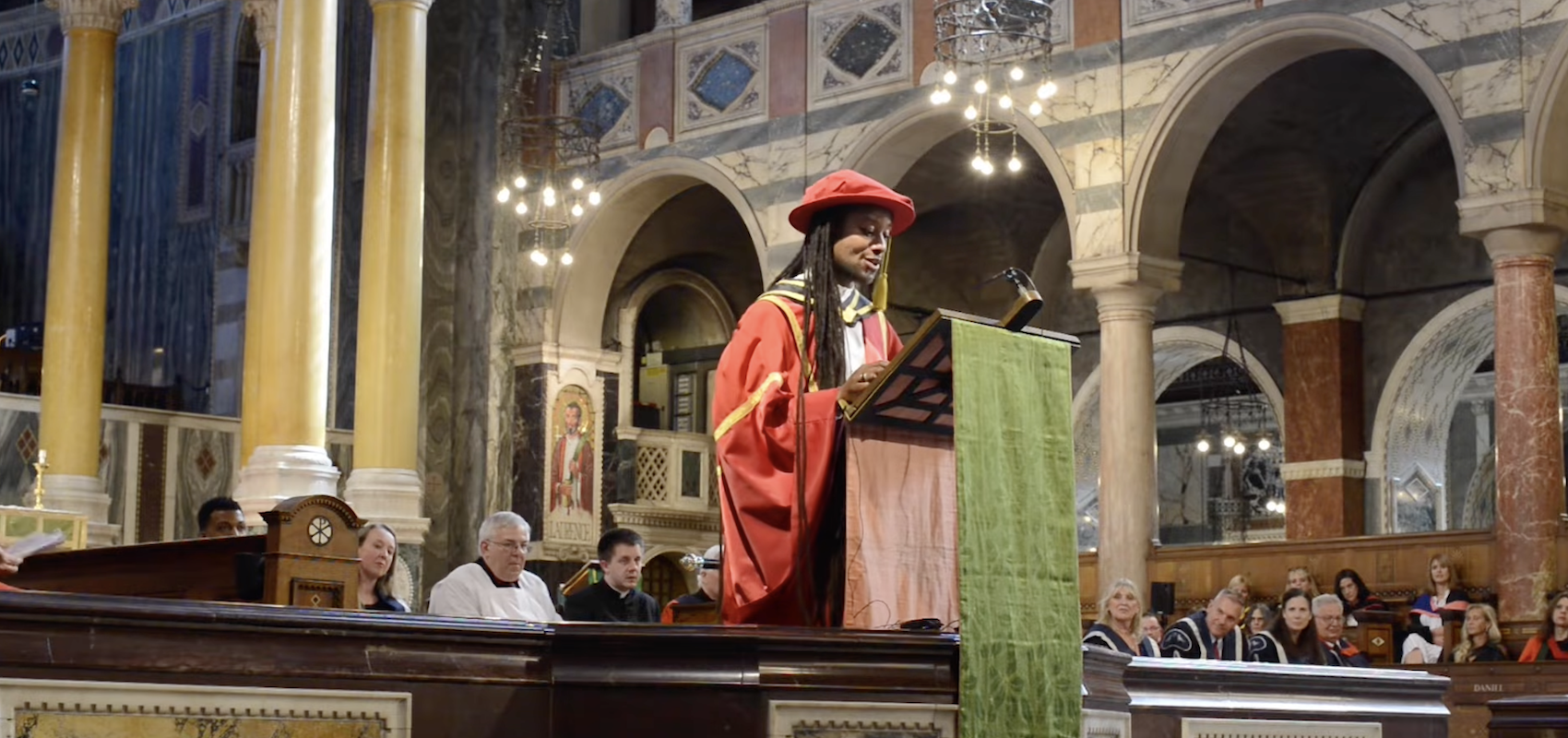
The fall of Cambridge wunderkind Jason Arday was the British press story of the summer. To any perceptive onlooker, his tall tales of overcoming numerous impossible odds to scale the highest heights of academia had never passed the smell test. But it was only this year that they were systematically and publicly dismantled as fiction. Then, three days ago, his story came to a sickening end in apparent suicide. There is a grim irony in the fact that this feels like the last knife twist of a sadistic satire novel, by the sort of writer who hates his readers as much as he hates his characters.
Who killed Jason Arday? The Spectator says it was the elites who fast-tracked a young black fabulist to DEI superstardom. Ibram X. Kendi says it was the journalists who cross-examined him. Both left and right argue in their own way that it was racism. But in the end, it was Jason Arday who wrote his story, including its ending.
Many on the right have correctly observed that Arday was more bully than bullied throughout the scandal, threatening to weaponize the courts and the police force against anyone who dared to challenge him. But among these responses, there have also been a few in what Ross Douthat might call a distinctly “post-Christian right” key. In a viral post, Eric S. Raymond deems Arday’s exit “honorable,” reflecting that it’s a pity this won’t inspire “a wave of copycat suicides” by similarly unqualified DEI hires. Sci-fi writer Devon Eriksen gets right to the point: “I think it’s good when my enemies hurt themselves instead of my friends.”
These reactions are admirably stark in their pagan brutality, abandoning the Christianized framework of justice and mercy wholesale for a framework of honor and shame: A weak man like Arday brings dishonor to the human race, therefore his life is worth less than nothing. We are stronger without him. Good riddance.
This mirrors the lie Arday was told by a no less post-Christian left: You are worth only as much as the lies you have invented about yourself. Without them, your life is worthless.
Arday’s memoir, which as I write still hasn’t been yanked from circulation by Simon & Schuster, is generously sprinkled with alleged prophecies—family, friends, and strangers repeatedly intoning that he is “special,” a Chosen One, destined for greatness. Among his other proven falsehoods, he claims he was illiterate until age eighteen, and he crafts a scenario around this falsehood in which a careers officer says he isn’t fit for any work but the supermarket. His outraged mother rails at the officer that one day her son “will do something great, unfathomable.” Arday also puts words in his younger brother’s mouth to the effect that he operates “on a higher frequency to the rest of us normal people.”
These fabrications are in painful contrast with the reported memories of people who grew up with Arday, including schoolmates who also debunked his claim to have been nonverbally autistic until age eleven. They paint a picture of a schoolboy who was a bit shy, perhaps on the spectrum, but on the whole, in one neighbor’s words, “just normal.”
Of course, if Arday had actually had such a crippling disability, and if there had been a way to detect this in the womb, the same elite gatekeepers who feted him would have deemed it moral to abort him. A truly helpless disabled person is inconvenient, unremarkable, reflecting no glory for anyone to bask in. He will never do “something great, unfathomable,” at least by the definition of “greatness” Arday believed in. But Christianity audaciously asserts that the little, hidden life is no less “great.” Indeed, the more helpless and less accomplished we are, the closer we may be to God’s heart.
Young men down the ages have aspired to greatness in the form of lasting fame and storied accomplishments. Such ambition is natural, but when untempered by healthy humility, it can kill. Sarah Ditum poignantly compares Arday to the doomed amateur sailor Donald Crowhurst, who in 1968 embarked on a round-the-world yacht race for which his boat was woefully inadequate, then sent back false milestone reports for seven months. In the end, it was not the dangers of the journey itself that killed him, but his inability to face his failure.
Arday laid claim to athletic as well as intellectual greatness, including the clearly ludicrous alleged feat of running six hundred miles in six days. Yet he wasn’t without athletic ability. Schoolmates remember him as a talented football goalkeeper. Before setting his sights on higher education, he worked as a PE teacher. What might his future have been, had he been content with the little life he was given? What fulfillment might he have found, had he believed that even our modest talents bear a divine stamp, and that we can offer them up to the Creator who delights over us as we are, not as we imagine ourselves in our daydreams?
Crowhurst’s final logs are the pitiful scrawlings of a man who has lost all hope and sanity. The last pages mingle mad raving, confession, and suicide note: “I am what I am and I see the nature of my offense. . . . It is finished. It is finished. IT IS THE MERCY.” By this, it seems he meant death. But true mercy was waiting for him, if only he had the strength to reach for it. It was waiting for Arday too—as it waits for us all.
Dear Reader,
Can I be direct with you?
War abroad. Socialists on the rise. AI upending human life. Endless uproar online. The modern attention economy doesn’t want readers — it wants users enslaved to the tyranny of the present.
First Things is the antidote: literary excellence, timeless truths, and a fixed point of reference in a culture that has lost its bearings.
But we can’t do it without readers like you.
Our goal: Raise $150,000 by November 1 to sustain First Things in the year ahead.
Your gift anchors readers in the permanent things.
Make your Fall Campaign gift now using the button below.
If you have any questions or would like more information, please contact Giovanni Del Piero, Director of the Editor’s Circle, at gdelpiero@firstthings.com or 212-627-1985.

YOU MIGHT ALSO LIKE
Foucault’s Idol of Nothingness
Today marks the 100th anniversary of the birth of Michel Foucault. He was influential in his lifetime,…
Forget Odysseus. Aeneas Is the True American Hero.
Who is our Odysseus? Or more precisely, who is the most Odyssean hero of American film? Matt…
The Last Statesmen?
In the latest installment of the ongoing interview series with contributing editor Mark Bauerlein, Steven B. Smith…
