
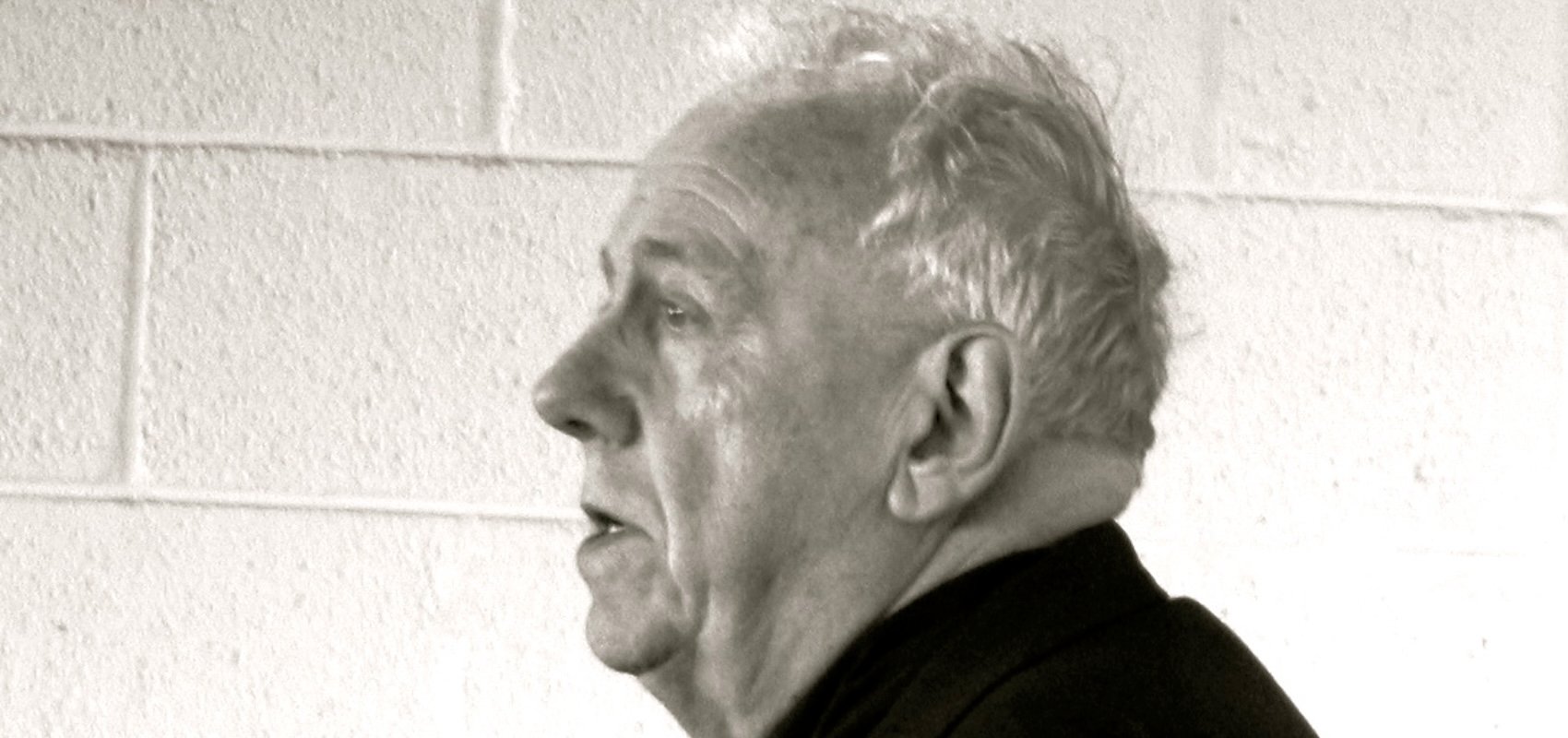
The death of Alasdair MacIntyre at the age of ninety-six is neither unexpected nor tragic. His close friend and colleague David Solomon, upon whom (together with David’s wife “Lou”) he relied in several respects, had passed three months before, and it was hard to imagine Alasdair carrying on long after. Besides, his work was long done, and he was content, and perhaps even eager, to pass from the waiting room into eternity without presumption, but with the hope of ultimately entering into the company of God.
The republic of letters is diminished by his death, not because of what he might yet have done (though he lived to write), but because of what he had already achieved. The much greater loss, however, is to the world of Christian thought and reflective living. MacIntyre had converted to Roman Catholicism in the early 1980s following his stay in Oxford, where he delivered the 1982 Carlyle Lectures (subsequently published as Whose Justice? Which Rationality?). During this time, he reconnected with the similarly feisty Dominican Herbert McCabe at Blackfriars, whom he had first known at Manchester University in the 1950s. They shared interests in intellectual challenges to British empiricism, then the dominant philosophy of knowledge, and in Marxist challenges to capitalism, the prevailing Anglophone philosophy of society and politics.
As the years passed, McCabe retained his critical posture without developing any constructive alternative; but MacIntyre, because of his immersion in the largely secular academic world, personal intellectual ambition, and compulsive need to write, pressed on to develop a broad and deep philosophy: combining the moral, social, and epistemological—the latter involving an account of enquiry, justification, and the integration of knowledge, values, and practice.
In this he was inspired by Aristotle, Augustine, Aquinas, Hegel, Newman, and Wittgenstein, but also by the example of literary cultures, pre-eminently that of Ireland and its diaspora. His philosophical peer group included Charles Taylor and Bernard Williams, and it was the latter who in 1995 gave a concise and insightful summary of their intellectual relationship: “Taylor and MacIntyre are Catholic, and I am not; Taylor and I are liberals, and MacIntyre is not; MacIntyre and I are pessimists, and Taylor is not (not really).”
Twenty years later, MacIntyre wrote his last book Ethics in the Conflicts of Modernity: An Essay on Desire, Practical Reasoning, and Narrative, which is in large part a response to Williams’s attacks on the objectivity of ethics (see my First Things review “MacIntyre against Morality“). There he writes, in a characteristic combination of praise and criticism: “It is Williams who does most in enabling us to understand the present situation of the [ethically] reflective agent and the alternatives that she or he confronts, in part by his insights, in part by the issues that his work raises but is unable to resolve.” Two hundred and thirty pages later, MacIntyre concludes: “This discussion and defense of a Thomistic Aristotelian account of the human good began as a response to the criticisms . . . especially of Williams. Would [he], could [he], have judged it adequate? Quite certainly not! Indeed, the theistic elements in that account would have given . . . sufficient reason for rejecting it quite apart from any other consideration.”
This raises a familiar point: the apparent dependence of a Thomistic account of the human good, and of the means of achieving it, upon religious assumptions. Secular philosophers deem this to be a criticism, in part because it is held to be an abandonment of philosophy in favor of theology, and in part because the religious assumptions are taken to be unfounded, and indeed unbelievable. But as MacIntyre, and we following him, may rightly respond, this raises two large questions. First, about the nature of philosophy; and second, about the character and status of religious claims.
Philosophy for MacIntyre is sustained (and culturally and historically informed) integrative thinking about the content and implications of experience, values, practices, and theories. Such thinking tends to perforate, if not obliterate, distinctions between disciplines. Relatedly, “theistic elements” may be arrived at not by appeal to revelation, or by means of natural theology, but as conclusions of arguments about the possibility of halting the otherwise regressive search for meaning in some transcendent and ultimate source of value.
Opening MacIntyre’s many volumes for the purpose of this brief appreciation, I was reminded, and once again daunted, by the breadth and depth of his reading and writing. His powers of comprehension of very diverse modes of literature—historical, anthropological, philosophical, poetical, political, and sociological, from quite different cultures—were matched by remarkable powers of concentration, imagination, and production. As much as he was a philosopher he was also, like Plato, a literary artist moving between dialectic to narrative, in order that each might inform and advance the other toward an understanding of the human condition and the possibility of shared fulfillment.
Contemporary academic practice discourages and disables the kind of broadly conceived and implemented projects that MacIntyre pursued. But recognizing their importance, both intellectually and existentially, and inspired by his pursuit and execution of them, we should not rest content with passive admiration, but make the effort to follow his example, or at least encourage and support others in doing so. Time now for the University of Notre Dame to create MacIntyre Fellowships in gratitude and in recognition of the importance of his contributions to the republic of letters and the world of Christian thought.
Image by Sean O’Connor, via creative commons. Image cropped.
Dear Reader,
Can I be direct with you?
War abroad. Socialists on the rise. AI upending human life. Endless uproar online. The modern attention economy doesn’t want readers — it wants users enslaved to the tyranny of the present.
First Things is the antidote: literary excellence, timeless truths, and a fixed point of reference in a culture that has lost its bearings.
But we can’t do it without readers like you.
Our goal: Raise $150,000 by November 1 to sustain First Things in the year ahead.
Your gift anchors readers in the permanent things.
Make your Fall Campaign gift now using the button below.
If you have any questions or would like more information, please contact Giovanni Del Piero, Director of the Editor’s Circle, at gdelpiero@firstthings.com or 212-627-1985.

YOU MIGHT ALSO LIKE
Why the Death Penalty Is a Sore Point for Papal Authority
Pope Leo XIV marked World Day Against the Death Penalty, observed on October 10, with the following…
The Myth of St. Francis
At the beginning of his 2020 encyclical, Fratelli Tutti, Pope Francis speaks of “an episode in the…
Job and Her
It is said that Job lost everything, but she has lost more. All her possessions—the money, the…
