
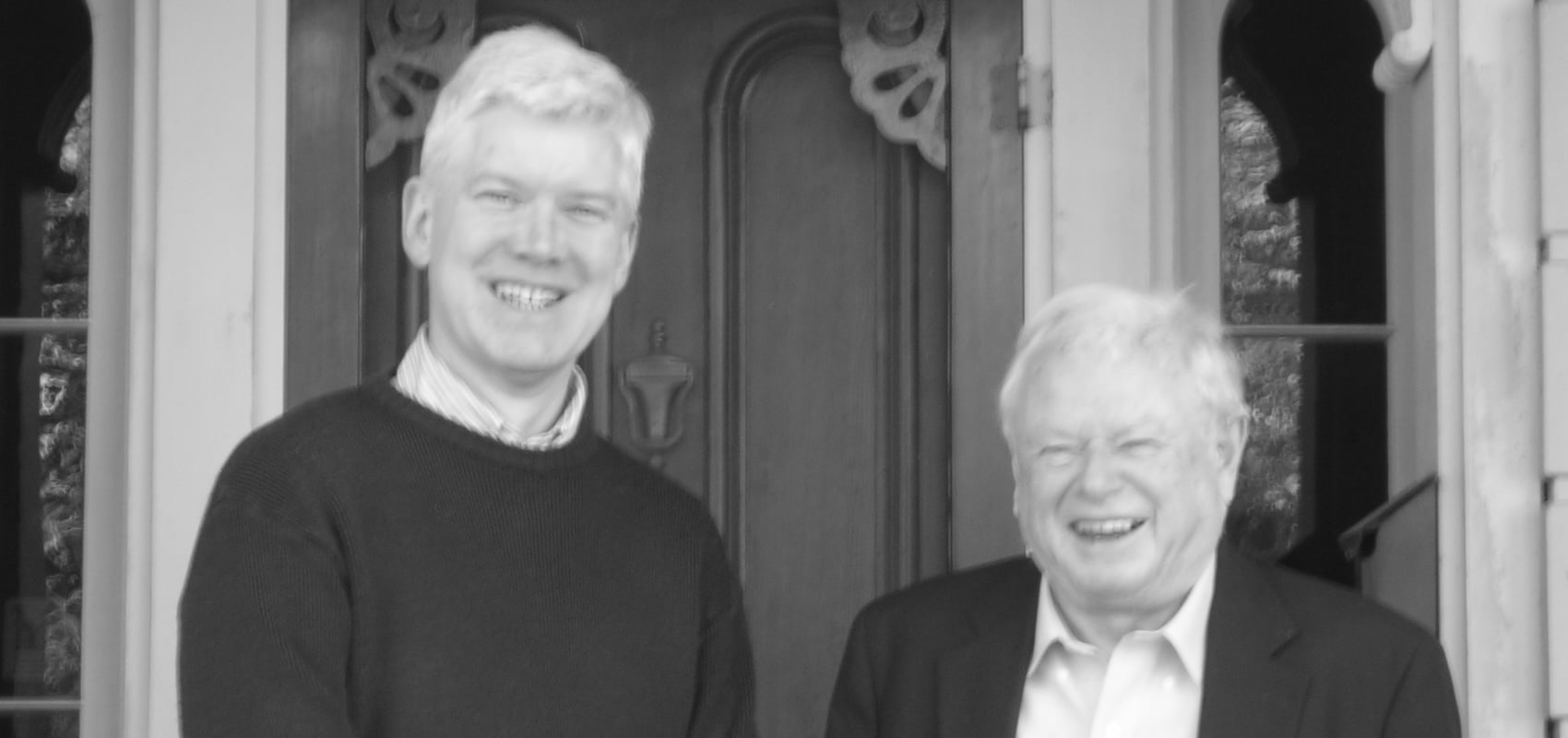
The death of Sir Anthony Kenny on August 3, at the age of ninety-five, broke one of the last direct connections to an unparalleled period in the history of philosophy in Britain, and to an era when the humanities consisted of disciplines rather than “studies”; when liberal arts academics were to varying degrees familiar with classical culture, Judeo-Christian Scripture, the high points of literature, and visual arts and music; and when university education was conceived as an introduction to “the best that has been thought and said” (Matthew Arnold) and as the training of the intellect “to have a connected view or grasp of things” (John Henry Newman).
Anthony Kenny (universally “Tony” to those who knew him) was not only linked to those times, conditions, and purposes, but was an outstanding representative of their values and virtues. While recording something of the extraordinary range and quality of his scholarly, academic, and public service achievements, I want to provide a more personal account of his character and life, placing them within academic, religious, and cultural contexts and adding notes drawn from thirty or so years of casual friendship and academic engagement.
Tony Kenny was born in 1931 into an Irish family in Liverpool, then a favored destination for Irish immigrants. Tony’s father, John, was a ship’s engineer and largely away at sea. His parents separated when he was two, and in 1940 John was killed when his merchant ship was torpedoed. Thereafter, the adult male in Tony’s life was his uncle Fr. Alexander “Alec” Jones, who had studied for the priesthood in Rome and become a seminary academic and scholar.
Alec was a major influence and abiding friend through Tony’s childhood; through his studies for the Catholic priesthood, his ordination, and his eventual laicization; through his subsequent departure from the Church; and through his rise to Oxford philosophy positions and the start of his long and distinguished academic career. Tony was also supported by his American wife, Nancy Gayley (a Vassar graduate), whom he married in 1966. Among Kenny’s many Oxford positions, he was master of Balliol (1978–89), one of the oldest colleges in the university and in the English-speaking world; pro-vice-chancellor of the university (1984–2001); curator of the Bodleian Library (1985–88); warden of Rhodes House (1989–99); and professorial and then emeritus fellow of St. John’s College (1989–2026).
Beyond Oxford, he was a fellow of the British Academy (1974–2026) and its president (1989–93); chair of the British Irish Association (1990–94), the British Library (1993–96), and the Warburg Institute (1996–2000); honorary bencher of Lincoln’s Inn, the grandest of the London medieval Inns of Court; and president of the Royal Institute of Philosophy (2006–09). In the United States, he was a member of the American Philosophical Society and a fellow of the American Academy of Arts and Sciences, and held visiting professorships at the universities of Chicago, Michigan, Minnesota, and Washington (St. Louis), and at Cornell, Rockefeller, and Stanford. He received honorary degrees from a dozen universities, and in 1992 was knighted for services to higher education and intellectual culture. The honor was expected but delayed, it is said, due to Margaret Thatcher’s ire at Oxford’s 1985 vote not to award her an honorary degree (though, ironically, Tony was among those who had put her name forward two years earlier).
The expression “the great and the good” is often used ironically to refer to members of the British establishment, but Tony’s ascent to the high table of the cultural elite in the company of Sir Isaiah Berlin and Sir Henry Chadwick (also heads of Oxbridge colleges) was unquestionably on account of his greatness and goodness. Those qualities were rooted in his nature but certainly encouraged and strengthened by his early education and subsequent studies and experiences.
Tony’s initial schooling was with nuns, and later at a Jesuit college, but by the age of twelve he had decided that he wanted to follow the example of Fr. Alec and become a priest. The junior seminary where Alec taught Scripture was a grand Gothic structure with a quad larger than that of most Oxbridge colleges. Many of the priests were Cambridge graduates, and the curriculum was focused on the humanities and theology. Tony acquired a love of sacred music and savored the Christmas and Easter liturgies, but by his own account he was not particularly devout. Academically he excelled in Latin, ancient history, and Greek, began to take an interest in philosophy, and discovered the profundity of poetry, alighting on that of the Jesuit Gerard Manley Hopkins.
At eighteen, he was selected for higher studies in Rome, residing at the Venerable English College and taking classes at the “Greg” (the Jesuit Pontifical Gregorian University). There he encountered a dull and turgid style of neo-scholasticism, presented (in Latin) with reference to a pantheon of favored authorities—Aristotle, Albert the Great, Aquinas, and Suárez—as well as deprecating asides against modern rationalists and empiricists—Descartes, Leibniz, Locke, and Hume. Relief and discovery came through courses taught largely in English by Frederick Copleston on the history of philosophy and Bernard Lonergan on dogmatic theology. It was through Copleston that Kenny first came to appreciate the philosophical importance of the subject’s history, and through Lonergan that he got a sense of the depth and enduring relevance of Aquinas. A third figure in his awakening was Fr. Alan Clark, philosophy tutor at the English College and subsequently a bishop and co-chair of the Anglican–Roman Catholic International Commission (ARCIC).
Kenny had discovered contemporary Oxford theology through writing a dissertation on Austin Farrer’s Finite and Infinite, but Fr. Clark directed his attention to contemporary Oxford philosophy, which was then in an exceptional phase. When it came to researching his philosophy dissertation, Tony settled on the logical status of theological propositions. This led him to examine the claim that only empirically verifiable propositions could be meaningful, and the idea that statements about the nature of God might be verified in the experience of mystics, which could then be communicated to others through poetic language, as in that of John of the Cross.
On the strength of his licentiate dissertations, it was judged that Kenny should proceed to study for a doctorate in divinity. By then his interests were more philosophical than theological, and he proposed as a bridging theme a deeper exploration of the relation between philosophical analysis and religious language. Since the type of analysis he had in mind was that of “ordinary language philosophy” and its acknowledged home was Oxford, it was agreed that he would do the first year in Rome, supervised by Lonergan, and enroll for his second year as a private student at Oxford. Arriving in 1957, he discovered that if he matriculated through one of the Catholic “permanent private halls” for the purpose of pursuing an Oxford doctorate, he would be eligible for a public grant from Liverpool covering fees and maintenance. Campion Hall was for Jesuits, Greyfriars for Franciscans, but St. Benet’s, though Benedictine, also accommodated secular clergy, so he went there.
Oxford was for Kenny what Nashville might be for someone who had recently encountered country music and wanted to immerse himself in it. He went to every philosophy forum he could—lectures, tutorials, and society meetings, including those of C. S. Lewis’s Socratic Club—and sought out the Catholic philosophers, including the Dominican Herbert McCabe, who introduced him to Elizabeth Anscombe and Peter Geach. From these he learned about the later philosophy of Wittgenstein and its resemblance to aspects of Aristotelian and Aquinian thought. Animated by this, he gave a paper to the Socratic Club in 1958 on “Aquinas and Wittgenstein,” which, appearing the following year in the Downside Review, was his first philosophical publication. Anscombe was especially supportive and suggested “The Intentionality of Psychological Verbs” as a theme for his Oxford doctorate—as in, the aboutness or directedness of “thinking [of],” “imagining [that],” “hoping [for],” “fearing [that],” and so forth. Later, with the degree awarded, the dissertation became his first published book, Action, Emotion and Will.
Tony’s insightful and scholarly participation in philosophical discussions got him noticed, and the leader of Oxford philosophy, Gilbert Ryle, encouraged and supported his application for academic positions there. This led to his appointment to Balliol, which began his ascent to the high points of academic distinction. In the same period, however, Tony, who was by then an ordained priest, had begun to lose confidence in aspects of Catholic teaching, especially in relation to transubstantiation, contraception, and infallibility. He sought and was granted laicization. This and his subsequent marriage, for which he did not seek Rome’s permission or recognition, put increasing strain on his relationship with Anscombe, effectively leading to her breaking it, though he continued to celebrate her genius and acknowledge his indebtedness to her instruction, example, and support.
His concerns about specifically Catholic teachings broadened into doubts about the rational grounds for belief in God and about the very coherence of the idea of an immaterial, omnipotent, and omniscient divine being who also created humans with free will. These he developed in a series of books, including The Five Ways (1969) and The God of the Philosophers (1979). By stages, his doubts became more extensive. He thought that none of the proposed proofs of the existence of God was sound, that the idea of the survival of death was illusory, and that talk of God could not be made sense of other than in metaphorical, non-literal terms. For all that, however, he never embraced atheism. Disliking its strident avowal by the likes of Richard Dawkins, he also queried its rational foundations. He was to the end an agnostic, and though he did not share Hume’s empiricism, he did admire his undogmatic and calm agnosticism and said that he set an example of how an agnostic should meet death with dignity.
I first got to know Tony Kenny thirty or so years ago, but he was then already a model for me of how to combine the insights of Aquinas with the methods and clarity of analytical philosophy. I had coined the term “analytical Thomism” as a vague label for this kind of approach, having in mind some of his work and Peter Geach’s. Neither much liked the idea of being designated “Thomists,” but that had not been my intention, and their concern reflected distaste for the sectarianism of Catholic philosophy and a general dislike of “ism-ization.” That said, Tony was generally encouraging and invariably friendly. We corresponded and contributed on several occasions to the same conferences, and I enlisted him in giving prominent public lectures and in publishing ventures.
One such venture was a book on a subject of his choice, for the series St Andrews Studies in Philosophy and Public Affairs. He said he was interested in the American concern for happiness and would write on the topic with his son Charles, who was then an economist with the World Bank. I responded enthusiastically, hoping for a submission within a year. A couple of months later, he sent the manuscript of Life, Liberty, and the Pursuit of Utility, adding that he was then working on a second book with his other son Robert. Can Oxford Be Improved? A View from the Dreaming Spires and the Satanic Mills was completed with comparable pace and rigor and appeared the following year.
Notwithstanding his departure from the priesthood and from the Catholic faith, Tony never lost his affection for some of his fellow seminarians who had remained priests, including Cormac Murphy-O’Connor, who became cardinal archbishop of Westminster and thereby spiritual head of Catholicism in England. Tony also retained ethical and cultural attachments to aspects of Catholicism, remaining firmly opposed to abortion and to the killing of innocents in war. He also liked to know about how things were going in Rome, and during the decade when I had a Vatican appointment, he would quiz me about the state of things thereabouts. I always remember him smiling, almost boyish in demeanor. Yet there is no doubt that he was Magister Magnus—Grand Master. I once said to him that in an earlier age, he would have been a Roman cardinal. I then immediately corrected myself, saying he would have been the learned and wise secretary to a prelate: the real mind behind the throne. In 2010, I had the privilege, along with other philosophers, of contributing to a festschrift in his honor, Mind, Method, and Morality, in which I was able to acknowledge my indebtedness to his work and example. We shall not look upon his like again.
Dear Reader,
Can I be direct with you?
War abroad. Socialists on the rise. AI upending human life. Endless uproar online. The modern attention economy doesn’t want readers — it wants users enslaved to the tyranny of the present.
First Things is the antidote: literary excellence, timeless truths, and a fixed point of reference in a culture that has lost its bearings.
But we can’t do it without readers like you.
Our goal: Raise $150,000 by November 1 to sustain First Things in the year ahead.
Your gift anchors readers in the permanent things.
Make your Fall Campaign gift now using the button below.
If you have any questions or would like more information, please contact Giovanni Del Piero, Director of the Editor’s Circle, at gdelpiero@firstthings.com or 212-627-1985.

YOU MIGHT ALSO LIKE
Why the Death Penalty Is a Sore Point for Papal Authority
Pope Leo XIV marked World Day Against the Death Penalty, observed on October 10, with the following…
Foucault’s Idol of Nothingness
Today marks the 100th anniversary of the birth of Michel Foucault. He was influential in his lifetime,…
Candace Owens and the Sin of Anti-Semitism
According to the online Encyclopedia Britannica, Sir Moses Montefiore (1784–1885) was “an Italian-born businessman who was noted…
