
For certain personalities, drugs such as methamphetamine have an almost irresistible appeal. Only later does it turn out that an addictive substance can take over your life, enslaving the intellect and the moral sense. Anti-Semitism works in a similar way. The evidence is all around us, in the resurgence of anti-Semitic ideologies and conspiracy theories on both the left and the right. Strikingly, much contemporary anti-Semitism comes from Christians—perhaps the two most prominent anti-Semites, Nicholas Fuentes and Candace Owens, are Catholics—and it sometimes justifies itself by appealing to Christian theology and history. Yet the real roots of modern anti-Semitism are not in orthodox Catholicism, but in the anti-Christian thinkers of the Enlightenment.
This origin is easily missed because, to the unaware, anti-Semitic theories can sound theologically sophisticated. Take the principal anti-Semitic Catholic agitator of recent decades, E. Michael Jones, described by Fuentes as a “legend.” For Jones, “Jews, by rejecting Christ, rejected Logos and became agents of moral subversion or, in the words of St. Paul ‘enemies of the whole human race.’” The moral order of the world is the plan of divine reason, and Christ is himself the Logos, the divine reason. So “when they rejected Christ, the Jews rejected Logos, and when the Jews rejected Logos,” they rejected “the social, moral and political order of any human society, which God intended for the world.” Now they seek a messiah who will carry out their plan of subversion.
Where did Jones’s theory come from? His main inspiration seems to have been the Irish priest Denis Fahey (1883–1954), an influential figure who did much to inspire the anti-Semitic diatribes of the American radio priest Charles Coughlin. Fahey believed the Jews were the chief enemies of God and the most important tool of Satan in the corruption of society. The Jewish people, he argued, rejected Christ’s messianic claims—not in favor of continued practice of the Mosaic Law, but in favor of a future messiah whose salvation would consist ultimately of Jewish rule over the whole world. This naturalistic goal, according to Fahey, led Jews to oppose every element of Christian morals, because these morals are directed to a supernatural end.
There are of course religious disagreements between Catholics and Jews. But Fahey’s theory has nothing to do with the standard Catholic critique of Judaism—namely, that Jews reject a supernatural good by refusing to believe in Christ as the divine messiah. “Supernatural,” in Catholic theology, means a good that is unattainable by human nature on its own and can be achieved only by grace—by direct divine assistance aimed at eternal salvation. This rejection of a supernatural good does not consist of or automatically entail any failings in natural virtue—in justice, temperance, prudence, or fortitude. St. Paul in his letter to the Romans identifies the error of non-Christian Jews as putting their faith in the Law of Moses but not in Jesus Christ. Jesus makes the same criticism in the Gospel of John: “You search the scriptures, because you think that in them you have eternal life; and it is they that bear witness to me” (John 5:39).
Fahey’s position is entirely different. For him, Jews are evil because of natural vices rather than a lack of supernatural belief. Their natural vices are pride, avarice, deceit, cruelty, and sexual immorality, and their machinations give them great power in the world, a power that amounts to virtual rule over the forces of evil and makes them the main enemy of the human race. The Jews were, Fahey proposed, the ultimate source of all the modern movements that did harm in the world, including the Freemasons, the Communists, the Nazis, the Rotary Club, the Orange Order, and the Irish Republican Brotherhood. This all-embracing conspiracy theory is, of course, mirrored by the belief among contemporary anti-Semites that Jews are responsible for the porn industry, the evils of finance capitalism, the errors of American foreign policy, and so on.
In Ireland at the time, Fahey was seen as somewhat mentally unbalanced. Frank Duff, the great founder of the Legion of Mary, whose cause for canonization is currently in progress, expelled from the Legion anyone upholding Fahey’s position. Yet Fahey’s books, which combined expositions of papal teaching with wild claims about Satanic Jewish influence, remain a formative influence on Catholic anti-Semitism.
Where, though, did Fahey get it from? The short answer is “from France,” where he pursued some of his studies for the priesthood. The longer answer takes us back to the eighteenth century.
The principal source of modern anti-Semitism was the principal anti-Christian figure of the Enlightenment: Voltaire. As Arthur Hertzberg notes in The French Enlightenment and the Jews: The Origins of Modern Anti-Semitism, it was Voltaire who “provided the fundamentals of the rhetoric of secular anti-Semitism.” Voltaire saw pagan antiquity as the golden age of civilization, which he sought to restore. This golden age was ended by the victory of Christianity, but this victory was itself the product of the Jewish traits of superstition and fanaticism. Opposition to Christianity was a fundamental tenet of Voltaire and his French Enlightenment associates, such as Diderot and d’Alembert. Voltaire adopted the views of pagan anti-Semites of antiquity, such as Apion and Tacitus, and used their positions to argue that Jews and Jewish culture and religion had no positive elements, and were entirely noxious and destructive. He held that Christianity was simply a diluted form of Judaism, a Jewish infection that was foreign to European tradition, although somewhat less evil than Judaism thanks to non-Jewish influences brought in by Gentile converts. Europe could recover her past glory because she could abandon Christianity and return to the civilization of Greece and Rome. The Jews, however, were beyond redemption, because their negative traits were not chosen, as Christianity was chosen by Europeans, but innate.
Ernest Renan succeeded Voltaire as the principal advocate of modern anti-Semitism; the term “anti-Semitism” was actually coined to describe his views. Renan lost his Catholic faith in his early twenties and devoted much of his work to attacks on Christianity. He achieved popular success with his Life of Jesus (1863), which presented Christ as a saccharine moral teacher rather than a divine redeemer. Renan used the discovery of an Indo-European family of languages as the basis for his anti-Semitic thought. He held that the Indo-European languages were suited by nature to art, civilization, philosophy, and science. Accordingly, every important achievement in philosophy, politics, art, science, morality, and literature was the work of the Aryans who spoke these languages. Semitic languages were too primitive to express the subtleties needed for these fields, and as a result the Semitic peoples had made no contribution to them. The characteristic traits of Jews were acquisitiveness and egoism. The ruling idea of all Jewish culture was monotheism, an idea that led to intellectual barrenness; all nuance in art and literature, and the understanding of multiplicity that was at the basis of philosophy and science, arose from polytheism and was extinguished by monotheism. The single important influence of Jews upon Aryans lay in the Aryan acceptance of monotheism, but in its Christian form the evil of Jewish monotheism was mitigated by Aryan influence. The key to progress for Europe lay in rejecting the Jewish elements of Christianity and abandoning monotheism. Doing so would lead to a bright future and ensure the well-deserved political supremacy of Europeans over the rest of the world.
There are two basic characteristics of modern anti-Semitism in its original form. One characteristic is its indifference to the Christian argument against Judaism—namely, that it rejects Christ and Christianity. On the contrary, for the Voltairean tradition, Jewish religious belief is identified as a threat and an evil precisely for beliefs that Christians share with Jews: monotheism and a belief in conscience. The allegedly inherent moral corruption of the Jewish people, together with cunning and adroitness, make up one part of the case for the modern condemnation of the Jews. The other part is the description of the Jews as an omnipresent threat to all that is good, as the main source of danger and evil in the world.
Renan’s anti-Semitism influenced Catholics through the Catholic Édouard Drumont’s tract La France Juive, published in 1886. Drumont relied principally on Renan for his portrayal of the Jews, and blamed all the ills of society upon them. They were a convenient outlet, it turned out, for Catholic bitterness about the Third French Republic, which discriminated against practicing Catholics and imposed secularist indoctrination in the state schools. Catholic resentment could be vented on the Jews, a traditional scapegoat, without provoking the real anticlerical enemy. At the same time, Drumont offered Catholics a way to fit into the ambience of the late nineteenth century, where anti-Semitism was on the rise, and thus to feel less at odds with the rest of society.
Partly because of Drumont’s influence, French Catholics took the lead in anti-Semitic agitation in France at the end of the nineteenth century. La Croix, the journal of the Assumptionist congregation of priests and brothers, was central to this agitation. Its attack on the Jews focused not on their rejection of Christ, but on their alleged malice, egotism, and lust for money and power. These traits were claimed to have characterized Jews throughout their history.
Drumont and the Assumptionists paved the way for Charles Maurras, one of the most important and sinister influences on the Catholic Church in the twentieth century. That influence is understandably not much discussed nowadays, but Catholic history since his time cannot be properly grasped without taking him into account. Raised in a pious Catholic family in Provence, Maurras lost his faith as a teenager after being stricken by incurable deafness. In philosophy, sociology, and religion he became a devoted follower of the nineteenth-century atheist founder of positivism, Auguste Comte, although Maurras substituted worship of France for Comte’s religion of humanity. In politics Maurras advocated a return to an absolutist monarchy on the model of Louis XIV and the persecution or expulsion of Protestants, Jews, and immigrants.
A man of letters of some talent, Maurras benefited from the deplorable French practice of taking the political views of literary figures seriously. In his anti-Semitism he followed Voltaire and Renan, seeing France as the heir of the classical civilization of Greece and Rome, and Jews as corrupters and enemies on account of their monotheism. He agreed with Renan about the superiority of polytheism to monotheism, and developed a new line of objection to monotheism that was based on his absolutism in politics. Maurras—who had a Nietzschean contempt for pity and mercy toward the weak, well described by Victor Nguyen in his Aux origines de l’Action Française—described the Magnificat as venomous for its exaltation of the poor and hungry.
He claimed that the idea of a single supreme God who rules and judges the universe implies the supremacy of the individual conscience over society, because the individual is thereby enabled to claim that he is following a higher law—that of God—which takes precedence over the claims of human authority. According to Maurras this claim is a disaster, because it exalts the humble and justifies anarchy and rebellion. In his view, it is a product of the egoism that he, along with Renan, held to be the fundamental characteristic of Jews. Monotheism serves as a multiplier for the passions, permitting individuals to erect their passions into absolute law, thus removing “the respect due to their visible and direct masters.” Maurras praised the Catholic Church for having (according to him) abolished in practice the authority of God by replacing it with its own authority, an earthly and human authority from which no appeal to God was possible. As a result, in his view, the Church had eliminated the Jewish evil of monotheism. The merit and honor of Catholicism was that it “removed the venom” of monotheism by requiring Catholics to submit their beliefs about God to the earthly authority of an infallible pope. This meant that its nominal commitment to the existence of God could safely be disregarded.
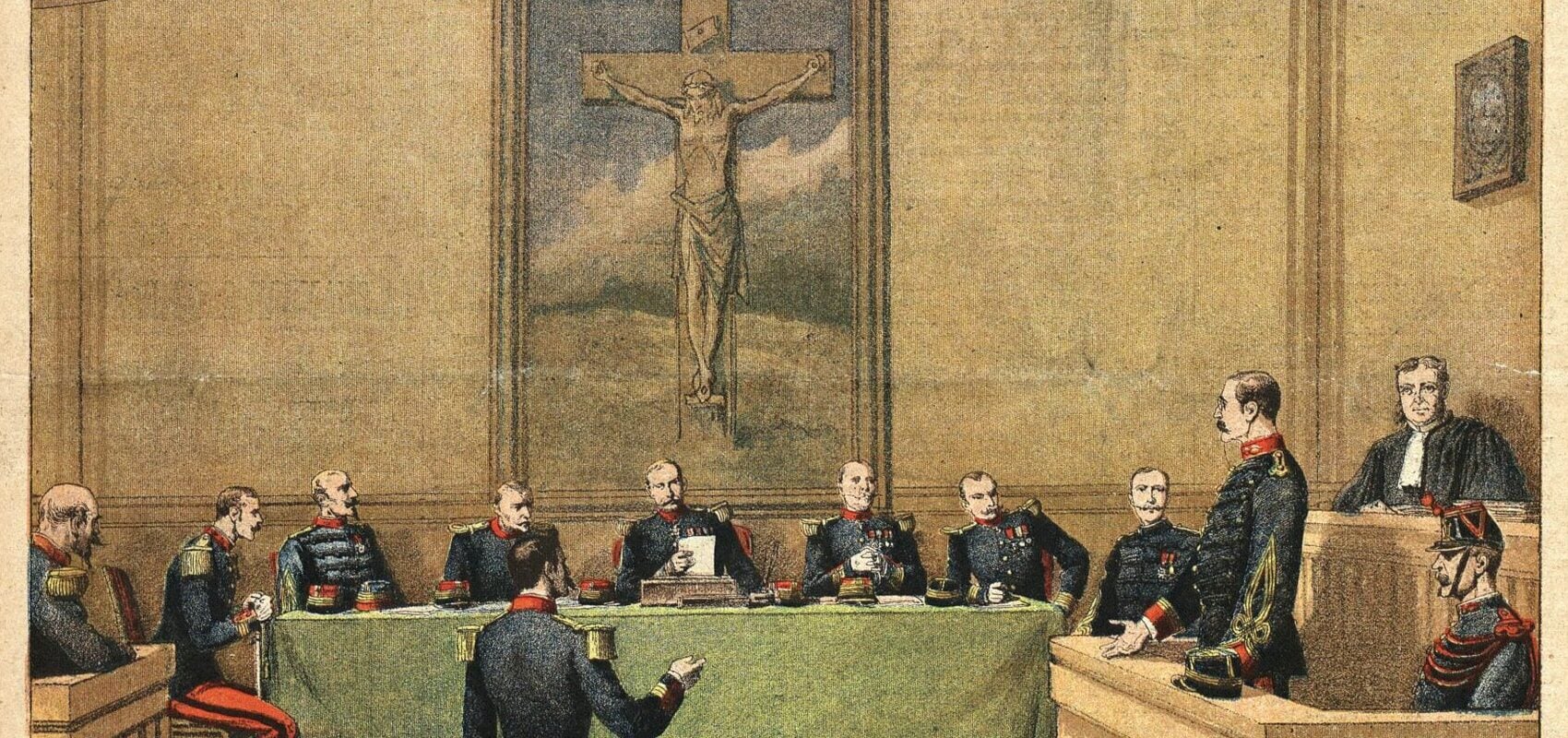
Maurras’s involvement in politics began with his intervention in the quarrel over the wrongful conviction of the Jewish Major Alfred Dreyfus for treason. He argued that, for reasons of state, Dreyfus’s conviction should stand, regardless of his guilt or innocence. French Catholics, inflamed by anti-Semitism, had taken the lead in pursuing Dreyfus’s conviction, and they welcomed this ally. They welcomed him even more when the Dreyfus affair led to the political victory of the anticlerical party in 1905, and to a systematic attack on the Church in France. Maurras’s political movement, Action Française, started a well-planned program to attract Catholic allies. Maurras cast himself in the role of successor to the brilliant ultramontane polemicist Louis Veuillot, playing down his own unbelief and emphasizing his appreciation for Catholicism. Under the slogan “Politique d’abord!” (“Politics first!”), he won the support of a large proportion of the most talented and zealous French Catholics, notably including the philosopher Jacques Maritain.
Maurras influenced the entire Catholic world. The political program of Action Française was one of the major ideological bases for twentieth-century right-wing dictatorships in Spain and Latin America. Maurras also had an important effect on contemporary Muslim extremists. Syrian Christians—who took the lead in the Arab literary renaissance of the late nineteenth and early twentieth centuries—translated French anti-Semitic works into Arabic, conveniently omitting the denunciations of monotheism but reproducing the demonization of Jews as the cause of all evil in the world. This demonization became central to the modern Islamic extremism that developed in the twentieth century and is now waging war on both Jews and Christians. Anti-Semitism has some basis in traditional Islam, but contemporary Islamism is distinctly modern, for instance in its use of the forged Protocols of the Elders of Zion as a central text and propaganda tool. The anti-Semitism of today’s pro-Muslim left thus ultimately derives from the nineteenth-century right.
Maurras’s timing was auspicious. Losers are often drawn to anti-Semitism: If Hitler had been admitted to the Vienna Academy of the Fine Arts, the Holocaust would never have happened. And many Catholics found themselves on the losing side of a culture war. In Spain and Latin America, anticlerical governments had been attacking the Church and confiscating its property since the early nineteenth century. After 1870, the Papal States were abolished, France and Italy were in the hands of anticlerical regimes, and a Protestant German Empire had replaced Catholic Austria as the main power in Central Europe. The new French, Italian, and German regimes all implemented severe attacks on the Church. For some Catholics, anti-Semitism offers a perennial explanation for failure in the form of a powerful evil conspiracy—a conspiracy that both provides an excuse for one’s failures and, since it is nonexistent, poses no danger to those who denounce it.
Catholic history since 1870 has been marked by a desperate—and very human—desire to avoid weakness and isolation when facing the enmity of those who control society. Too often, this desire has made Catholics uncritical in their alliances. Among right-wing Catholics, it has meant anti-Semitism and a willingness to follow authoritarian figures such as Maurras, despite their antipathy to the faith. Among left-wing Catholics, a different set of responses to persecution predominates: the defense mechanism of identifying with your persecutor and blaming the persecution on those who resist it. Together with simple loss of faith, these responses do much to explain the progressive Catholic policy of sympathy and accommodation with the secular world.
Catholic involvement with modern anti-Semitism has had momentous and disastrous consequences for the Church. For the adoption of modern anti-Semitism among Catholics became entangled with another phenomenon: the birth and rapid growth of the modernist movement among Catholic priests and theologians from the end of the nineteenth century onward.
Modernism, unlike previous rebellions against Catholic teaching within the Church, did not reject specific doctrines while preserving others. Instead, it rejected the traditional account of faith itself. According to the traditional account, the dogmas of the faith contain information about reality communicated by God himself, and believing in these dogmas means believing that God has in fact asserted them, and hence that reality is as the dogmas portray. The modernists conceived of divine revelation not as the communication of factual knowledge about reality, but as religious experience; Catholic dogmas were held by them to be human attempts to do justice to this deeper experience. These dogmas were thus revisable in the light of increased knowledge, and the modernists took the desired revision very far. George Tyrrell thought that Christ had never intended to found a Church, and that the pope was the Antichrist. Alfred Loisy denied the reality of the sacraments and the divinity of Christ. However, the modernists did not explicitly reject as false the dogmatic formulations whose substance they contested, because they considered them true in the sense of having been adequate at the time of their formulation. This willingness to concede “truth” in the modernist sense to traditional doctrines obscured for many Catholics the radical nature of the modernist project.
On the face of it, this theological movement would seem to have little or nothing to do with Catholic involvement in modern anti-Semitism. However, the two collided as a result of a complex series of intellectual and historical developments, giving an enormous boost to modernism.
The story begins with conflict over Action Française. Maurras’s position on religion did not entirely escape the notice of French Catholics, and it sparked a debate that was to have incalculable consequences for Catholic theology. Pedro Descoqs, S.J., published an analysis of Maurras’s thought that criticized his irreligion but concluded that Catholics could ally themselves with him in political matters. The theological basis of Descoqs’s argument was the distinction between the natural and supernatural ends of man. The natural end was the highest form of happiness attainable by human nature using its own powers, and the supernatural end was the beatific vision, attainable only by grace. Descoqs claimed that this distinction implied a certain independence of the temporal from the supernatural, so that cooperation on temporal ends was possible between Catholics and unbelievers like Maurras.
Descoqs’s position on both theology and cooperation with Maurras was attacked vigorously by the philosopher Maurice Blondel and, significantly, by the theologian Lucien de Laberthonnière, a modernist thinker with a manic detestation of St. Thomas Aquinas. This debate gave theological disputes a political cast that they would retain throughout the twentieth century. Descoqs presented his thesis on the natural and the supernatural as having the support of Aquinas, although in fact the thesis was Suarezian rather than Thomist. Thomism thus came to be identified with allegiance to Action Française, while opposition to Maurras and allegiance to liberal democracy came to be identified with modernist sympathies.
After protests from members of the French hierarchy about the noxious influence of Action Française on Catholics, Pius XI condemned both Maurras and Action Française in 1926. A crackdown on the supporters of Maurras in the Church ensued, which included the denial of Christian burial to 121 French Catholics who refused to leave Action Française or stop reading its journal. Jacques Prévotat shows in his Les Catholiques et l’Action française that the doctrinal reasons for the condemnation of Action Française were not understood by the majority of the French bishops. The condemnation was seen as supporting Maurras’s anti-Thomist and modernist opponents. As a result, Pius XI’s policy of appointing and promoting bishops who were enemies of Action Française produced a French episcopate full of modernist sympathizers.
The effect of the condemnation on the Catholic philosopher Jacques Maritain was likewise highly consequential. Maritain initially defended Maurras with arguments similar to those used by Pedro Descoqs. After a personal appeal from Pius XI, he engaged in what appeared to be a 180-degree turn and condemned Maurras unreservedly. Yet he retained the structure of Descoqs’s argument. Maritain went on to produce a new plan for the Church’s involvement in the world, principally in his 1936 work Humanisme intégral. He held that the supernatural was the remote goal of all of human existence, but he was clear that purely temporal goals—the “earthly and perishable good of our life here below”—were the objectives to be sought in social and political life, independent of religion and of philosophical and ethical theory. Agreement on these goals was merely practical and did not require common ethics or philosophy: “To try to establish a common doctrinal minimum among [Christians and non-Christians], which would serve as a base for common action, is . . . a sheer fiction.” These goals were “the holy freedom of the creature,” the “mastery of nature by man . . . the development of knowledge . . . the manifestation of all the potentialities of human nature.” Pursuit of these goals required “the liquidation of capitalism.”
Christians should organize themselves into elite associations, the cives praeclari, inspired and motivated by Christianity. Maritain does not rule out normal political activity for Christians, and in fact this activity is required by his program for some individual Christians. But he is clear that it is through disciplined Christian organizations, which he compares to religious orders, that Christian activity in society takes place. Since these groups are akin to religious orders, their individual members will act not independently, but as they are ordered to act by their organizations. The organizations will play in society the role of the monarch in the Middle Ages. But the organizations themselves will not take public responsibilities, will not form part of the official political authority, and will not form a political party.
Their rule would not necessarily require conformity to the natural law, if such conformity was unacceptable to the different components of the pluralistic society: “Legislation could and should permit or give allowance to certain ways of conduct which depart in some measure from Natural Law,” if “such prohibition would be at variance with the ethical code of communities of citizens.” Maritain’s program was that Christians should integrate into non-Christian societies, conform to their practices, and seek to gain power over them. He presented the realization of this program as the coming of age of Christians and of human society as a whole. Something like his plan for society is recognizable as the ideological basis for the European Union, whose founders included many of his followers.
Maritain thus preserved Descoqs’s theological argument, while changing his political sympathies from Maurras’s dictatorial monarchism to a left-wing secular progressivism. Maritain’s notion of “integral humanism” had many devoted disciples among the clergy, of whom the most important was Giovanni Battista Montini, the future Pope Paul VI. It had a considerable impact in Latin America, where it laid the ground for liberation theology, as Gustavo Gutierrez has testified.
By groveling to Pius XII, Action Française obtained the lifting of its papal condemnation in 1939. Maurras, who opposed French resistance to Hitler, made a crucial contribution to the sapping of the French will to fight in 1940. He described the collaborationist French government of Petain as a “divine surprise” and gave it his enthusiastic support. Action Française was heavily involved in the Vichy regime, and particularly in its crimes against Jews. Raphaël Alibert, one of its prominent Catholic members, introduced the first Vichy Statut des Juifs, which stripped Jews of the rights of citizenship. The French Catholic bishops rallied to Vichy with enthusiasm, with Pierre Gerlier, the cardinal primate of France, rapturously announcing: “Pétain is France, and France, today, is Pétain.” (Gerlier, it should be noted, also did a great deal to save Jews from the Germans.) The leading anti-modernist theologian, Reginald Garrigou-Lagrange, O.P., denounced opposition to Vichy as a mortal sin.
The Holocaust and the defeat of Hitler discredited anti-Semitism and its political promoters. The association between these political causes and Thomist opposition to modernism was eagerly seized on by progressives and modernists within the Church, and was used to discredit Thomism and orthodoxy. In fact, the philosopher Etienne Gilson and the novelist Georges Bernanos, the intellectual and literary leaders of the Thomist and anti-modernist movements, had been determined opponents of Vichy, Franco, and the Nazis, and had rejected Descoqs’s position on the autonomy of temporal affairs. But their influence on clerical movements of thought was minimal.
The case of Bernanos is an instructive one. He had been an avowed anti-Semite, an admirer of Drumont, and a close associate of Maurras before falling out with him. Nonetheless he fought against Vichy and the Nazi regime with all his might, unlike most French Catholics, and he denounced Nazi crimes against Jews. The crucial factor in this stance was his personal courage, which meant that the craving to ingratiate oneself with the powerful, and to compensate for one’s inferiority by persecuting the helpless, had no purchase on him. As a result, he did not feel the attraction of Vichy collaboration and persecution of Jews that many French Catholics did.
Revulsion from the violence of the war led to a brief period in the 1950s when Christianity and Catholicism were accorded some respect from the non-Catholic world in Europe, a period that included the tenure in office of Catholic politicians such as Robert Schuman, Alcide De Gasperi, and Konrad Adenauer. This period lent support to Maritain’s vision of Catholics working harmoniously with nonbelievers within a non-Catholic society. Étienne Fouilloux has observed that the statements about the modern world found in the documents of the Second Vatican Council clearly have the relatively favorable context of the 1950s in mind, not the world of the 1960s in which the council actually occurred.
The “Günter Grass factor” was also important in the post-war world. After a long career of left-wing political activism, the German novelist Günter Grass revealed in 2006 that he had been a zealous Nazi in his youth and had served in the Waffen SS. It is not hard to see in his left-wing politics a desire to erase his past. The contrast between Grass and Joseph Ratzinger, who belonged to an anti-Nazi family, left the Hitler Youth out of opposition to Nazism, and deserted from the German army in World War II, is instructive.
The Günter Grass factor operated powerfully on the hierarchy in France, Germany, and Belgium (where Maurras had been influential). A classic example is Cardinal Emmanuel Célestin Suhard, the archbishop of Paris. He was the most active collaborator with the German occupiers in the French hierarchy and denounced the activities of the French Resistance as terrorism. On February 11, 1947, Suhard issued a pastoral letter, “Essor ou déclin de l’Eglise” (“Growth or decline of the Church”), in which support for modernism was portrayed as the key to the growth of the Church, and opposition to it as guaranteeing decline. He was immediately hailed by progressive Catholics as a hero with impeccable modernist credentials.
When John XXIII opened the Second Vatican Council in 1962, he presided over a Church that was demoralized, intellectually confused, and compromised by its involvement with modern anti-Semitism. The council soon came to be dominated by an alliance of bishops from the Rhine countries, principally the French and the Germans. The records of these episcopates under the Nazis were not estimable. The French bishops had been pro-Vichy, and the German bishops had been silent about Hitler’s extermination of Jews—exactly one German priest denounced in his sermons the Nazi persecution of Jews (Fr. Bernhard Lichtenberg, who died on the way to Dachau). They were solidly committed to Maritainian accommodation with the modern world. Bishops of this stamp threw their support behind the modernists during and after the council, and Paul VI, a devotee and friend of Maritain, gave them discreet support.
As a result of this domination, a wave of modernist revisionism swept over the Catholic Church. The Dutch Catechism, rushed to publication immediately after Vatican II, denied important dogmas. Religious education, liturgy, and theological scholarship all came to be dominated by modernists. Faith and practice in the Church were devastated in consequence, with the countries of the Rhine being the worst hit.
Modernist revisionism tended to go deepest in those orders that were most involved in anti-Semitism. The Assumptionist daily La Croix is now a standard-bearer for modernist Catholicism, which is rather as if the Nazi propaganda sheet Der Stürmer had become the house organ of the German Green party. As an order, the Jesuits, despite individual exceptions, have adopted modernist theological positions. The enthusiasm of Jesuits for liberation theology is, however, in continuity with their past in some respects: It is Maurras’s “Politics first,” transferred to left-wing political causes. Maritain’s integral humanism is still the effective faith of much of the leadership of the Catholic Church.
Maurras has had another, more direct influence on Catholicism today. Two of his more zealous French supporters were the theologian Louis Cardinal Billot and the influential rector of the French Seminary in Rome, Fr. Henri Le Floch. When Pope Pius XI condemned Action Française, he removed Le Floch from his post, and Billot resigned from his cardinalate. Before that, however, both men had taught the Irishman Denis Fahey during his studies in France. Before long, under the cover of Christianity, Fahey was promulgating the main theses of modern anti-Semitism as found in Drumont and Maurras.
There is thus a historical line of influence from Voltaire to Renan, to Drumont and Maurras, to Fahey, to contemporary Catholic anti-Semitism. The origins of this poisonous substance, in other words, lie not in the Catholic piety that twenty-first-century anti-Semites sometimes affect, but in paganism and unbelief. It is not just wicked, but fraudulent.

YOU MIGHT ALSO LIKE
Vatican II Didn’t Kneel to Modernity
In his weekly catecheses on Vatican II, Pope Leo is now discussing Gaudium et Spes, one of…
Two Spectacles, Two Frances
The Stade de France, the country’s largest soccer stadium, holds about 80,000 fans. On Friday, September 25,…
America’s Empty Confessionals
In the latest installment of the ongoing interview series with contributing editor Mark Bauerlein, James M. O’Toole…
