

Liberals and conservatives disagree less about principles than we often imagine. (It’s common for intellectually inclined, theory-informed people to interpret disagreements about policy as matters of principle.) For example, aside from full-bore revolutionaries, everyone endorses the rule of law, even as we sometimes violate that principle in the heat of political battle. I regard the prosecutions of Trump as political in nature, something liberals tolerate (or refuse to acknowledge) because they think the stakes are so high that principle must be relaxed. They convince themselves that bending the rule of law is necessary to prevent a demagogue from gaining power and flouting that same rule of law. The same line of reasoning justifies social media censorship and other illiberal collusions of government and corporate power to suppress speech.
This inconsistency among liberals illustrates my point: Our judgments about political and social realities are often more decisive than our principles. If Trump in fact represents a threat to our constitutional system, if he commands a proto-fascist army of ardent supporters, then dire countermeasures are justified, even extra-constitutional ones.
I don’t share the liberal establishment’s assessment of Trump, but I don’t want to litigate the immediate issue. My disagreement goes much deeper than any dispute over Trump’s rhetoric, personality, and role in American politics. As I’ve talked with my liberal friends, I’ve come to see that we have fundamentally different assessments of the central problems facing our country. They fear a closed-minded hostility to the “other.” I worry about the disintegration of crucial institutions and anchoring authorities.
Liberals think our society is too homogeneous, judgmental, hidebound, and restrictive. To some extent, this judgment is inherent to the progressive mind. Progressives seek to be open to the future, which they believe can be better and brighter—provided we’re willing to free ourselves from present constraints and embrace new possibilities.
The unique circumstances of the twentieth century encouraged this attitude. After World War II, liberals interpreted fascism as arising from a “closed-minded” mentality. Erich Fromm’s widely read book, Escape from Freedom, was a psychological version of this interpretation. A frightened, disoriented populace turns to authoritarian leaders because people fear the uncertainties and responsibilities of modern freedom. Another influential book, The Authoritarian Personality by Theodor Adorno and a team of social scientists, described traditional views of parental authority and sexual morality as proto-fascist. On this view, conservative sensibilities became suspect. They were symptoms of psychological disorder and harbingers of totalitarianism.
Few Baby Boomers have read these books. But having grown up during a period that was uniquely homogeneous, they were sympathetic to the main thrust of these and similar assessments of the dangers facing the West. After the war, the American middle class expanded dramatically. Society was governed by a largely traditional morality that prized being “normal.” In the 1950s, social scientists such as David Reisman, author of The Lonely Crowd, worried about the pervasive conformity of that era.
The 1960s brought many changes. The civil rights movement challenged bourgeois complacency. The sexual revolution took hold. Yet even amidst cultural uproar, marked by riots and anti-war protests, the homogeneity was palpable. Everyone watched the same TV shows. The then-young Baby Boomers thrilled to top-40 hits. Moreover, the decades after World War II were a time of extraordinary demographic stability. Aside from wartime refugees, immigration was minimal. By 1970, the percent of non-native born residents in the United States was at a historic low of less than 5 percent. (In 1890, that population had been nearly 15 percent; today it is reaching that level again.)
These factors, ideological, cultural, and demographic, fueled a consensus in favor of openness: the open-society consensus. It took unity and stability for granted and focused on the failures, injustices, and dangers of an overly consolidated society. To this day, being liberal means adopting the open-society consensus.
Consider the sixty-year-old Ivy League graduate and corporate lawyer. He is by no means radical. But he’s troubled by Trump’s harsh talk about deporting those who are here illegally, and he places a sign in his front yard: “In this house we believe . . .” He regrets some of the excesses of Black Lives Matter, but endorses the view that racism remains a major social evil. He’d rather not think about drag queens, transgender surgeries, and the chaos at the border, but if pressed, he’ll assert that we should reduce social stigma and make our society more inclusive. He believes that diversity enriches and strengthens the body politic.
I’m baffled by these sentiments, not because they are wicked, but because they are so disconnected from present realities. I look at America in 2024 and see a globalized and financialized economy that has eroded the foundations of middle-class prosperity. We’ve witnessed the striking decline of marriage and the near complete acceptance of all sexual practices. (Will the New Yorker ever tire of running articles about “throuples” and other deviant practices?) The old, censorious morality no longer exists, much less dominates. Charles Murray’s 2012 book, Coming Apart, documents the nearly complete secession of society’s winners from those who have been abandoned and damaged by the economic and cultural revolutions of recent decades. Demographic change—collapsing birthrates combined with high levels of immigration—is accelerating. Our body politic is increasingly fragmented, sometimes to the point of open hostility.
In a word, our society is threatened with disintegration. In the face of this peril, the regnant liberal consensus is worse than irrelevant; it’s part of the problem. Take as an example the southern border. Polling indicates that voters overwhelmingly favor stopping the influx of migrants. Yet the Biden administration does nothing, because liberal elites are beholden to the open-society consensus. Or consider the sad fact that children born to mothers without a college degree are likely to have no fathers in their homes. The response of liberal elites? Make Pride Month the nation’s most sacred celebration. Huge numbers are dying of drug overdoses—and liberal elites legalize marijuana.
There’s an academic fashion called “queer theory.” Unlike older efforts to secure gay rights, queer theory does not argue for the acceptance of homosexuality as normal. On the contrary, it opposes the notion that anything should be normative. “Queering” society means demolishing social authority, deconsolidating and disintegrating institutions that impose standards and censure deviance. This ambition is extreme, to be sure. University presidents, trustees, and other elites don’t embrace it. But the imperative of radical deconsolidation and disintegration makes sense within the open-society consensus, which is why universities hire and promote faculty who advance queer theory, just as they sponsor colloquia on critical race theory, programs of postcolonial studies, and other instruments of disintegration.
In Return of the Strong Gods, I argue that the open-society consensus has become a flesh-eating monster. We are living in a deconsolidated and disintegrated world, one that lacks the strong loves and loyalties that anchor personal and collective life. We need a new consensus that recognizes that fascism, middle-class complacency, racism, and other dangers of an over-consolidated society were our grandfathers’ problems. Our challenges are quite different. They can be summed up as the dangers of drowning in a liquid world.
We’re seeing the first signs of change. Both political parties have strong voices urging a pivot away from globalization and toward re-industrialization. This shift in economic policy gives priority to reconsolidation. Both candidates for president have proposed significant subsidies for newborn children—another sign of awareness that we need to buttress the fundamental institution of society, the family, rather than celebrating an infinite variety of “lifestyle choices.” Some are calling for a chastened foreign policy, another sign of the turn toward reconsolidation.
And we can observe a parallel spiritual trend, one that emphasizes God’s authority. Yes, we’re called to sanctify the world, but many are aware that we first must re-sanctify the church. We can’t “go to the peripheries,” as Pope Francis urges, unless the center holds.
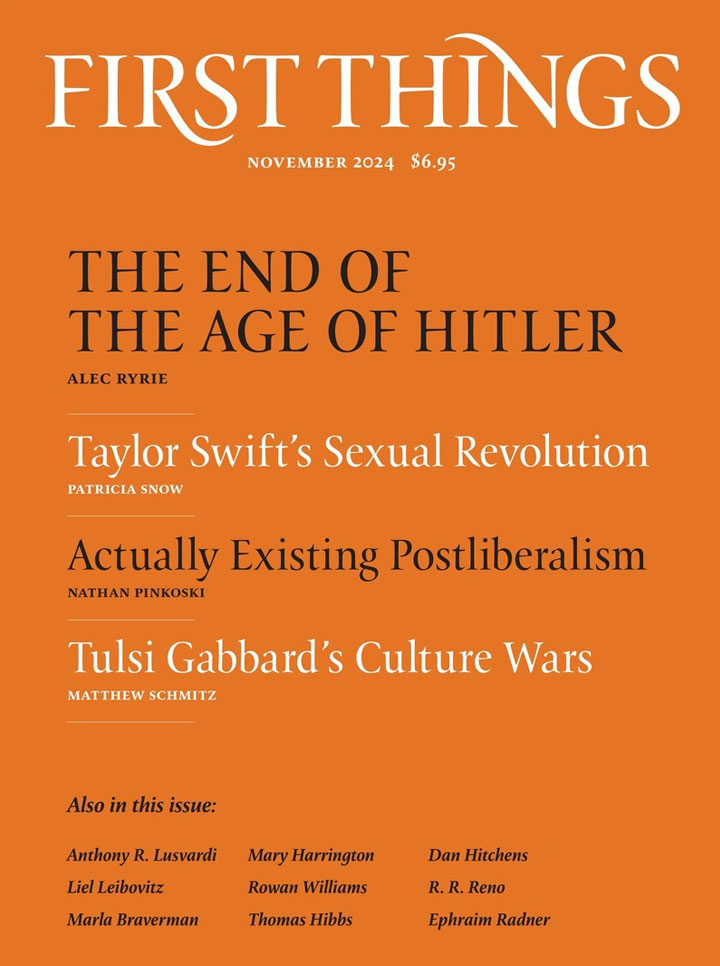
I’m convinced that a new consensus will take hold in the twenty-first century. (Alec Ryrie suggests something similar in “The End of the Age of Hitler” in this issue.) At some point, perhaps soon, responsible leaders will recognize that we need to do the opposite of “queering”; we need to restore the stable anchors of spiritual, moral, and political life. When that change comes, the application of principles—left, right, and center—will change as well.


YOU MIGHT ALSO LIKE
Who Killed the Clancy Children?
After a Massachusetts jury failed to convict Lindsay Clancy of strangling her three small children to death…
Roger Scruton’s Eternal Youth
In this episode, First Things senior editor Dan Hitchens joins R. R. Reno on The Editor’s Desk…
A Terrible Coarsening
The now-ubiquitous terms “reproductive health” and “reproductive freedom” have contributed mightily to a slaughter of the innocents…
