
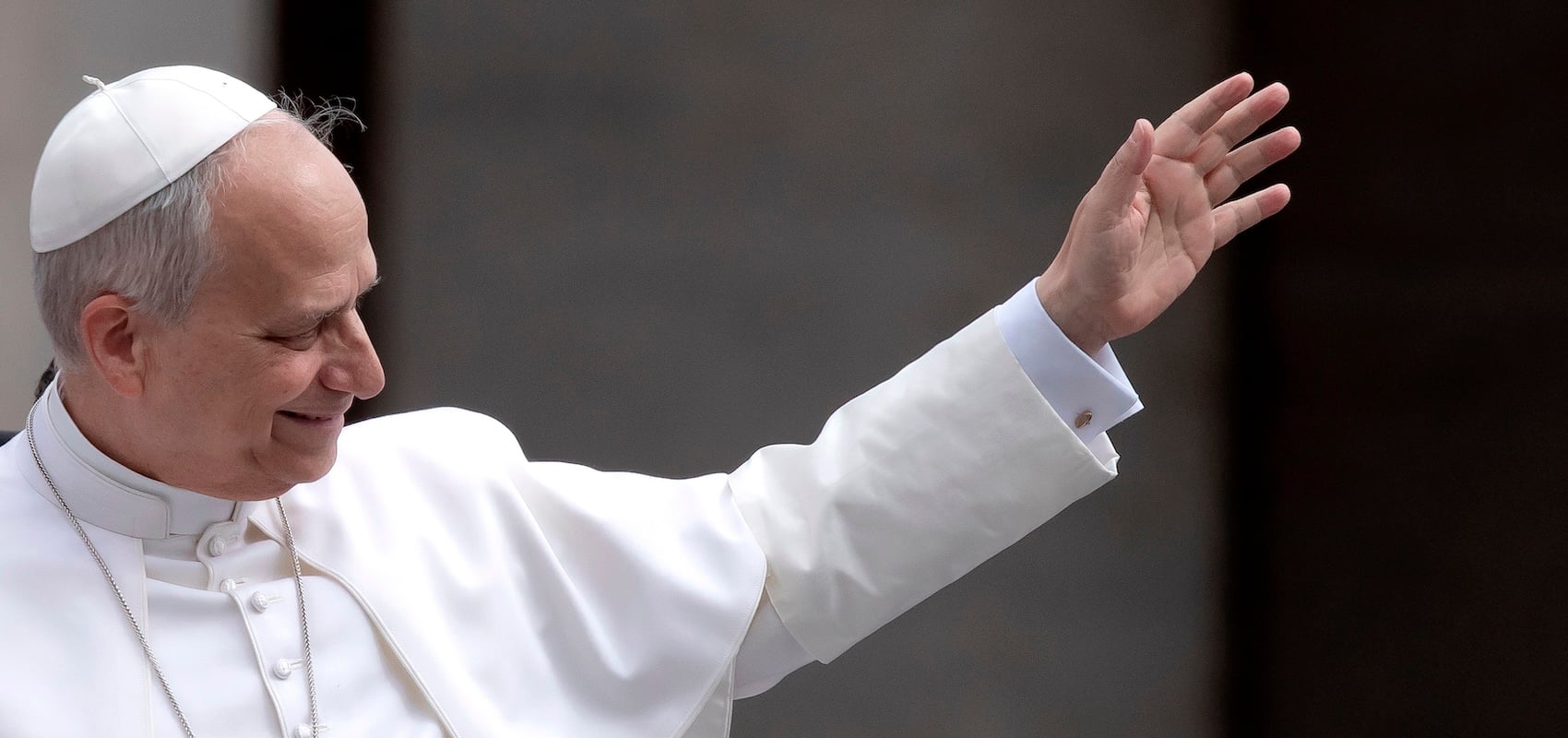
I have often remarked upon an odd occurrence. Frequently, in the Catholic press and even in scholarly journals, commentators and theologians will solemnly invoke chapter one of Lumen Gentium, Vatican II’s Dogmatic Constitution on the Church. “The Church is . . . like a sacrament or sign and instrument of intimate union with God and of the unity of all humanity.” But, in the rush to affirm the unity of humankind, those who intone the above quote omit two crucial words: “in Christ.” A pope whose episcopal motto is “In Illo Uno Unum” will not merely avoid neglecting “in Christ”—he will make it the centerpiece of his pontificate. Indeed, the first year of Leo XIV’s magisterium has been marked by his consistent and coherent articulation of a Christocentric vision. Jesus Christ is, indeed, Lumen gentium: the Light of the nations. And, as the pope’s “spiritual father,” Augustine of Hippo, loved to meditate: “in his Light, we see light.”
Though Leo XIV was elected one year ago today, in many respects the Leonine pontificate only commenced in January of this year after the close of the Jubilee Year, which was inaugurated by Pope Francis. Through the remainder of 2025, Leo had continued the catecheses in his general audiences on the theme begun by his predecessor.
In January, three significant events bore the distinctive mark of Pope Leo. Each showed a decided Christic coloration: the start of a new series of reflections at the general audiences; the convocation of an extraordinary consistory of cardinals; and an important address to the diplomatic corps accredited to the Holy See. In each we perceive the recovery of the centrality of “in Christ.”
In his very first general audience of the new year (January 7), Leo announced his intention to devote a series of presentations to a renewed consideration of the documents of Vatican II. He told his hearers: “Vatican Council II rediscovered the face of God as the Father who, in Christ, calls us to be his children; it looked at the Church in the light of Christ, light of nations, as a mystery of communion and sacrament of unity between God and his people.”
That same day marked the opening of the extraordinary consistory. It is worth remarking that Pope Francis had rarely availed himself of the advice of the body of cardinals, whereas Leo almost immediately revived the practice of calling consistories, and has already announced a second gathering for the end of June.
Addressing the cardinals, he again invoked the council and reminded them that the conciliar perspective “sees the mystery of the Church as entirely held within the mystery of Christ, and thus understands the evangelizing mission as a radiation of the inexhaustible energy released by the central event of salvation history.”
Two days later the third notable event took place. Leo gave the annual address to the diplomatic corps accredited to the Holy See. His long and remarkable speech bears attentive reading. The pope framed his remarks in terms of Augustine’s classic City of God and its dialectic of the two cities, so often at odds in their basic desires and values—their “loves.” But he then insisted that “Christians living in the earthly city are not strangers to the political world, and, guided by the Scriptures, seek to apply Christian ethics to civil government.”
Leo enumerates a number of concerns ingredient to the Catholic moral tradition. He laments that “war is back in vogue” and underscores the importance of “international humanitarian law.” He urges respect for the dignity of refugees and strongly affirms the right to freedom of conscience and religion. He catalogues pressures facing families, extolling the right to life and rejecting abortion. He challenges the diplomats and their governments to recover “the meaning of words,” which too often have become untethered from reality and used as “a weapon with which to deceive, or to strike and offend opponents.” In brief, he outlines a seamless garment moral vision befitting and elucidating a truly integral anthropology.
Significantly, in a secular age too often deaf to transcendence, Leo expresses this fundamental conviction: “In the absence of a transcendent and objective foundation, only self-love prevails, to the point of indifference to God, who governs the earthly city.” Indeed, he goes even further and forthrightly confesses the Christic foundation of the Catholic moral vision.
[Peace] is the very aim of the city of God, to which we aspire, even unconsciously, and of which we can enjoy a foretaste even in the earthly city. During our pilgrimage on this earth, peacemaking requires humility and courage. . . . In the Christian life, we see these virtues reflected at Christmas, when Truth, the eternal Word of God, becomes humble flesh, and at Easter, when the condemned Righteous One forgives his persecutors and grants them his life as the Risen One.
In this regard, as Christine Emba perceptively contends in an opinion piece in the New York Times, the pope models “what it looks like to think rigorously about moral principles through a Christ-specific lens.”
I would add that this “Christ-specific lens,” this Christological hermeneutic, not only governs Leo’s moral teaching, but it also undergirds and permeates his entire religious vision, his understanding of humanity and history. All is seen in Christ.
This Christ-centered conviction was already fully in evidence in Leo’s November address in Istanbul commemorating the 1700th anniversary of the Council of Nicaea. There he voiced a caution and a confession. He warned of “a ‘new Arianism,’ present in today’s culture and sometimes even among believers. This occurs when Jesus is admired on a merely human level, perhaps even with religious respect, yet not truly regarded as the living and true God among us. His divinity, his lordship over history, is overshadowed, and he is reduced to a great historical figure, a wise teacher, or a prophet who fought for justice—but nothing more.”
And he confesses, in union with the bishops at Nicaea: “Jesus Christ is not a figure of the past; he is the Son of God present among us, guiding history toward the future promised by God.” Hence, he alone is the Light of nations and only in Christ can the Church claim to be the sacrament and instrument of intimate union with God and of the unity of humanity.
I think it telling, therefore, that in a response to a reporter’s question on the return from his recent voyage to Africa, Leo gave this exegesis of Pope Francis’s well-known appeal for the Church to welcome “tutti, tutti, tutti!” Leo explained: “[It] is an expression of the Church’s belief that all are welcome; all are invited; all are invited to follow Jesus, and all are invited to look for conversion in their lives.” All are indeed invited—to transformation in Christ.
Photo by Maria Grazia Picciarella / SOPA Images/Sipa USA (Sipa via AP Images)
Dear Reader,
Can I be direct with you?
War abroad. Socialists on the rise. AI upending human life. Endless uproar online. The modern attention economy doesn’t want readers — it wants users enslaved to the tyranny of the present.
First Things is the antidote: literary excellence, timeless truths, and a fixed point of reference in a culture that has lost its bearings.
But we can’t do it without readers like you.
Our goal: Raise $150,000 by November 1 to sustain First Things in the year ahead.
Your gift anchors readers in the permanent things.
Make your Fall Campaign gift now using the button below.
If you have any questions or would like more information, please contact Giovanni Del Piero, Director of the Editor’s Circle, at gdelpiero@firstthings.com or 212-627-1985.

YOU MIGHT ALSO LIKE
Foucault’s Idol of Nothingness
Today marks the 100th anniversary of the birth of Michel Foucault. He was influential in his lifetime,…
Forget Odysseus. Aeneas Is the True American Hero.
Who is our Odysseus? Or more precisely, who is the most Odyssean hero of American film? Matt…
Why the Death Penalty Is a Sore Point for Papal Authority
Pope Leo XIV marked World Day Against the Death Penalty, observed on October 10, with the following…
