
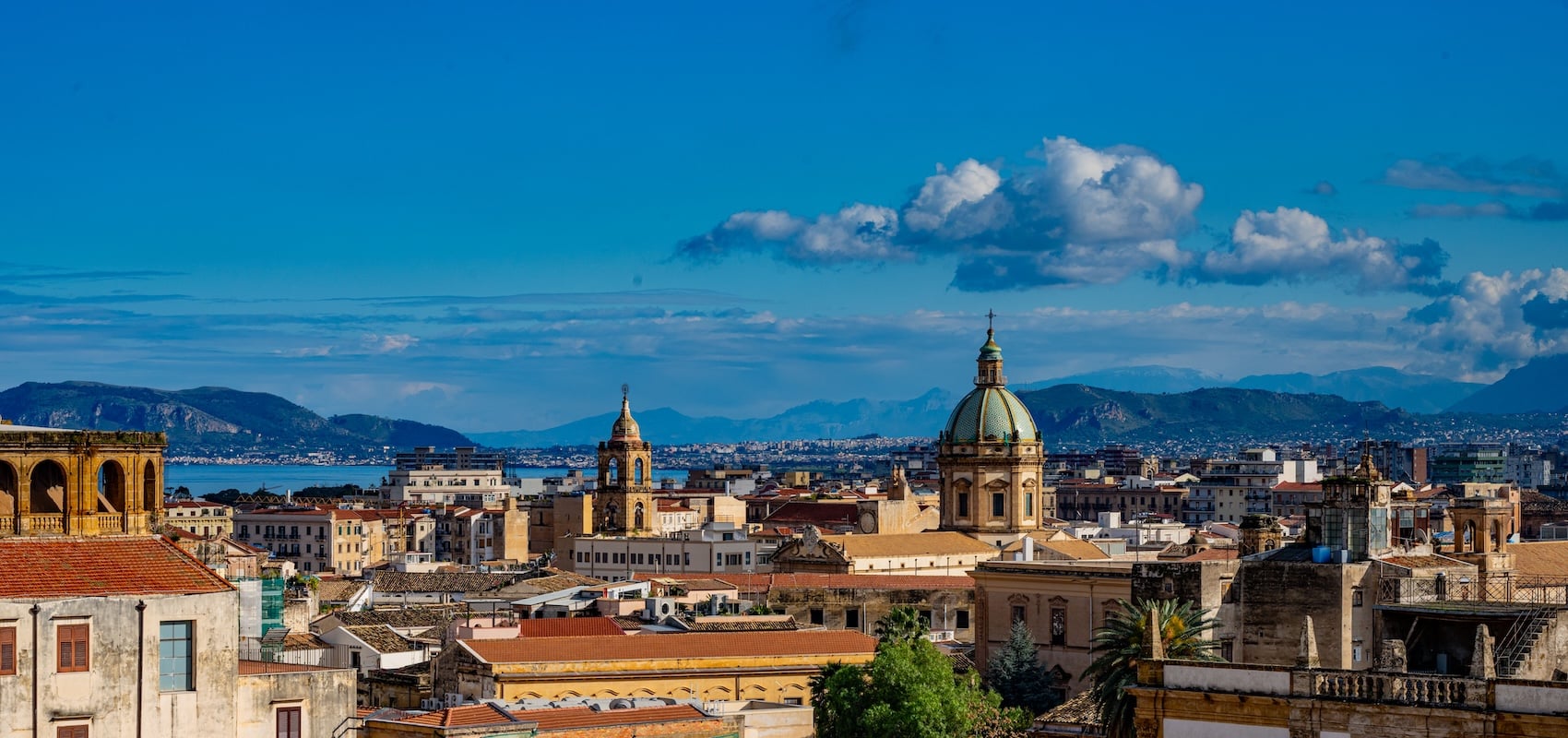
My ITA Airways flight landed near Palermo on a Sunday morning. After leaving my baggage and ten euros with a friendly souvenir shop owner, I set out, masstimes.org in hand, to fulfill my Sunday obligation. I ended up at the Church of the Gesù.
Late Baroque and Jesuit, it is perhaps the most beautiful church I have ever seen. Gilded white marble rests upon black backing, a dramatic contrast that spans the entire interior, floor to ceiling. There are cherubs everywhere, and the ceiling frescoes are cosmic, depicting last things. I am told that Lady Elizabeth Herbert, a friend of the English cardinal Henry Edward Manning and benefactor of Florence Nightingale, had a conversion experience there. It was largely destroyed by an Allied bomb two months before the commencement of Operation Husky, and the six-decade project of restoration only concluded in 2009.
The church was declared a national monument shortly following the risorgimento and is historically and artistically important, but my interest extended beyond that. I wanted to compare what I saw to what I’d been reading about Catholicism in Sicily. According to reports, Italy is secularizing; twenty years ago, 36 percent of Italians said they attended Mass weekly. Now, it’s 18 percent. And yet, Italy remains among the most religious countries in western Europe, though it doesn’t take much to be considered very religious these days, and even in Sicily—a land of saints and churches—religious practice is deteriorating. My mission that Sunday was to observe. In what health is the Sicilian church?
When I visited the Church of the Gesù, tours were winding through, and Mass was delayed for a few minutes to allow one group to finish. In one nave, an elderly Jesuit heard confessions—the sacrament of reconciliation seemed more readily available in Sicily than it does in America—while across the church a display of papier-mâché effigies announced the order’s political priorities: Diminutive ICE agents scourged Christ, and a cradled globe seemed to indicate the importance of environmental stewardship. The Sunday Mass was lightly attended, and I noticed a few themes that would reappear during my time in Sicily. For one, the Sicilians sing more readily than Americans, and one colorfully dressed local usually serves as (self-appointed) choir mistress, guiding the congregation from her pew. Homilies are long. (I am ever more sympathetic to Pope Francis’s calls for priestly brevity.) And kneeling is far less uniform than in American churches. Most kneel for the consecration, but after that all bets are off, and it was not uncommon to see split congregations: At the same point in the Mass, some knelt, some stood, and some sat. A few churches I visited had seating arrangements that seemed to proscribe kneeling.
After the staggering beauty of the Jesuit church, I decided to visit as many Sicilian churches as possible, to step through any open door. I saw perhaps fifty. Most were beautiful and baroque. Some were Norman, some brutalist. I saw the art of Caravaggio and Marko Rupnik, the white limestone of Siracusa and the black basalt of Mt. Etna.
Many churches in heavily touristed areas or historical cores did not offer daily Masses. Within the Punic walls of Erice, the “City of a Hundred Churches” with its dozens of religious buildings, there are some days where no Mass is held at all. Other churches have been so heavily modified as performance or exhibition spaces that I hope they have been deconsecrated. And others still had clearly been deconsecrated, the wound from where their tabernacles were pulled out gaping.
Where I traveled, most churches were open to visitors. A majority required tickets for entrance, an inconvenience I am loath to complain about given the Sicilians’ heroic, expensive efforts at restoration. Sometimes the ticketing system consisted of an elderly parishioner with a plate for euros, but other churches had more complicated setups. In Palermo’s Piazza Bellini, one can buy discounted combo tickets for a trio of historic churches. (I attended Mass right off of the plaza, in the crypt of San Giuseppe dei Teatini.) Across the island, in Catania, a fifteen-euro ticket allowed me to follow the passion of “Sant’Agata” from church to church, ending at the city’s cathedral.
Speaking of Agatha, the virgin patroness of Catania, the Sicilians are devoted to their saints. Churches are filled with floats for festas in their honor, vias and piazzas are named after them, and roadsides are dotted with alcoved shrines dedicated to the Virgin Mother and local saints. In Palermo, I saw at least two different fast food restaurants with signage depicting St. Rosalia munching on arancini. Sicilian culture is a Catholic culture.
But for all of this enthusiasm and devotion, Sicily is still secularizing. Exact regional numbers are hard to come by, but the decline in religious vocations is evident. One night, I stayed at what was once an active Ursuline motherhouse. There are only two sisters still in residence at the repurposed palace. Elsewhere, I inquired about the continued presence of long-established religious communities. One community had four surviving members, another had only one; most will close. There are fewer seminarians than ever, and the population of priests is aging. Mass attendance has declined generationally, all but ensuring that the decline will continue for decades. Eventually, the organizational structure will break down. There will be no one administering the sacraments, and no one seeking them either. Hundreds of churches will need to stop functioning as such.
And yet, Sicilians are a baptized people. They are open to graces through that baptism, and so is their land, their culture. The work of bringing Sicilians back to the ordinary means of salvation is one of redirection, of coaxing the devotees of Sts. Rosalia and Agatha to embrace the fullness of their heritage. The fuel is there, and setting it alight is only a matter of finding an evangelist of sufficient boldness.
Dear Reader,
Can I be direct with you?
War abroad. Socialists on the rise. AI upending human life. Endless uproar online. The modern attention economy doesn’t want readers — it wants users enslaved to the tyranny of the present.
First Things is the antidote: literary excellence, timeless truths, and a fixed point of reference in a culture that has lost its bearings.
But we can’t do it without readers like you.
Our goal: Raise $150,000 by November 1 to sustain First Things in the year ahead.
Your gift anchors readers in the permanent things.
Make your Fall Campaign gift now using the button below.
If you have any questions or would like more information, please contact Giovanni Del Piero, Director of the Editor’s Circle, at gdelpiero@firstthings.com or 212-627-1985.

YOU MIGHT ALSO LIKE
Foucault’s Idol of Nothingness
Today marks the 100th anniversary of the birth of Michel Foucault. He was influential in his lifetime,…
Why the Death Penalty Is a Sore Point for Papal Authority
Pope Leo XIV marked World Day Against the Death Penalty, observed on October 10, with the following…
Forget Odysseus. Aeneas Is the True American Hero.
Who is our Odysseus? Or more precisely, who is the most Odyssean hero of American film? Matt…
