
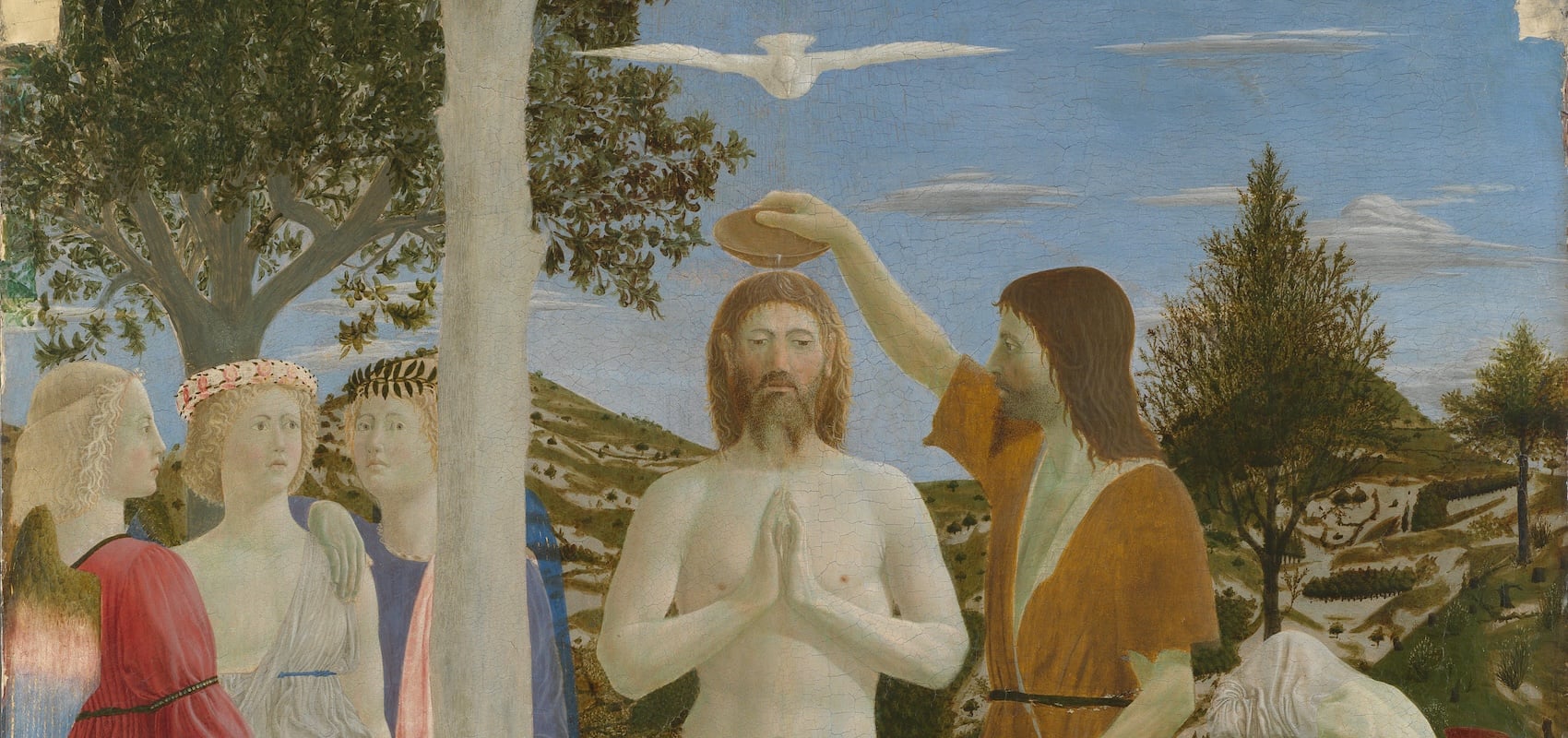
Three-quarters of a century ago, on April 29, 1951, I was baptized by Fr. Thomas Love, S.J., in Baltimore’s Church of Saints Philip and James. Old Scratch must have thoroughly sunk his claws into my infant self; according to family tradition, I sent up such a howl when he was ousted by water and the Holy Spirit that my cousin Judy hid in a confessional. (Critics may find traces of this experience in my later prose style; I couldn’t possibly comment.)
Saints Philip and James, a fine combination of Greco-Roman and Byzantine architectural styles, is now under the care of the Dominican Fathers of the St. Joseph Province, who run a lively parish and a campus ministry to nearby Johns Hopkins University. The church has some splendid stained glass and its apse decoration, reminiscent of many Roman basilicas with their arrays of saints, reminds me of a pertinent theme for reflection on this diamond anniversary of my baptism: the communion of saints.
To be baptized is to be incorporated into the Church. To be raised to new life in Christ in the waters of baptism is to be simultaneously incorporated into the transtemporal body of the friends of the Lord Jesus Christ: what tradition calls the Church Militant (those living today), the Church Suffering (those being purified after death), and the Church Triumphant (those blessed with the vision of the Thrice-Holy God). These three “states” in the Church form one body, or communion, across the centuries, and indeed beyond the natural world as we perceive it. It is a “communion of saints” because all who belong to it by reason of their baptism are called to the vocation of sanctity, for which there is no single template.
Over these seventy-five years, I have experienced that sanctity in so many ways, each of which has left its imprint on my soul and my spiritual life. To mention but a few:
I likely got my first intuition of what sanctity might mean through the sacrificial love of my parents, who brought me to the waters of baptism and did so much for me in the two decades I lived with them.
Retrospectively, I now understand that the teachers who most profoundly shaped my mind and disciplined my childhood and adolescence offered another experience of the communion of saints. So, too, did my piano instructor, the ever-patient Sr. Mary Arnold, S.S.N.D., and my great choirmaster, that irascible, passionate genius Robert Twynham—for whenever I’ve had what I imagine to have been a “religious experience,” it’s almost always had something to do with music.
I learned a lot from my experience of a pastor who fought his way to sanctity and serenity through a lengthy battle with alcoholism.
My wife and children have each shown me unique gifts of sanctity—and all of them have surely lived the saintly quality of patience!
I have been privileged to know persecuted martyr-confessors who grew into sanctity amid persecution through the faith, hope, and love infused in them by baptism: Myroslav Marynovych of Ukraine, Sr. Nijolė Sadūnaitė of Lithuania, Jimmy Lai of Hong Kong, and Cardinal Francis-Xavier Nguyễn Văn Thuận of Vietnam, to name but four.
And while the past thirty years have given me a keen appreciation for Ronald Knox’s prudent warning (which I formerly misattributed to John Henry Newman) that “he who travels in the Barque of Peter had better not look too closely into the engine room,” I have had many experiences of sanctity in Rome, in encounters with men like Cardinal Bernardin Gantin of Benin, Cardinal Francis Arinze of Nigeria, and Cardinal Robert Sarah of Guinea—three churchmen, living and dead, whom even the most cynical curialists recognized as men of God who lived the sanctity to which they were called in baptism.
Moreover, I am especially mindful of the tremendous grace of having known two saintly popes, John Paul II and Benedict XVI. In both cases, the greatness of their work and teaching reflected the fact that they were radically converted Christian disciples—men who took their baptism with utmost seriousness as the most important day of their lives.
Participation in the “communion of saints” is one of the great gifts conferred in baptism. As I give thanks for the gift of my baptism seventy-five years ago, it is incorporation into this “great cloud of witnesses” (Heb. 12:1) for which I am particularly grateful. And it is the prospect of joining them at “Mount Zion, [in] the city of the living God, the heavenly Jerusalem” (Heb. 12:22) that constitutes my great hope.
George Weigel’s column “The Catholic Difference” is syndicated by the Denver Catholic, the official publication of the Archdiocese of Denver.


YOU MIGHT ALSO LIKE
No Place Like Home
Who is our Odysseus? Or more precisely, who is the most Odyssean hero of American film? Matt…
The Myth of St. Francis
At the beginning of his 2020 encyclical, Fratelli Tutti, Pope Francis speaks of “an episode in the…
A Cold Beauty
Jan Morris (1926–2020) was a writer of astounding gifts who not only recorded history but made it.…
