
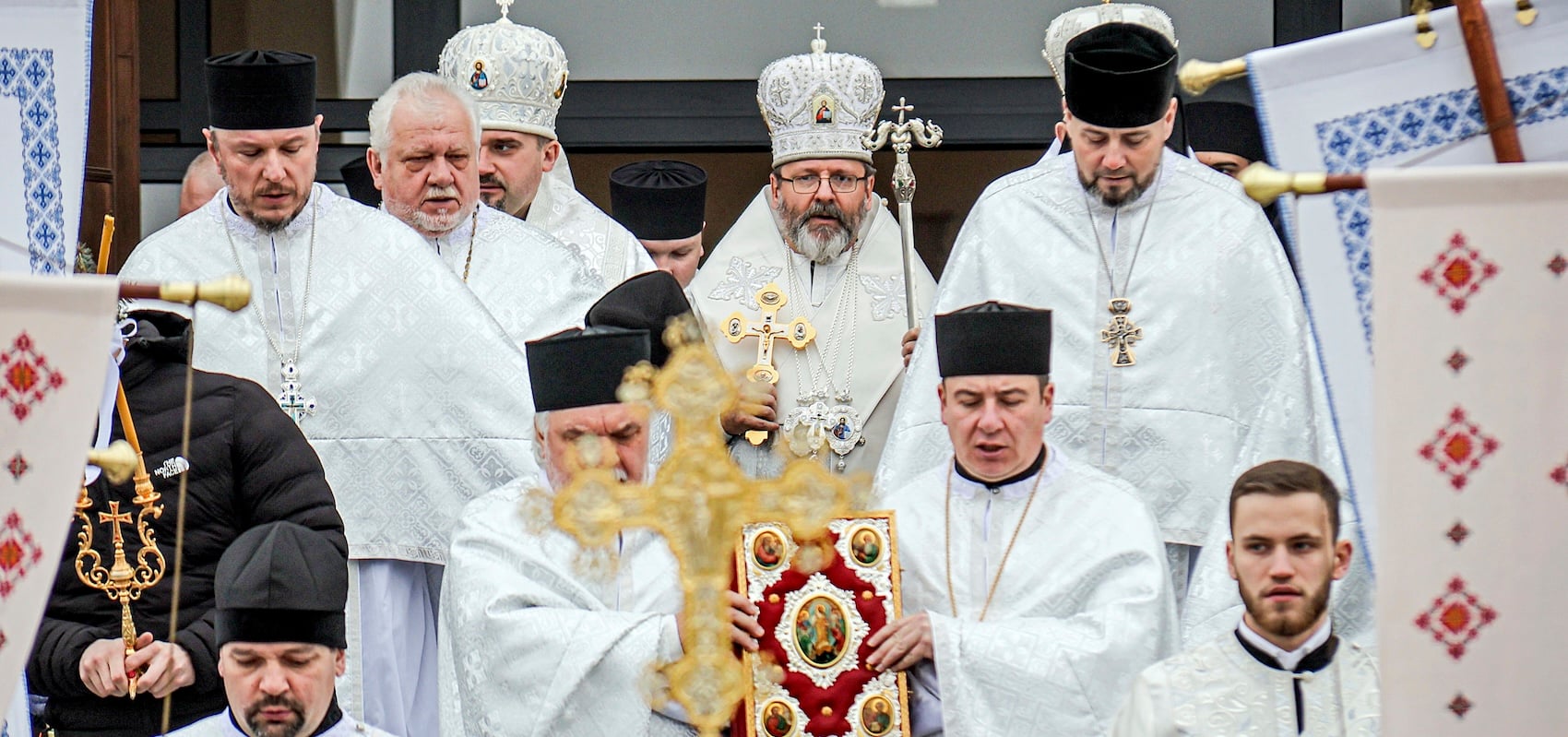
Pardon the Latin-rooted neologism, but if “patricide” works for murdering your father and “regicide” for taking out a king, why not “ecclesiacide” for trying to kill an entire Church?
That’s what happened some eighty years ago, on March 8–10, 1946, at St. George’s Cathedral in L’viv, Ukraine. There, what was alleged to be a church council (or sobor) voted to annul the 1596 Union of Brest and thereby reunite the Ukrainian Greek Catholic Church (UGCC) with the Russian Orthodox Church (ROC)—an act that a high-ranking Russian Orthodox official once told me was perfectly kosher (so to speak) because “When Uniates [Eastern Catholics in full communion with Rome] return to their [Orthodox] home, it is always legitimate.”
Yet we now know for certain, and from primary source material in the Ukrainian state archives, that the so-called “L’viv Sobor” of 1946 was engineered by the Soviet security services and had no more moral, spiritual, or legal legitimacy than any other act coerced at gunpoint.
To be sure, this “pseudo-sobor” was a strategic failure, as the Soviet Ministry of State Security acknowledged shortly afterward, in a directive to its agents in what is now western Ukraine:
The formal liquidation of the Greek Catholic Uniate Church, arising from the resolutions of the sobor of March 8–10, and the formal reunification with the ROC do not constitute the completion of the actual liquidation of those hostile aspirations of which the Greek Catholic Uniate clergy were the bearers.
Massive and often-lethal repression followed. Yet the net effect of this attempted “ecclesiacide” was to create the world’s largest underground religious body. For the UGCC survived for forty-five years through clandestine religious services, clandestine religious education, clandestine priestly formation, and clandestine episcopal consecrations, before the Church emerged from under the ruins of the shattered Soviet empire in 1991. Today, the thriving UGCC is growing in numbers and influence. Its immediate post-Soviet leader, Liubomyr Cardinal Huzar, was the most respected moral authority in Ukraine. His worthy successor, Major Archbishop Sviatoslav Shevchuk, has been a national inspiration since the Russian invasion of February 2022, while becoming a major global figure as the model of a twenty-first-century bishop. The UGCC runs the most highly rated institution of higher learning in Ukraine, the Ukrainian Catholic University, and its extensive charitable, educational, social, and cultural initiatives helped build the Ukrainian civil society that now supports the nation’s political, military, and diplomatic struggle against Tsar Putin’s barbarism.
That Major Archbishop Shevchuk was high on the list of Ukrainian leaders to be assassinated, had Putin’s hordes achieved their goal of conquering Kyiv in three or four days, tells us that the “ecclesiacide” of the UGCC is still a Russian goal; so does the Russian seizure of the Greek Catholic Church of the Holy Apostles Peter and Paul in Zaporizhia on Easter Sunday this year. In 1946, the ROC hierarchy, reconstituted by Stalin in 1943 to rally popular support for the Great Patriotic War against Germany, colluded with Soviet security services in the L’viv pseudo-sobor. Eighty years later, Patriarch Kirill of Moscow has tried to put a religious gloss on Putin’s aggression, while heretically declaring that any Russian soldier killed in the war is automatically forgiven of all his sins and delivered forthwith to a heavenly address. That Kirill, at the very least KGB-adjacent as a young priest, would welcome the liquidation of the UGCC cannot be doubted; why else would he bless a war in which UGCC clergy have been killed, kidnapped, and tortured when captured by Russian forces? Yet amid all this, UGCC bishops, priests, and deacons have stood by their people, putting their lives at risk every day.
A March 27–28 conference at the Catholic University of America explored both the history of the mid-twentieth-century Russian attempt at Ukrainian “ecclesiacide”—which actually began in September 1939 when the Soviet Union occupied what is now western Ukraine thanks to the infamous Molotov-Ribbentrop Pact—and today’s Russian anti-Ukrainian campaign, conducted under the rubric of reconstituting the Russkiy Mir, the “Russian world.” The conference was conducted at a high scholarly level; one of its most fascinating papers was given by Dr. Sergei Chapnin, a former official of the ROC Moscow Patriarchate, who explained how the Russkiy Mir idea was weaponized into what it is today: a theo-political ideology, one of whose intentions remains the liquidation of the UGCC (and indeed the liquidation of a distinctive Ukrainian nation).
Which is to say that, in the matter of Russia and Ukraine, it’s the same old same old, eighty years later. Politicians and diplomats who imagine that religious conviction, genuine or perverted, plays no role in world affairs should think again.
George Weigel’s column “The Catholic Difference” is syndicated by the Denver Catholic, the official publication of the Archdiocese of Denver.
Photo by Ukrinform/NurPhoto via AP
Dear Reader,
Can I be direct with you?
War abroad. Socialists on the rise. AI upending human life. Endless uproar online. The modern attention economy doesn’t want readers — it wants users enslaved to the tyranny of the present.
First Things is the antidote: literary excellence, timeless truths, and a fixed point of reference in a culture that has lost its bearings.
But we can’t do it without readers like you.
Our goal: Raise $150,000 by November 1 to sustain First Things in the year ahead.
Your gift anchors readers in the permanent things.
Make your Fall Campaign gift now using the button below.
If you have any questions or would like more information, please contact Giovanni Del Piero, Director of the Editor’s Circle, at gdelpiero@firstthings.com or 212-627-1985.


YOU MIGHT ALSO LIKE
Why the Death Penalty Is a Sore Point for Papal Authority
Pope Leo XIV marked World Day Against the Death Penalty, observed on October 10, with the following…
Candace Owens and the Sin of Anti-Semitism
According to the online Encyclopedia Britannica, Sir Moses Montefiore (1784–1885) was “an Italian-born businessman who was noted…
The Myth of St. Francis
At the beginning of his 2020 encyclical, Fratelli Tutti, Pope Francis speaks of “an episode in the…
