
Thirty-five years ago, Pope John Paul II issued his most developed social encyclical, Centesimus Annus; its title signaled the author’s intention to honor the centenary of Leo XIII’s 1891 encyclical, Rerum Novarum, which launched the modern papal social magisterium. Yet Centesimus Annus, while paying due homage to Leo XIII’s enduring insights, was far more than a papal traipse down nostalgia lane. Rather, John Paul II used Rerum Novarum and the papal social encyclical tradition it inspired as the intellectual baseline from which to look into the future, as the Polish pope proposed certain moral and cultural prerequisites for the free and virtuous society of the twenty-first century.
Centesimus Annus was a call to think about free politics and free economics—democracy and the market—as more than mechanisms. Democracy and the market, the pope insisted, are not machines that can run by themselves. Absent a virtuous citizenry, he cautioned, political and economic freedom would decompose into various forms of self-indulgent license, thereby throwing sand into the gears of democratic self-governance and the free market.
John Paul thus understood the free society of the future to involve three, not just two, interlocking parts. A vibrant public moral culture, inculcating and supporting the virtues that make it possible to live freedom well, was essential to guide the workings of free politics and free economics. And it was the task of the Church to shape that public moral culture through its teaching and witness.
In 1991, it seemed that the century-long tradition of papal social teaching would continue beyond Centesimus Annus by developing John Paul II’s insights in light of unfolding twenty-first-century circumstances. A bit of that happened: Benedict XVI usefully added the notion of “human ecology”—a public environment conducive to personal flourishing and social solidarity—to the Catholic social doctrine vocabulary. In doing so, he fleshed out John Paul II’s teaching about the priority of culture in shaping political communities and economic systems in which freedom could be lived nobly rather than crassly.
In the main, however, the social teachings of Benedict XVI and Francis were more ad hoc; they did not build out from what we might think of as the “intellectual scaffolding” that had been erected, layer by layer, from Rerum Novarum through Pius XI’s Quadragesimo Anno (written for the fortieth anniversary of Leo XIII’s encyclical) to Centesimus Annus. So in the retrospect of thirty-five years, Centesimus Annus looks less like the opening of the next chapter in an evolving papal social magisterium constructed using the same architecture of principles, and more like the concluding chapter of Catholic social doctrine in its classical form.
However the papal social doctrine tradition develops in the future, though, that evolution would do well to take seriously one of the enduring truths in Centesimus Annus: John Paul II’s trenchant analysis of why the communist project crumbled in the Revolution of 1989.
Communism failed for many reasons, of course. Communism was based on idiotic economics. Communism created cruel—lethally cruel—forms of politics. Communist culture was ugly when it wasn’t simply banal. Above all, however, communism got the human person wrong: Marx, Engels, Lenin, and the rest of that sorry lot misconstrued who we are, where we came from, how we build authentic communities of solidarity, and what our ultimate destiny is. All four of those mistakes grew out of communism’s godlessness. As John Paul II put it in paragraph 24 of Centesimus Annus: “The true cause of [the communist crack-up] was the spiritual void brought about by atheism, which [could not satisfy] . . . the desire in every human heart for goodness, truth, and life. . . . Marxism had promised to uproot the need for God from the human heart, but the results have shown that it is not possible to succeed in this without throwing the heart into turmoil.”
The attempt to create utopia without God ended up in the desecration of man and an unprecedented slaughter of human beings. Which means that there can be no authentic “human ecology” capable of sustaining societies of freedom absent a recognition of what St. Augustine wrote when he summed up his own search for the truth of things, seventeen hundred years ago: “Thou hast made us for Thyself, and our hearts are restless until they rest in Thee.” That yearning for an encounter with the divine is hardwired into the human condition. It was boldly proclaimed by Centesimus Annus, as John Paul II analyzed the late-twentieth-century signs of the times. It must be just as boldly proclaimed today.
George Weigel’s column “The Catholic Difference” is syndicated by the Denver Catholic, the official publication of the Archdiocese of Denver.
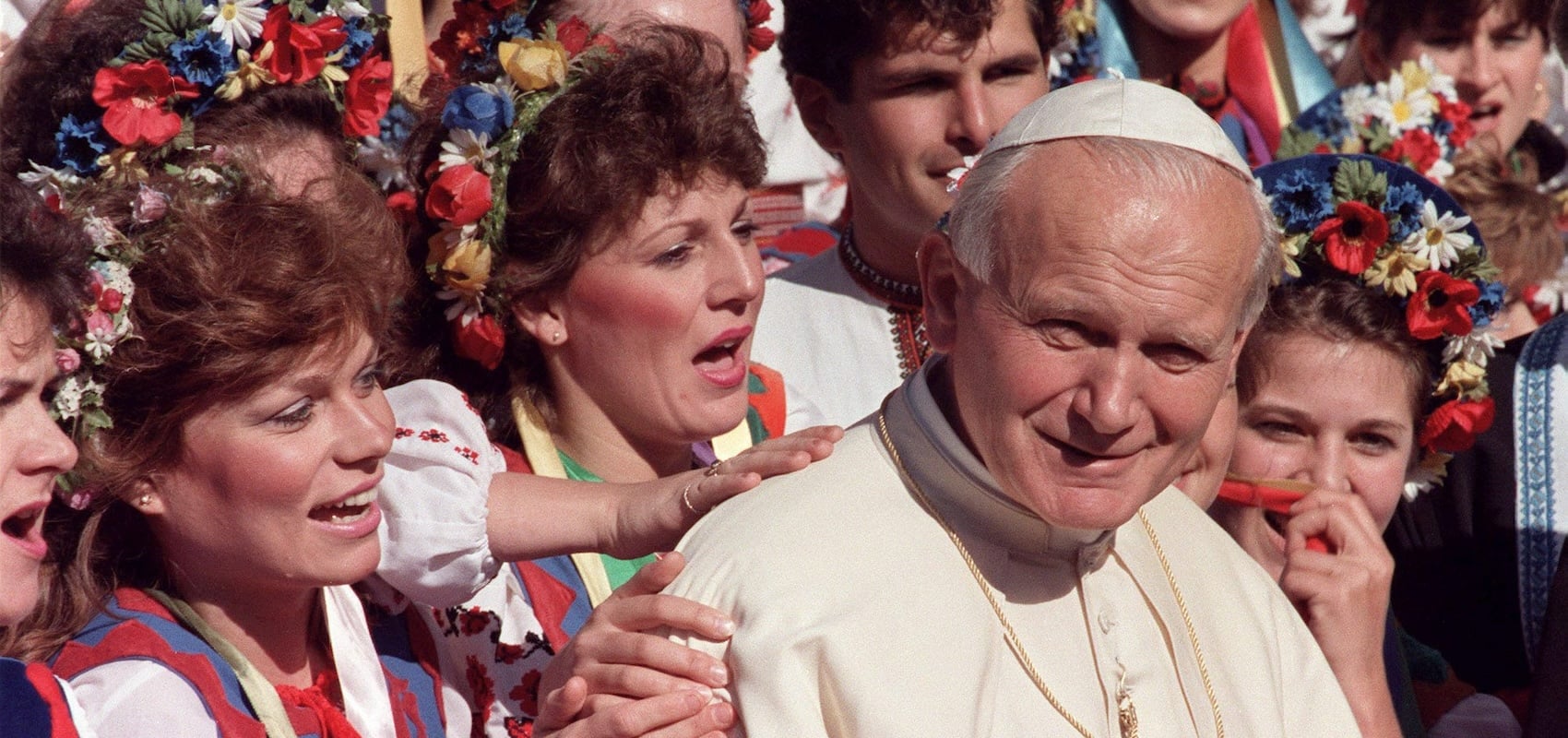
AP Photo/The Canadian Press, Jose More
Dear Reader,
Can I be direct with you?
War abroad. Socialists on the rise. AI upending human life. Endless uproar online. The modern attention economy doesn’t want readers — it wants users enslaved to the tyranny of the present.
First Things is the antidote: literary excellence, timeless truths, and a fixed point of reference in a culture that has lost its bearings.
But we can’t do it without readers like you.
Our goal: Raise $150,000 by November 1 to sustain First Things in the year ahead.
Your gift anchors readers in the permanent things.
Make your Fall Campaign gift now using the button below.
If you have any questions or would like more information, please contact Giovanni Del Piero, Director of the Editor’s Circle, at gdelpiero@firstthings.com or 212-627-1985.


YOU MIGHT ALSO LIKE
Why the Death Penalty Is a Sore Point for Papal Authority
Pope Leo XIV marked World Day Against the Death Penalty, observed on October 10, with the following…
Candace Owens and the Sin of Anti-Semitism
According to the online Encyclopedia Britannica, Sir Moses Montefiore (1784–1885) was “an Italian-born businessman who was noted…
The Myth of St. Francis
At the beginning of his 2020 encyclical, Fratelli Tutti, Pope Francis speaks of “an episode in the…
