
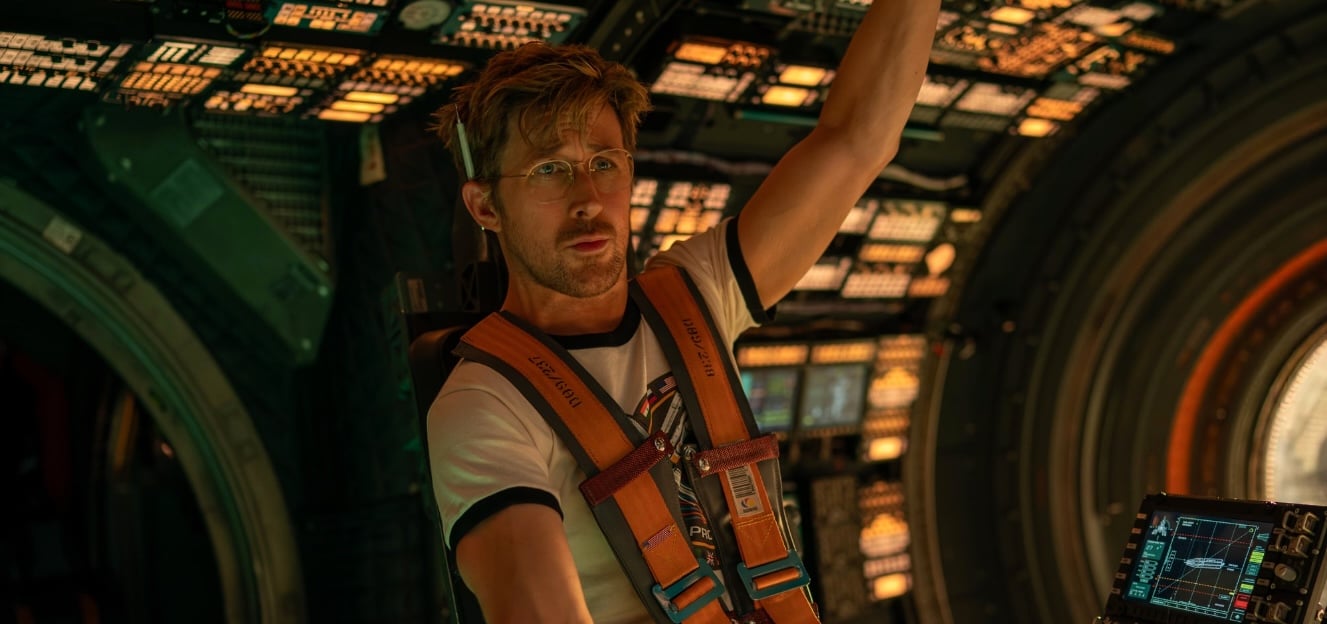
Like practically everyone else, I loved Project Hail Mary, the runaway science fiction mega-hit film that has so far garnered over $600 million in worldwide revenue. Everything about the movie is wonderful: the gorgeous, luminous visuals (thank cinematographer Greig Fraser of the Dune films); the fact that directors Phil Lord and Christopher Miller (of Lego Movie fame) used built sets, puppets, and classic special effects instead of leaning on dull-witted CGI; and the sweetly romantic score composed by Daniel Pemberton and interspersed with vintage vocal classics.
And who can fail to be charmed by Ryan Gosling as protagonist Ryland Grace, the brilliant but self-effacing molecular biologist turned middle-school science teacher, exiled from academia for offending the powers-that-be with his theories about life’s origins? Grace awakens from an induced coma and finds himself the lone surviving crewmate of a spaceship twelve light years away from Earth heading for the Tau Ceti system. He has amnesia but gradually recalls that he was tasked with figuring out how to save the sun from heat-eating bacteria before the planet cools and everyone dies of starvation. All nearby stars have been infected—except for Tau Ceti. The ship is named the Hail Mary because its mission is a scientific Hail Mary pass; no one really knows what’s exactly out there and what anyone can do about it.
So far, so familiar. The survival story quickly shifts gears when Grace encounters another intelligent being, also the sole survivor of a crew tasked with saving their planet. Grace dubs the crablike creature without a face “Rocky” because of his craggy exoskeleton. Grace and Rocky will die without protective spacesuits in each other’s atmospheres, and they can’t communicate except via computers that translate Rocky’s bat-like echolocation into pidgin English—but they bond in friendship through their shared sense of humor and their shared capacity for grieving over their dead crewmates. It’s a lovely and moving tale of mutual sacrifice: Rocky nearly dies protecting Grace, while Grace in turn gives up his one chance to return home in order to save Rocky’s life. “Greater love hath no man than this.” It’s rendered all the more human and touching by Lord and Miller’s decision to cast master-puppeteer James Ortiz as Rocky’s own voice, rather than hiring a big-name voice actor as they had originally planned.
And yet—the sheer delightfulness of Project Hail Mary glides over two moral dilemmas that its talented makers couldn’t bring themselves to deal with. The first is a trolley problem. We learn early on that Project Hail Mary isn’t just a mission to save billions of lives on Earth; it’s also a death sentence for its human crew, including Grace. As the mission is originally conceived, there isn’t enough fuel for a return voyage. Then we learn, a little later, that Grace is not a voluntary participant on this expedition. It’s one thing to lay down one’s life for one’s friend, and another to lay it down for an abstract agglomeration of strangers. So Eva Stratt (Sandra Hüller), the leader of the international commission in charge of the project, has him kidnapped, drugged, and put into an early coma. The movie makes it all seem easy—after all, Grace is a loner with no wife or family to mourn him—but it is actually a decision to murder an innocent human being in the name of a greater good that ought to give Project Hail Mary‘s audience pause.
The second moral dilemma arises from the fact that the Hail Mary‘s crewmates, including Grace, are expected to commit suicide by a method of their choice when they have completed their mission, because the alternative is slow and miserable death by starvation. They joke about it in the movie—“I want to do lethal injection with a little bit of heroin,” says one. But, in fact, “assisted suicide,” “medical aid in dying,” or whatever you want to call it is another live issue—indeed a pressing political one, especially in a society that increasingly downplays the evil of killing oneself. It shouldn’t be glossed over quite so easily.
Project Hail Mary has a religious aura to it, a specifically Christian one. The Hail Mary, the Ave Maria, is the core Catholic prayer to Christ’s mother—and the “Hail Mary pass” as an expression originated with the University of Notre Dame’s football team. In the words of the prayer, and also in the Latin Vulgate version of Luke’s Gospel, Mary is “full of grace” (gratia plena). Ryland, call your office. But it is unclear what we, the audience, are supposed to make of this. The theme of Grace’s double sacrifice, for his friend, Rocky, and for the population of Earth, bears some resemblance to the sacrifice of Christ on the cross—but how much? In the movie, Stratt tells an astonished Grace that she believes in God. “Beats the alternative,” she says. But Stratt and her confreres don’t seem to believe in God so much as play God, deciding who shall live, who must die, and when. It’s not a role to be taken lightly or glossed over.
I know I sound like the Grinch at Christmastime trying to wreck a sadly rare cinematic exercise in optimism and sheer entertainment that has hit a populist nerve. (I also may be spoiling the fun of hundreds of geeks on Reddit trying to figure out the movie’s science.) Still, I think the movie would have been even more satisfying, not only morally but artistically, had it presented more seriously the dilemmas its characters confront and perhaps can’t ever resolve. After all, the sacrifice of Christ and the salvation it brought mankind rested on a murder of a peculiarly bloody and violent nature.

YOU MIGHT ALSO LIKE
SlutCon’s Emotional Void
The tech-rationalist phenomenon “SlutCon” caused quite a stir online, perhaps predictably. SlutCon was a multi-day retreat and…
The Boys on the Brink
In the latest installment of the ongoing interview series with contributing editor Mark Bauerlein, Leonard Sax joins…
Serial Liar, Serial Comma
How would you write a public letter that you know will become front-page news? Would you write…
