
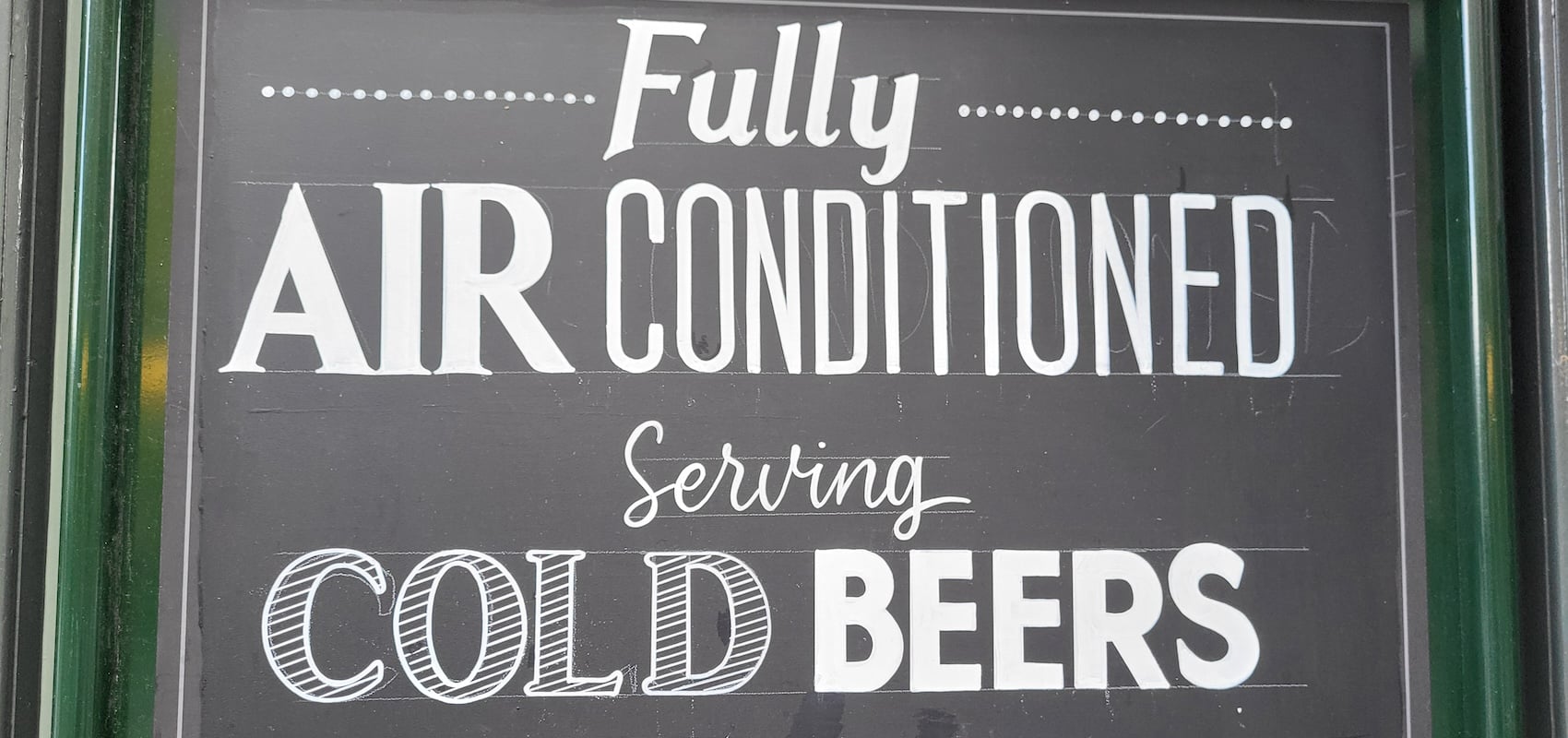
In London this summer, I walked past a pub sign near Trafalgar Square that read “Fully Air Conditioned. Serving Cold Beers.” Turning to my wife, I laughed: “I truly don’t recognize my own country anymore.” I was being (somewhat) facetious, but I recalled this incident when a few readers contacted me privately about my claim, in these pages, that the England I knew as a child has died. One expressed the belief that England is alive and well and that I need only go to a pub to see that—a very particular application of the classic “you should get out more” line.
I confess that English pubs have been among the great joys of my life. I routinely give directions around Gloucestershire by the names of the various village pubs, and even this summer I managed to indulge a little in visiting those old gathering places. Sadly, the condition of the English pub is not counter-evidence to my basic thesis but rather evidence of it.
The English pub—at least the kind I loved in that England of my youth—represented a particular sort of community and therefore embodied key aspects of those shared intuitions that make social life possible. There was never any need to buy food, although some basic dishes were typically available (and sometimes even edible). One went to the pub for a drink. But—and this is an important distinction—one did not go there to drink. One went there to spend time in conversation with friends, with drinks playing a key part. Warm, flat beer lubricated conversations about anything and everything, and a simple ritual graciously subverted any hierarchy or personal barriers that existed: the buying of rounds. Each person would take his or her turn to go to the bar, pay for everyone’s drinks, and bring them back to the table. That did not simply reflect community; it helped constitute it as well. A point of equal importance was the absence of any television. One went to the pub to talk over a drink, not to sit in the company of strangers (or indeed friends) while having one’s mind taken elsewhere.
Pub culture has died, just as the England I remember and loved has died. On a small but notable point, the British government now limits the type of foreigner with whom I can share the buying of rounds. There is no chance of me doing so with a conservative Dutch politician who believes men cannot be women or a distinguished Finnish politician who dared to write a pamphlet consistent with historic Christian principles. Foreigners who hold views like mine and have made them public are no longer welcome in the country. I am thereby unable to go with a friend to one of those pubs that apparently witness to the country’s unchanging vitality. But let us be encouraged: The British government may be unable to act decisively on illegal immigration or on child rape gangs, but it can at least keep out those people who have dared to put into words what almost everyone in England believed until the day before yesterday.
The pubs themselves have also transformed. In my home village, the local public house has changed owners numerous times in the last decade because running it as a viable financial proposition has proven difficult. This is reflected in the nation as a whole: From 2000 to 2025, there was a drop of 16,150 in the number of pubs in the U.K., a reduction of 36 percent. And that is a net figure that takes into account the number of new pubs opening. The number of actual closures will therefore be higher.
What lies behind this? Taxation and business rates have put huge pressure on landlords’ financial margins. These reveal a government with no concern for what pubs represented—and what they did—in their communities. And people who go to pubs are now looking for food and (so it seems) entertainment, not conversation and the affirmation of that community that arises out of a sense of interdependency, proximity, and mutual respect. The village community, of which the pub was a focal point, is no more. Of course, that is not the fault of the current Labour government. It is the result of social and cultural forces that have been at work for decades, slowly but surely eroding the kind of community life upon which the England I knew depended. And I am part of the erosion: I have lived in a far country for decades now. I too am a symptom of what I decry.
My point, therefore, is not that of the Pharisee thanking the Lord that he is not like other men, but that what we see in England (and, in a different form, in the United States) is the death of something significant. And it is being replaced by something much worse: a culture that has run out of communal social capital and is now marked by a routine, casual contempt for others; a culture where expletives that I don’t want to have to explain to my four-year-old granddaughter are used by leading politicians, left and right, on primetime news; and a culture where mindless, passive entertainment is pumped from screens, large and small, at home, at the petrol station, and, yes, even in the pub. It’s the culture of expressive individualism. And English pubs are not an antidote but a symptom of this malaise. I love a warm pint or two in a pub with good friends when I am home, but I fear that now it only reminds me of what we are losing or have already lost. I never thought I would say this, but the advent of cold beer is now the least of my fears when approaching the bar.
Dear Reader,
Can I be direct with you?
War abroad. Socialists on the rise. AI upending human life. Endless uproar online. The modern attention economy doesn’t want readers — it wants users enslaved to the tyranny of the present.
First Things is the antidote: literary excellence, timeless truths, and a fixed point of reference in a culture that has lost its bearings.
But we can’t do it without readers like you.
Our goal: Raise $150,000 by November 1 to sustain First Things in the year ahead.
Your gift anchors readers in the permanent things.
Make your Fall Campaign gift now using the button below.
If you have any questions or would like more information, please contact Giovanni Del Piero, Director of the Editor’s Circle, at gdelpiero@firstthings.com or 212-627-1985.


YOU MIGHT ALSO LIKE
Foucault’s Idol of Nothingness
Today marks the 100th anniversary of the birth of Michel Foucault. He was influential in his lifetime,…
Forget Odysseus. Aeneas Is the True American Hero.
Who is our Odysseus? Or more precisely, who is the most Odyssean hero of American film? Matt…
How Sweden’s Immigrant Vote Toppled the Right
For decades, Sweden had perhaps the most open immigration policy and the strongest commitment to tolerance and…
