
to see
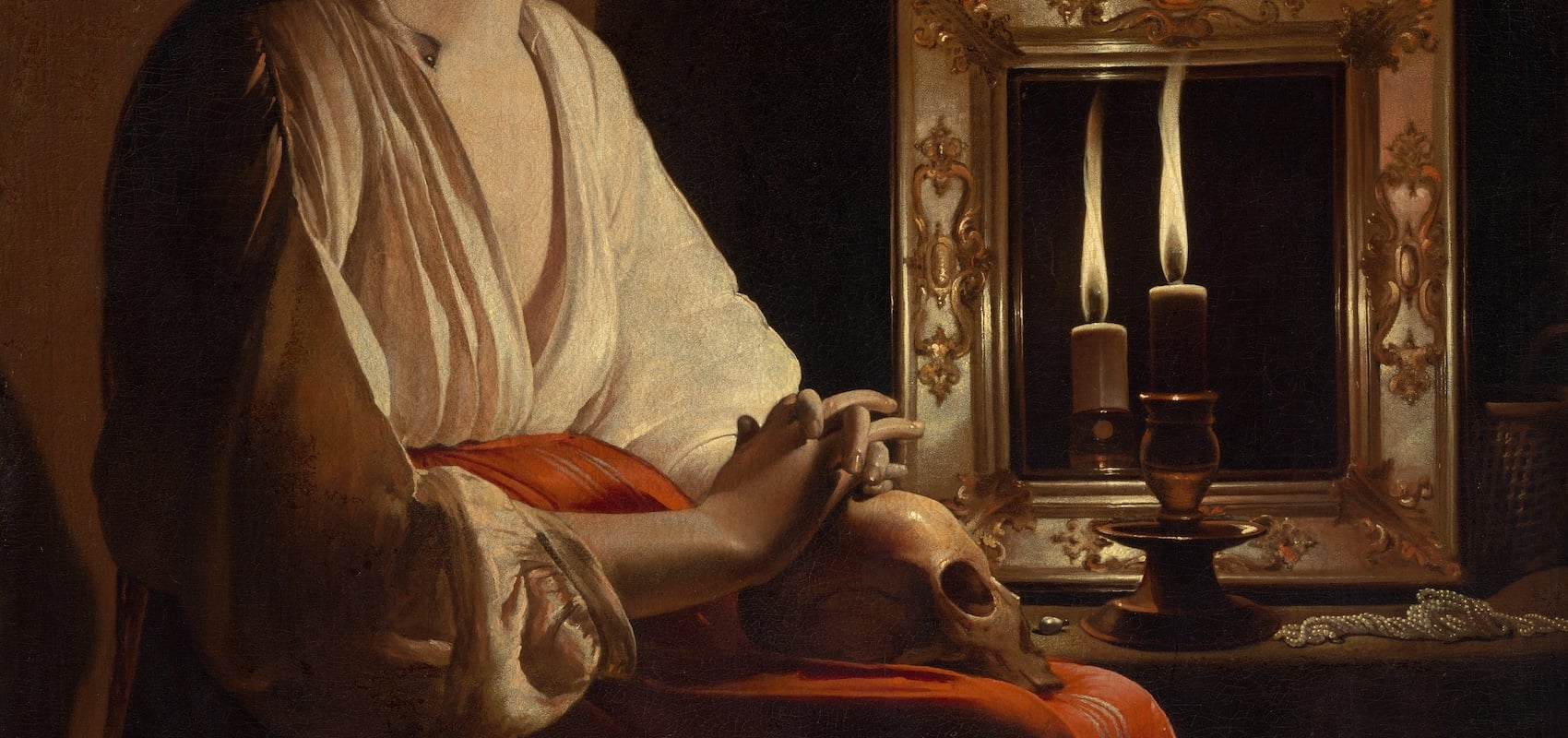
Her wanting some illusion in the glass
As much as I want things I cannot have:
Assurance that my children never suffer;
An ordinary life where things make sense.—Wilmer Mills, “Crosswalk”
There is a particular kind of modern person who, upon encountering the messiness of human life, its sheer ungovernable profusion, and the suffering it entails, recoils not with pity or solidarity but with disgust. And because disgust is rarely accepted as its own justification, such a person dresses his disgust in the language of optimization, selection, species-level improvement—that is, eugenics. But if you listen carefully, he is not really saying, “Humanity could be better.” He is saying, “I cannot bear what I am.”
This distinction matters enormously, and almost nobody is making it.
The old eugenics of Galton and his heirs, of Buck v. Bell (1927) and the Kaiser Wilhelm Institute, was many terrible things, but its terribleness was at least coherent. It believed, with the confidence peculiar to the late nineteenth century, that the human species was a stock to be managed, and that the managers were identifiable by their breeding, their cranial measurements, and their position in the social hierarchy. The eugenicist of 1910 looked out at the world and saw inferiors. He honored himself. He was monstrous, but he was monstrous in the direction of self-congratulation.
The new eugenics operates from an almost perfectly inverted posture. It does not look outward with contempt but inward with revulsion. When someone on the internet announces that it would be better if people with certain genetic predispositions—depression, obesity, chronic illness—simply did not reproduce, he is rarely talking about strangers. He is talking about himself. In nearly every case, he has been taught to see his own body, his own mind, his own inherited frailties as defects in need of correction or, better yet, elimination. He does not want to improve the race. He wants to be unmade.
A great deal of what circulates online as eugenic ideology is simply depression wearing a lab coat. It is self-loathing that has graduated from the personal to the philosophical, that has found a way to universalize its private verdict of worthlessness. If I should not exist, then surely others like me should not exist either. The conclusion may sound scientific, but the premise is despair.
You can see this pattern everywhere. The antinatalist forums, the “voluntary human extinction” communities, the casual talk of genetic screening as a moral obligation—these are not populated, in the main, by triumphant Nietzschean Übermenschen, but by people who are suffering and who have concluded that suffering is a design flaw rather than a feature of creaturely life. This is true whether the suffering is that of the cancer patient wishing for a cure or the subtler suffering of the expectant mother whose heart breaks thinking of her child (as in Mills’s poem above). They have been failed, not by their genes, but by a culture that sees their existence as requiring a cost-benefit analysis, rather than as a gift.
The Christian tradition has a name for this failure: the refusal of creatureliness. To be a creature is to be dependent, limited, mortal, and marked by the particularities of one’s birth. It is to have a body that breaks down, a mind that wanders, a will that falters. The whole arc of Scripture assumes that this is the condition into which grace arrives, not the condition from which we must engineer an escape. The Psalmist who cries out from the depths does not conclude that the depths should be abolished. He waits for the Lord.
But our civilization treats limitation as a scandal. From the productivity culture that measures human worth in output, to the therapeutic culture that treats every discomfort as a pathology, to the techno-utopian culture that promises transcendence through the machine, everywhere the message is the same: You should not have to suffer, and if you do, something has gone wrong. Not wrong in the moral sense, mind you, not wrong in the way that might call us to repentance or charity or patient endurance. Wrong in the engineering sense. A bug to be patched. A defect to be screened out in the next iteration.
When people marinate long enough in this logic, the step from “my suffering is a defect” to “I am a defect” is vanishingly small. And from there, the step to “people like me are defects” is smaller still. Eugenics becomes, paradoxically, a form of self-harm like a young woman who cuts herself to feel better, however briefly. But this cutting happens at the level of the soul rather than the skin.
This is why arguing against neo-eugenics on purely scientific grounds is necessary but insufficient. You can win every empirical argument and still lose the person, because the person was never really making an empirical argument. He was crying for help in the only dialect his culture gave him—the dialect of data, of studies, of rational self-improvement. He needs to hear something that no genetically optimized biohacking program can tell him, which is that he is not a problem to be solved.
The proper answer to the new eugenics is not, in the first instance, a policy argument or a bioethics seminar. It is an anthropology—a true account of what a human being is. And what a human being is, according to the oldest and most enduring witness of the Western tradition, is a creature made in the image of God, broken by sin, and offered restoration not through the elimination of weakness but through its transfiguration. “My grace is sufficient for you,” Paul hears, “for my power is made perfect in weakness.” This is the farthest thing from a platitude. It is a metaphysical claim about the structure of reality, and it is directly and irreconcilably opposed to the self-hatred of the new eugenics.
We will not talk people out of eugenics by proving it unscientific, though it is. We will talk them out of it by convincing them—slowly, patiently, probably over meals and in the context of churches whose members actually bear one another’s burdens—that they are not mistakes. That their neediness is not a flaw but an invitation to become whole in a way they cannot currently imagine. “There is a crack in everything,” as Leonard Cohen sings, “That’s how the light gets in.” The world in pain must hear the word of hope: There is a meaning to your suffering.
The eugenicist who hates himself needs a better mirror. One that reflects not defects to be edited, but a person to be loved.

YOU MIGHT ALSO LIKE
Standing Athwart AI, Yelling Stop
The editors discuss the AfD’s continued victories in Germany, the death of the assisted dying bill in…
Living Humanae Vitae in Poland
Humanae Vitae remains alive, if not entirely well, fifty-eight years after its promulgation. When Pope Paul VI…
The “Right to Die” Will Be The Death of Solidarity
Imagine that you work as a janitor in the office building of a large corporation. One evening…
