
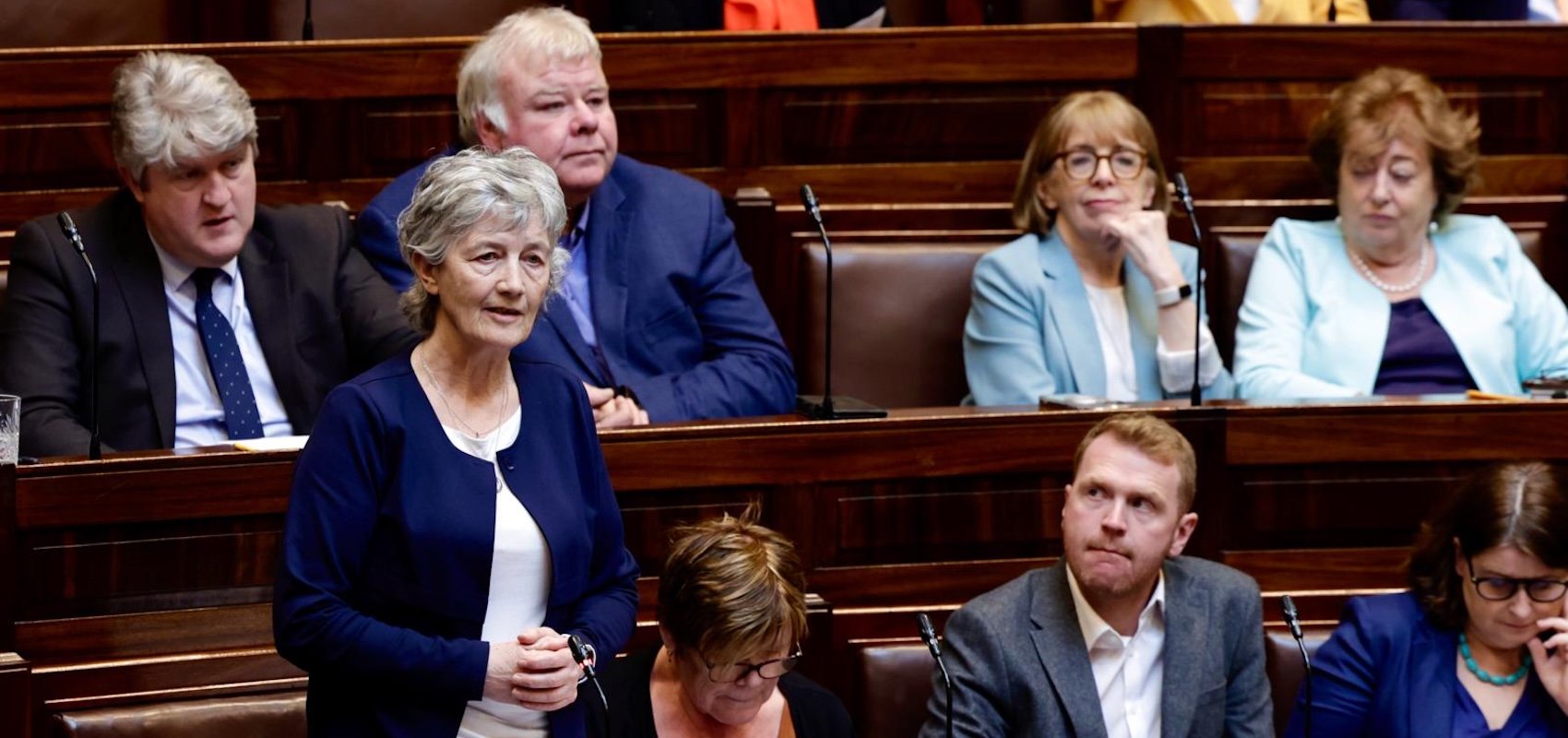
Catherine Connolly is Ireland’s new president. Connolly, who was backed by the hard-left parties, received 63 percent of the vote, the highest percentage for any presidential candidate in Ireland’s history. She will be in post for the next seven years, replacing Michael D. Higgins, a left-wing incumbent who served for the past fourteen years.
It has the look and feel of a landslide; one that, among other things, buries socially conservative Catholic Ireland under an even deeper motherlode of indifference and contempt. At an eve-of-election rally, a musician performing in Catherine Connolly’s honor sneeringly dedicated a song to a string of deplorables: the rich, the older political parties, the landlords, and “the f***ing Catholic Church, all those cu**s.” The crowd whooped.
Yet, despite the apparent clarity of the outcome, the true meaning of this election will be argued over for a very long time.
How so? Let’s look at some more figures. Fifty-four percent of the whole electorate did not bother to vote at all, producing the second-lowest turnout ever. Seven percent of those who did come out voted for a candidate who had withdrawn from the race weeks before. (For technical reasons, his name remained on the ballot paper.) Another 30 percent voted for the remaining politico in what had turned into an unusual two-horse race: There were six candidates in the previous presidential election, for instance, and seven in the one before that.
Most striking of all, though, was the completely unprecedented proportion of votes that were spoiled: 13 percent. For the first time in the history of the state, valid votes cast, as a proportion of the electorate, dipped below two-fifths. If this was a landslide, it was one that kept shifting shape and changing direction, taking with it comforting hopes and cherished assumptions on all sides.
There are three explanations for the historic low turnout and spoiled votes.
The first is mundane enough but always carries weight: the voting public’s perpetual disgruntlement with whoever rules over them. This will wax and wane with the caliber and performance of the government of the day; and Ireland’s leaders have not been covering themselves in glory, especially when it comes to things like housing costs, the tax burden, and delivery of essential infrastructure. The completion of a new National Children’s Hospital, for instance, has been delayed for the sixteenth time and costs have skyrocketed to €2.24 billion (and possibly more).
As a result, many people may have been in no mood to vote lackluster candidates from the governing parties into a largely ceremonial (if symbolically significant) position. This mass abstention, along with the narrow field, swung the door open for Catherine Connolly, with the backing of one in four of the electorate, to win her curious landslide.
The second explanation relates to immigration. Some of the largest numbers of spoiled votes came from Dublin working-class constituencies where disquiet about levels of immigration is strong, leaving the left-wing parties, and their privately-educated leaders, with a difficult circle to square. The asylum system in particular is under scrutiny and is forcing ever new agonies on the public mind. Earlier this month, Vadym Davydenko, a seventeen-year-old Ukrainian, having arrived in Ireland only three days previously, was stabbed to death while in state care; a Somalian boy of the same age has been charged with murder.
And then, just before the presidential election itself, reports emerged that an asylum seeker had allegedly raped a ten-year-old Irish girl missing from state care. The suspect had ignored a deportation order issued seven months ago. The assault is said to have taken place on the grounds of a state-owned asylum hotel. Photographs have circulated on social media of spoiled ballots with the words “She was only ten” written across them.
The final possible reason for the unprecedented uprising in the polling booths comes from a Spoil the Vote campaign launched only ten days before the election, claiming that “a core promise of Irish democracy—genuine choice and competition of ideas” had been “trashed.” The political establishment, it was suggested, had used the constitutional rules governing the nomination of presidential candidates to block outsiders and quash choice.
The most prominent of the outsiders who did not make it onto the election roster because of the procedural shenanigans was Maria Steen, an architect, barrister, practicing Catholic, and homeschooling mother of five. Steen was at the forefront of last year’s enormously successful campaign to oppose proposed changes to the Constitution that would have altered the definition of the family and removed the word “mother.” One pre-election poll showed Steen—whose campaign never began and who appeared in none of the televised debates—with 22 percent of support. Again, on voting day, the internet was flooded with images of spoiled ballots on which voters had written Maria Steen’s name and given her their number one.
Steen is without doubt one of the most intelligent and articulate figures on the Irish political scene—or rather on the fringes of that scene. A campaigner at referendums, an occasional columnist, and a speaker, she is not part of any political party and had no role in the Spoil the Vote movement. She has yet to declare any further political ambitions. Yet her stature is growing perceptibly.
Ireland’s official center-right has drifted massively leftward on social policy, cutting even the gentlest ties with the Church, while also getting saddled with a reputation for managerial incompetence. A gap as large as those one finds in Ireland’s western mountain ranges has opened up. The question now is whether anyone will rise to fill the void.
Image by Houses of the Oireachtas, licensed via Creative Commons. Image cropped.
Dear Reader,
Can I be direct with you?
War abroad. Socialists on the rise. AI upending human life. Endless uproar online. The modern attention economy doesn’t want readers — it wants users enslaved to the tyranny of the present.
First Things is the antidote: literary excellence, timeless truths, and a fixed point of reference in a culture that has lost its bearings.
But we can’t do it without readers like you.
Our goal: Raise $150,000 by November 1 to sustain First Things in the year ahead.
Your gift anchors readers in the permanent things.
Make your Fall Campaign gift now using the button below.
If you have any questions or would like more information, please contact Giovanni Del Piero, Director of the Editor’s Circle, at gdelpiero@firstthings.com or 212-627-1985.

YOU MIGHT ALSO LIKE
The Myth of St. Francis
At the beginning of his 2020 encyclical, Fratelli Tutti, Pope Francis speaks of “an episode in the…
Briefly Noted
Sir Andrew Motion is former poet laureate of the United Kingdom and cofounder of the Poetry Archive...
Vatican II Didn’t Kneel to Modernity
In his weekly catecheses on Vatican II, Pope Leo is now discussing Gaudium et Spes, one of…
