
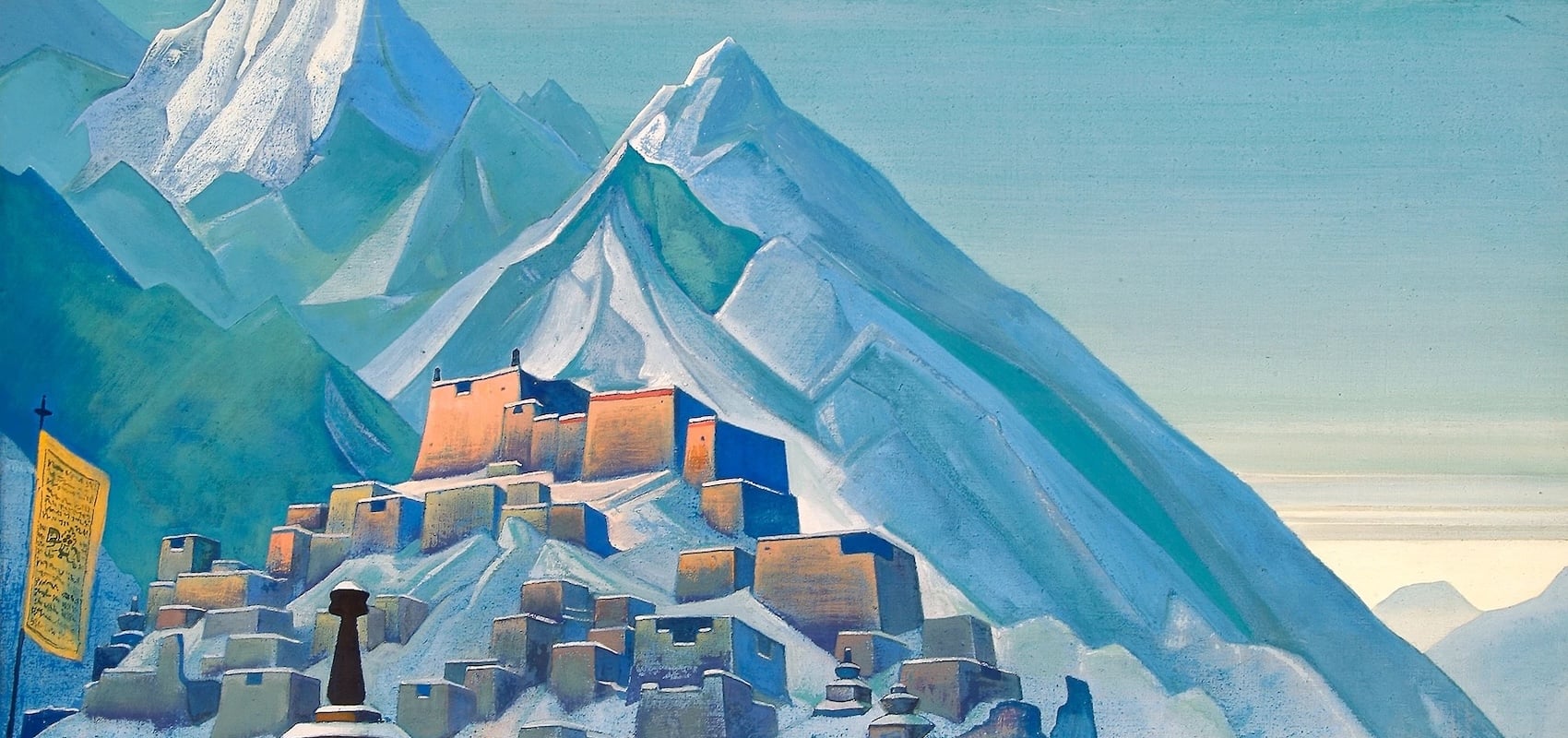
In Thomas Mann’s novel The Magic Mountain, the Enlightenment champion Lodovico Settembrini and the Jesuit communist Leo Naphta argue about nearly everything, including the modern project to conquer nature. When Settembrini declares that there is likely no place on Earth where man has not set foot, Naphta retorts that there is “Mount Everest, which had thus far responded to human curiosity with an icy refusal and appeared to want to remain in that state of cold reserve.”
“The humanist was annoyed.” Settembrini’s annoyance is understandable: Great honor for the human race was at stake. Formidable men had started thinking seriously about climbing the world’s highest mountain a generation earlier. Clinton Thomas Dent, an English surgeon, had written about such an undertaking as early as 1885, and his scientific plausibility and measured exhortation had anticipated the more vehement decisiveness of Lord Curzon, viceroy of India, who in 1905 deemed it a “reproach” that British manhood, “the mountaineers and pioneers par excellence of the universe,” had not already conquered the peak. The British failure to be the first to reach the North and South Poles made success on this front all the more imperative.
But political upheaval made even organizing an expedition impossible for a time: In 1910, China invaded Tibet, which had been weakened by the British imperial devastation of the Tibetan army in 1903–1904. Yet even in the absence of Tibetan permission, the dreamers of the Royal Geographical Society and the Alpine Club made plans anyway for a crack at the mountain. A reconnaissance mission followed by a dash to the top were scheduled for 1915 and 1916.
World War required the British Empire’s full attention. And it would be survivors of the butchery at the Somme and Passchendaele who would launch the heroic assaults on Everest of 1921, 1922, and 1924. “Only they could possibly know what the vision of Everest had become . . . a sentinel in the sky, a place and destination of hope and redemption, a symbol of continuity in a world gone mad.” So writes the anthropologist and adventurer Wade Davis in his splendid book Into the Silence: The Great War, Mallory, and the Conquest of Everest.
Nearly 20,000 British soldiers had been killed on the first day of the Battle of the Somme, without a single military objective achieved. The failure of imagination, and of simple reasoning, on the part of British generalship would be lethal a million times over before the war was finished. During the four years and four months the war lasted, the British army suffered an average of six hundred battle deaths daily.
Several of the Everest climbers were surgeons—not killers but healers, who as medical officers had done their damnedest to patch together the countless broken bodies of young men. Alexander Wollaston, who came from a scientific and scholarly family that down the generations had included more members of the Royal Society than any other family in Britain, had served on the seas and in German East Africa; the war’s carnage—in Africa, more death by disease than in battle—so devastated him that he came to hate all religion, and particularly loathed the Buddhist theocracy of Tibet, where in his view parasitic religious personnel thrived while the impoverished peasantry footed the bill. Arthur Wakefield had seen his Newfoundland Regiment cut to pieces at the Somme, every last officer lost. “Never again would he speak of God or attend religious service,” writes Davis. “His children would never in his presence know the inside of a church.” Howard Somervell, who while a young atheist at Cambridge received a revelation at a prayer meeting he had just happened upon, found his faith strengthened by his wartime service, that prodigious indoctrination into boundless human pain. The pleasures of a vital mind, sublime gifts, kept him from dwelling upon the abyss. An accomplished amateur painter and musician, he was fascinated by Tibetan culture, and sought to do the first in-depth study of Tibetan ethnomusicology.
George Mallory, another Cambridge man, was renowned as the greatest mountaineer of his time. At university he had fallen in with the Bloomsbury crowd, and their influence showed, in the best way: He would read Henry James in spare moments at the Somme and Keats’s letters and a biography of Shelley while camped on the slopes of Everest. An artillery officer at the Somme, on the eve of battle he wrote to his wife about their daughter, with intense hope and independence of mind: “The conception of God must be formed very gradually out of the child’s own spiritual experiences.” The four-month-long battle, in which he saw friends nearly decapitated on either side of him, reduced him to despair. A year later, he would tell his climbing mentor, who had lost a leg in combat, “I don’t intend, for what ever little that might be worth, to be alive at the end.” He was still standing when the smoke cleared, however. “How he avoided the front for sixteen months during the climax of the war is a mystery,” Davis writes, “though one senses the hand of Eddie Marsh”—Winston Churchill’s personal secretary and an invaluable friend to have.
Five days after the war’s end, Mallory wrote to his clergyman father of his generation’s “disgust for the appearances of civilization so intense that it was an ever present spiritual discomfort . . . an overwhelming sense of an incalculable evil.” It is not clear if he was referring exclusively to the experience of war or if he meant the preceding time of peace as well.
But life felt different on the heights. There he was fully alive and happy. Three times Mallory would seek the summit of the world, and three times he failed. On the 1922 expedition, he nearly died in an avalanche, as seven Sherpa porters beside him were swept to their deaths. In 1924, he and his partner Sandy Irvine, an Oxford oarsman, were lost a few hundred feet from the mountaintop. His body was not found until 1999, and it was only then that the evidence indicated he had likely not made it to the summit.
Mallory and his companions were men of supreme ambition. The contrast between the Western men who attempted to conquer the mountain and the natives who lived in the mountains is stark: tough-minded spiritedness as against aspiration to complete indifference to this world. At the Rongbuk Buddhist Monastery at the base of Everest, the climbers were shown a mural painted after the fatal 1922 expedition of mountaintop demons with pitchforks thrusting presumptuous white men into an icy hell. (The monastery was later destroyed by the Chinese communist regime in its effort to extinguish Tibetan religion.) Elsewhere the climbers were bemused by the sight of a man deliberately falling face-down on the ground with each step—ritual prostration, to be performed on the entire 650-mile journey from Lhasa to Kathmandu. And they were awed by the scattered hermits isolating themselves on the mountainsides at 17,000 feet, with monks from the monastery bringing them the bare necessities periodically. There is heroism and there is heroism, and an astonishing measure of human excellence flourished on the slopes of Everest.
Dear Reader,
Can I be direct with you?
War abroad. Socialists on the rise. AI upending human life. Endless uproar online. The modern attention economy doesn’t want readers — it wants users enslaved to the tyranny of the present.
First Things is the antidote: literary excellence, timeless truths, and a fixed point of reference in a culture that has lost its bearings.
But we can’t do it without readers like you.
Our goal: Raise $150,000 by November 1 to sustain First Things in the year ahead.
Your gift anchors readers in the permanent things.
Make your Fall Campaign gift now using the button below.
If you have any questions or would like more information, please contact Giovanni Del Piero, Director of the Editor’s Circle, at gdelpiero@firstthings.com or 212-627-1985.

YOU MIGHT ALSO LIKE
The Last Statesmen?
In the latest installment of the ongoing interview series with contributing editor Mark Bauerlein, Steven B. Smith…
A Culture of Parricide
I learned a new word the other day: déploration. It’s the French, directly from the Latin, for “lament.”…
The Chariot Burials
Wheeling through the clotted earth, / Bronze, bone, and leather clumped in clay...
