
Forty-five years ago, the New York Times cast its gimlet eye over the first three days of Pope John Paul II’s return to his Polish homeland. Reading the signs of those times through the conventional wisdom of the day, the Gray Lady then offered a typically ex cathedra judgment, in a June 5, 1979, editorial: “As much as the visit of John Paul II to Poland must reinvigorate and reinspire the Roman Catholic Church in Poland, it does not threaten the political order of the nation or of Eastern Europe.”
Oops.
To begin with, the Polish Church did not need reinvigorating or reinspiring in June 1979—it was the strongest local Church behind the Iron Curtain, the repository of Poland’s authentic national identity, and a constant thorn in the side of the communist authorities. (Stalin had famously said that trying to make Poland communist was like fitting a saddle on a cow. Little did he know.)
As for the “political order of the nation,” well, Polish Communist party boss Edward Gierek surreptitiously watched John Paul’s homecoming Mass on June 2 from a hotel room high above what was then Warsaw’s “Victory Square.” When he heard the pope call on the Holy Spirit to “renew the face of the Earth—of this land!,” as hundreds of thousands of Poles chanted “We want God! We want God!,” he surely felt the winds of change blowing, even if the anemometers in New York failed to register what amounted to a force 10 storm on the Beaufort Scale.
And as to the “political order . . . of Eastern Europe,” America’s premier historian of the Cold War, Yale’s John Lewis Gaddis, would write in 2005 that “when John Paul II kissed the ground at the Warsaw Airport on June 2, 1979, he began the process by which communism in Poland—and ultimately everywhere else in Europe—would come to an end.” I had made precisely that argument thirteen years before in my book The Final Revolution. There, I suggested that, while many causal factors shaped what we know as the Revolution of 1989, the indispensable factor determining when the revolution happened, and how it happened, was John Paul II.
What did he do, and how did he do it?
What he did was ignite a revolution of conscience, which preceded and made possible the nonviolent political revolution that brought down the Berlin Wall, emancipated the countries of East Central Europe, and, through the auto-liberation of the Baltic States and Ukraine, imploded the Soviet Union. The tinder for such a revolution of conscience—the decisions of men and women determined to “live in the truth,” as Václav Havel put it—had been in place for some years in East Central Europe. Activists encouraged by the 1975 Helsinki Final Act and its “Basket Three” human rights provisions built organizations like Czechoslovakia’s Charter 77, Lithuania’s Committee for the Defense of Believers’ Rights, and Poland’s KOR (Workers’ Defense Committee) that were linked to “Helsinki Watch Groups” in North America and Western Europe. John Paul supplied the flame that lit that tinder and helped keep the fire burning by his vocal support for those who were taking “the risk of freedom” (as he would describe it at the United Nations in 1995).
And how did that happen?
John Paul’s revolution of conscience began when he restored to the Polish people the truth about their history and culture, which Poland’s communist regime had both distorted and suppressed since 1945. Live in that truth, the pope suggested from June 2 through June 10, 1979, and you will find tools of resistance that communism’s brute force cannot match. John Paul didn’t design those tools; the Polish people did that when, fourteen months later, they formed the Solidarity trade union, which later evolved into a vast social movement. But the movement’s heart and soul—like its name—was shaped by the thought and witness of John Paul II.
The pope’s friend, philosopher-priest Józef Tischner, once described Solidarity-the-movement as a great forest planted by aroused consciences. Fr. Tischner’s brilliant image is one that bears reflection today. For the West needs “reforestation”: a planting of new seeds of conscience, reflecting the built-in truths about human dignity to which John Paul II appealed during those nine days of June 1979. Those were days on which modern history pivoted—for once, in a more humane and noble direction.
In Professor Gaddis’s words, John Paul II was one of those “visionaries” who, as “saboteurs of the status quo,” were able to “widen the range of historical possibility.” Are there such visionaries among us today?
George Weigel’s column “The Catholic Difference” is syndicated by the Denver Catholic, the official publication of the Archdiocese of Denver.
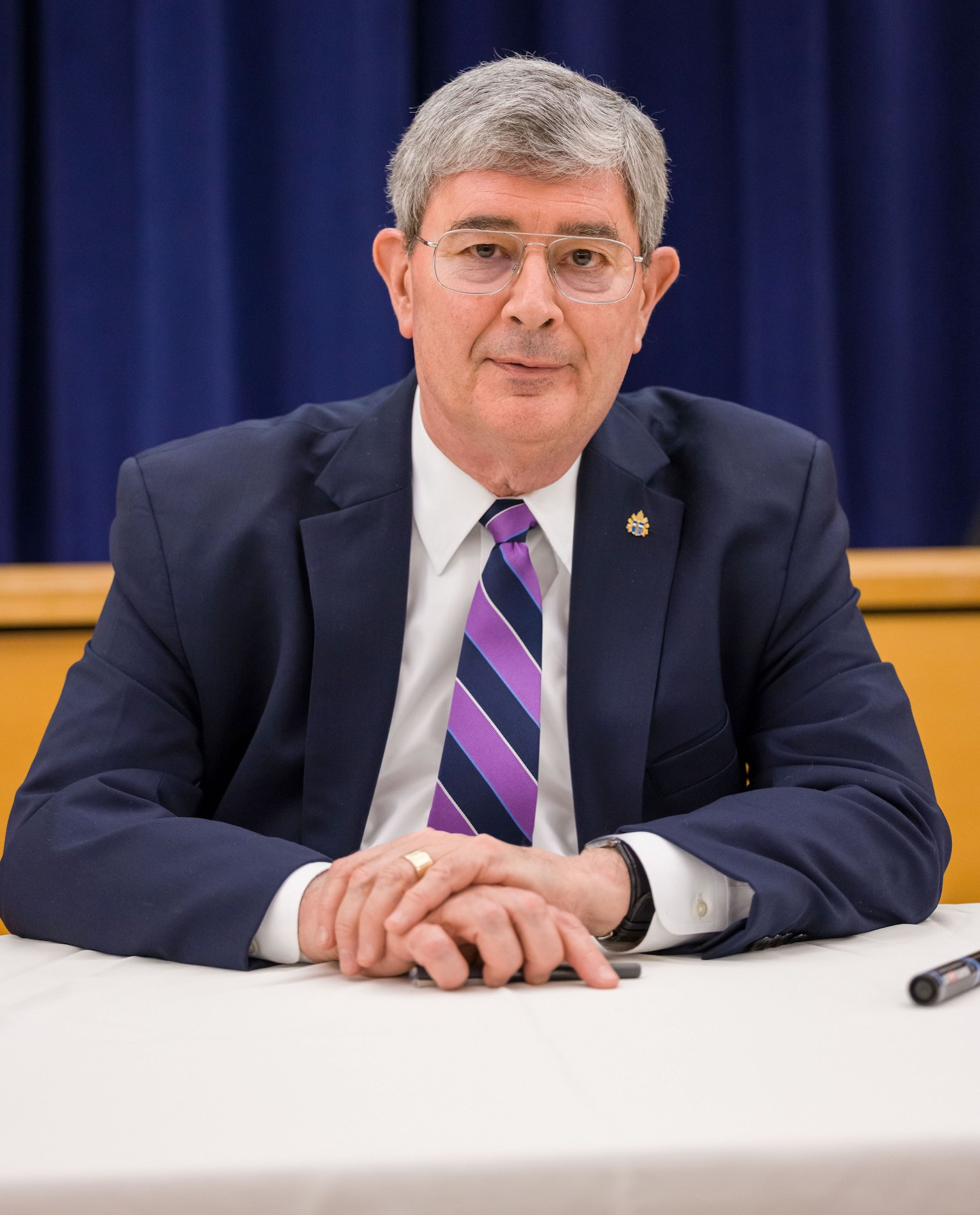
George Weigel is Distinguished Senior Fellow of Washington, D.C.’s Ethics and Public Policy Center, where he holds the William E. Simon Chair in Catholic Studies.
First Things depends on its subscribers and supporters. Join the conversation and make a contribution today.
Click here to make a donation.
Click here to subscribe to First Things.
Image by Levan Ramishvili, licensed via Creative Commons. Image cropped.
Dear Reader,
Can I be direct with you?
War abroad. Socialists on the rise. AI upending human life. Endless uproar online. The modern attention economy doesn’t want readers — it wants users enslaved to the tyranny of the present.
First Things is the antidote: literary excellence, timeless truths, and a fixed point of reference in a culture that has lost its bearings.
But we can’t do it without readers like you.
Our goal: Raise $150,000 by November 1 to sustain First Things in the year ahead.
Your gift anchors readers in the permanent things.
Make your Fall Campaign gift now using the button below.
If you have any questions or would like more information, please contact Giovanni Del Piero, Director of the Editor’s Circle, at gdelpiero@firstthings.com or 212-627-1985.


YOU MIGHT ALSO LIKE
Forget Odysseus. Aeneas Is the True American Hero.
Who is our Odysseus? Or more precisely, who is the most Odyssean hero of American film? Matt…
A Muslim Answer to Muslim Immigration
Modern America worships at the altar of youth and eagerly tracks in polls and market research its…
Meet the Post-Religious Right
There have been many books written about the online right and the Trump movement, most by people…
