
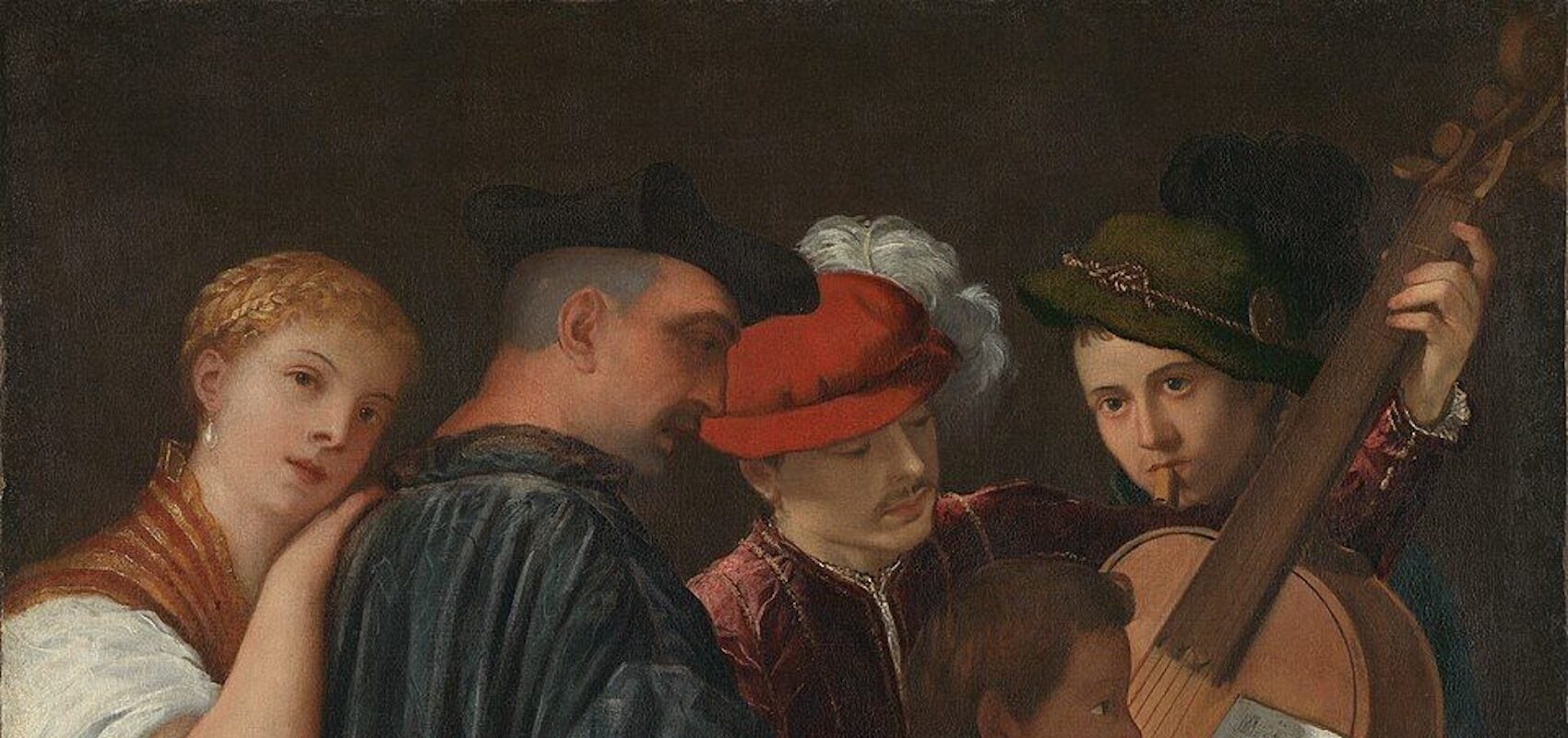
I learned a new word the other day: déploration. It’s the French, directly from the Latin, for “lament.” But as a term for a specific musical genre, it was novel to me. I came across this use of “lament” while researching the work of several Franco-Flemish composers of the late-medieval and Renaissance period: Gilles de Bins dit Binchois (c. 1400–1460), Johannes Ockeghem (c. 1410/1425–1497), Josquin des Prez (c. 1450/1455–1521), and Nicolas Gombert (c. 1495–1560). Ockeghem wrote a déploration for Binchois, his teacher, and the others likewise wrote laments for their own teachers. Master–pupil, in a sweep of generations, each weeping over and celebrating his mentor. The self-conscious use of borrowed material—each quoting his teacher’s previous lament as a way of marking succession—makes this a genuine chain, not just a formal trope repeated but unrelated. I marvel at this continuous tradition of lifting up, in regret and joy, the creative family tree. These tributes to musical bloodlines are all masterworks.
The master–pupil lineage can be found in academia today, though less and less. There’s the festschrift tradition, which involves gathering into a volume the essays of colleagues and former doctoral students to mark the accomplishments of a senior scholar. But publishers don’t like these kinds of collections, and scholars are decreasingly interested in the genre. It has largely faded.
I am not sure anyone can trace his intellectual patrimonies beyond a generation, perhaps two. I can celebrate George Lindbeck as a mentor and behind him perhaps Robert Calhoun, but after him it is all mist. Academics these days are driven more by the need to repudiate and innovate than to carry on the work of their teachers. In his famous The Anxiety of Influence, Harold Bloom traces the pull of a teacher or model on a writer, and he portrays such “influence” as the opposite of déploration. Bloom celebrates the creative tension that arises out of Oedipal murderousness. There may be no truly “original” poem, but the drive toward this ideal is one that has bloodied both father and son.
There is good reason to see ourselves as living in a parricidal era. The characterization is too strong, I realize, but the contrast with the familial resonances of the déploration in the noble line of composers whose music delighted me is stark. Freud drew from a well of troubling familial ambivalence with his theories about the child killing the parent. Before Oedipus, there was Hesiod’s primal story of the gods. In his Theogony, Uranus’s abuse provokes Cronus to castrate him; Cronus’s tyranny (devouring his children) provokes Zeus to overthrow him. Plato, in book II of the Republic, singles out these stories as the ones that must be censored in the education of the guardians—not because the poets lied, but because the truth is too dangerous to tell the young. “If possible,” counsels Socrates, “they had better be buried in silence.”
This worry about the temptations of parricide informed much of the ancient tradition into early modernity. We are aware of the horrific cruelty that fathers (and mothers) can visit upon their children. Yet writers like Cicero and Seneca, or Christian theologians like Chrysostom, approach this reality with the aim not of overthrowing parents but of reforming their passions. St. Paul’s advice stands as a universal expression: “And, ye fathers, provoke not your children to wrath: but bring them up in the nurture and admonition of the Lord” (Eph. 6:4), and “Fathers, provoke not your children to anger, lest they be discouraged” (Col. 3:21). Undergirding these practical counsels of paternal nurture is a comprehensive divine command: “Honor thy father and thy mother” (Exod. 20:12), emphasized by Jesus as God’s own bidding (Matt. 15:4) and, according to St. Paul, “the first commandment with promise” (Eph. 6:2–3), that of “long life” and its creative continuity. Although this has an embodied, physical meaning, it also applies to the life of the mind and spirit.
The son cannot create without the father. The creation of the son is but the continuance of the father’s energies. This creative current reaches back into the grandfather’s and great-grandfather’s. This work is not only paternal, of course. Women transmit their craft, and mothers and grandmothers hand down their own inheritance of love and wisdom. Think of the philosophical line of Husserl–Heidegger–Arendt–Young-Bruehl and its hidden intermediaries. You and I are extensions, not new lineages creating out of nothing. At the same time, we cannot say we are “but” extensions, for we are not “merely” brutes passing on genes. Rather, we are privileged to be a part of creation itself, God’s confection of family, relation, conversation, human life. How glorious that I am my parents’ child! This goes for my body, my speech, my thought, my scribblings. I am different from those who went before. But the difference is only an aspect of the integrated gift, subordinate and accountable to it.
This gift has been refashioned and to some extent denied in our parricidal times. In premodern deplorations, the death of a teacher, patron, or father figure is mourned within a moral order rather than a psychological one. The deceased occupies a hierarchical position above the mourner. What is lost is a source of virtue, wisdom, and continuity; the mourner owes loyalty, gratitude, and public acknowledgment. The relationship belongs to a stable transgenerational structure, and the lament itself instructs the living in proper feeling and conduct. Grief becomes centripetal, drawing the mourner back into the inherited architecture of communal order, expressing not “this person shaped my inner life” but “this person upheld the order that shapes us all.”
Modern tributes, by contrast, operate with a psychological and individuating grammar. They privilege interiority, validate personal feeling, treat the relationship as unique rather than hierarchical, frame the deceased as shaping one’s identity rather than playing a role in an ordered cosmos, and often resist notions of continuity by emphasizing self-formation over tradition. This grief is centrifugal, pushing the mourner outward into personal self-definition, expressing not “I inherit your place” but at best (and often not even this), “You helped me become who I am.”
I confess that it has taken me a long time to grasp the blessing of inheritance and its linkages, and thus to take hold of the gift of my lineage. How difficult it is to learn true “deploring”! On a recent trip to Eastern Europe, I visited the Franz Liszt Music Academy in Budapest, one of the great conservatories of the world. With a bit of reflection, I realized something remarkable: I had, as a young teenager, studied piano with a Hungarian refugee from the 1930s, Joseph Weingarten. He, in turn, had studied at the Liszt Academy with the great pedagogue and composer Ernst von Dohnányi. Dohnányi had studied with István Thomán, who had been Liszt’s favorite pupil. My musical life, stunted as it may be, was the fruit of Liszt himself. And what a wonderful fruit: the fullness of the joy of listening and playing, being drawn into the world of all my ancestors and their spirits, troubled or serene, in melody and declamation. It was another Hungarian, the writer Frigyes Karinthy, who in a short story called “Chains” first propounded the now popular theory of “Six Degrees of Separation,” the notion that all people are linked by no more than six intermediary social connections. The point is similar, if only superficially. What I am suggesting is that generational gratitude is at the core of our spirit’s health and creative energy.
This truth long eluded me, to my disadvantage. I early lost interest in mathematics and mostly rejected its puzzle-mysteries. To some extent, that turn away was a distancing from my father, whose life was bound up with such mysteries applied to economic theory, which he held dear. He could trace this lineage back, through his doctoral supervisor, Jacob Marschak, and then through Emil Lederer, to the great founder of the “Austrian School” of economics, Carl Menger.
My father wept at his teachers’ deaths. I did not understand this at the time. I did not understand him and his passions. Yet, as I grow old, both father and passions have welled up in me in the form, not of regret and ghostliness, but of divine light. Econometrics may have little to do with the concepts at play within my writing. But if I do write about the human person as God’s act of creative grace, it is surely just because I am a child of a parent and the student of a teacher, each of whom has received his life from another.
This delighted recognition moves along many axes: parentage, professional work, art, nuptial ingrafting (my wife’s family), friendship. It is a recognition that arises in the act of reception, not rejection. The world is so much richer for the happy quiet of living with, rather than pushing away: richer in love, richer in beauty, richer in truth. Ockeghem (perhaps the text is his own composition) laments his teacher Binchois: “Death, you have wounded with your dart the father of joyfulness, unfurling your standard over Binchois, model of goodness . . . pray for his soul.” Prayer: the great antidote to anger, the paragon of thanks.


YOU MIGHT ALSO LIKE
Job and Her
It is said that Job lost everything, but she has lost more. All her possessions—the money, the…
The Chariot Burials
Wheeling through the clotted earth, / Bronze, bone, and leather clumped in clay,
The Zone of Commitment
I’m working on a memoir of my long-standing passion for climbing. Last spring, I shared a section,…
