
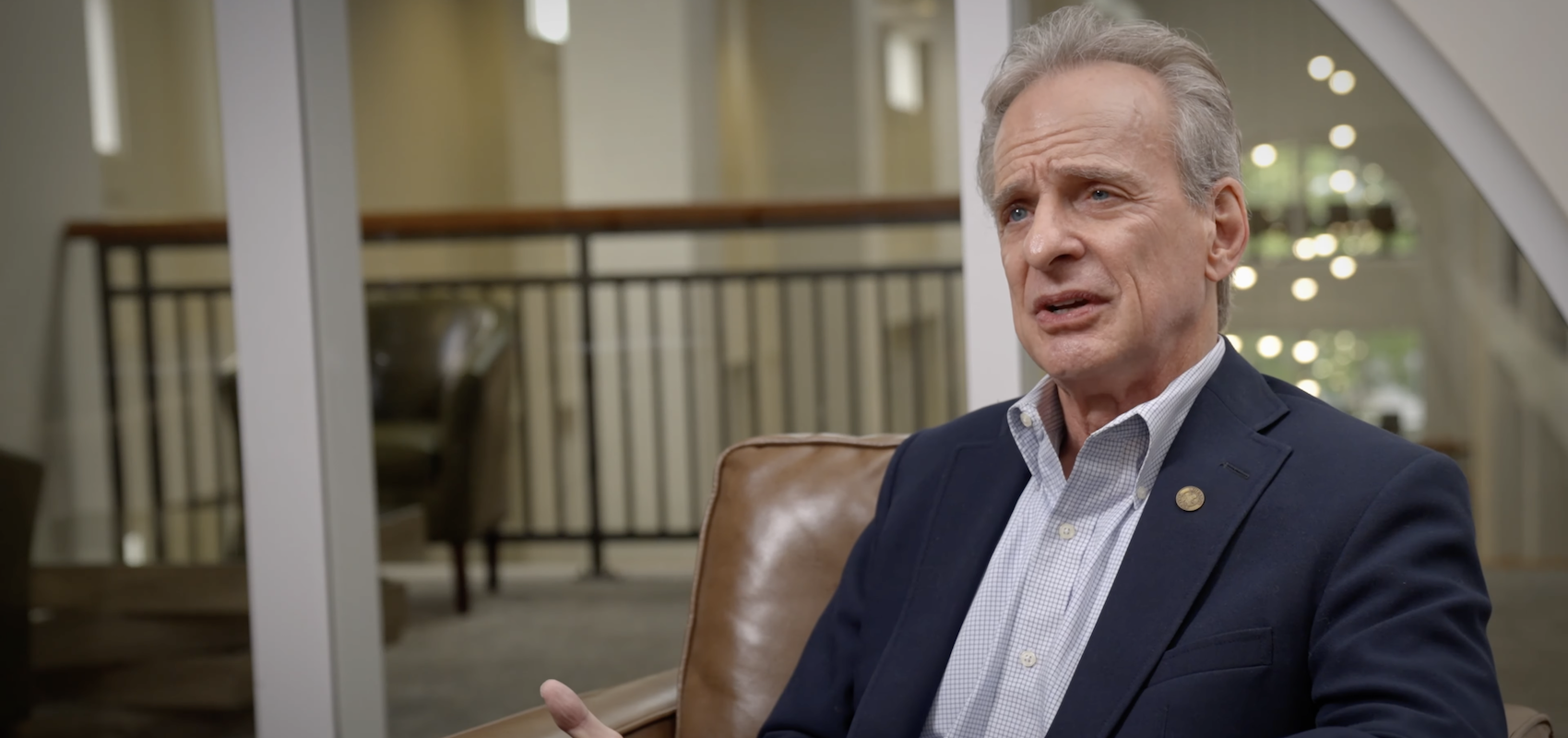
William Lane Craig has recently caused some consternation by saying he does not confess the faith of the Nicene Creed. The reaction is understandable. Nicene orthodoxy, after all, is the faith confessed by Catholics, Orthodox, and most Protestant traditions going back to the sixteenth-century Reformation. And here is a prominent philosopher and apologist in the American evangelical tradition who does not share the same faith. Yet perhaps the most important thing to understand is why many evangelicals do not share the consternation.
Of course, most of the Creed—its belief in the Trinity, creation, incarnation, resurrection, and so on—does pass muster with Craig. And he has no objection to what was originally its most controversial phrase, affirming that the Son of God is “of one essence” (homoousion) with the Father. He clearly agrees that there can be only one divine essence. The sticking point rather is the Nicene teaching that the Son is “eternally begotten of the Father” or (in a more precise rendering of the Greek) “begotten from the Father before all ages.”
No doubt part of the problem for many evangelicals is that “begotten” is no longer a familiar word. In its ordinary literal sense, it refers to what happens among the birds and the bees: fathers beget, mothers conceive, and offspring are born. Clearly this ordinary way of relating a father and a son has to be drastically modified in order to apply to the Father begetting his eternal Son “before all ages.” This is an origination that is not a process in time; it is independent of the successiveness of one age after another (like the era of Charles III succeeding the era of Elizabeth II).
The Nicene Church Fathers emphasized the timelessness of the begetting of the Son by rejecting any teacher who would say of him, “there was once when he was not” or “he came to be from nothing.” What’s more, they insisted that the way the Son originates from the Father in eternity is not something we can comprehend. Hence when John Chrysostom, for example, preached a famous series of sermons on the incomprehensibility of God, what he had in view was the eternal begetting of the Son.
This is typical of the Nicene tradition, which finds the mystery of the Trinity not in a puzzle about arithmetic (it’s worth noting that the Creed never uses the word “three”) but in relations of origin: the Son begotten, the Spirit proceeding, the Father having no origin at all. You can certainly say that God is “three in one,” but that tells you almost nothing about the Trinity. After all, you can say the same thing about three peas in a pod.
So how does the eternal begetting of the Son become a sticking point? Craig is on record arguing that, contrary to the intention of the Nicene Fathers, it leads to subordinationism. His reasoning is that if the Son derives his being from the Father, then he must be ontologically inferior to the Father. This is also the reasoning of Arius, the great arch-heretic rejected by the Council of Nicaea in 325, at the very beginning of the Nicene tradition.
To avoid Arius’s conclusion, Craig thinks we must deny the premise that the Son is begotten from the Father in his divine nature. Nicene theologians, on the contrary, took the other logically possible route to rejecting Arius’s conclusion: They denied that a derived being is an inferior being. For example, a human son is no less human than the father who begot him or the mother who conceived him. Thus in the century after Nicaea the Council of Chalcedon could proceed to say: The incarnate Son of God has the same human essence as us, and the same divine essence as the Father. He receives the one in his temporal birth from his mother Mary, and the other in his eternal begetting from God the Father.
A few decades after Nicaea, Nicene theologians debating an Arian named Eunomius made a crucial logical clarification. The oneness of the divine essence means that Father, Son, and Holy Spirit share equally and fully in all the divine attributes (eternity, omnipresence, omnipotence, and so forth). But being unoriginated or underived is not one of these attributes; it does not belong to the divine essence but is unique to the Father.
This clarification opened the way for the Nicene teaching that Father, Son, and Holy Spirit are distinguished from one another by relations of origin: the Father unoriginated, the Son begotten, the Spirit proceeding. It also meant that the attribute later called “aseity” (from Latin a se, meaning to have being “from oneself”) is characteristic of the Father but not the Son or the Holy Spirit. Craig’s departure from Nicene orthodoxy stems logically from his insistence that the Son and the Spirit must have the same aseity as the Father.
The clarifications established as orthodoxy in the century or so after Nicaea are apt to be unknown in traditions that suppose that “three in one” is nearly all that needs to be said about the Trinity. The official faith statements of many evangelical organizations, for example, announce that God is “three persons in one divine essence.” The phrase is too vague to be heretical, but it does unhelpfully suggest a picture of the divine essence as a kind of container for three unrelated individuals.
It’s easy to arrive at this picture if your trinitarian doctrine includes the homoousion without the relations of origin such as begetting. The picture may seem good enough if you’ve forgotten what the doctrine of the Trinity is for, and what it has to do with Christ and salvation and the Christian life. And that’s the setting in which a prominent philosopher may reject Nicene orthodoxy without causing too much consternation.
The deficit in trinitarian faith that afflicts American evangelicalism is no small thing. It results in preaching that pictures Jesus as the way to God, while hardly noticing that Jesus is God already with us, giving us not only salvation but God himself in his own flesh. But there is a younger generation of evangelical theologians, most notably Fred Sanders and Matthew Barrett, who are working hard to make up that deficit. May their tribe increase.

YOU MIGHT ALSO LIKE
The Boys on the Brink
In the latest installment of the ongoing interview series with contributing editor Mark Bauerlein, Leonard Sax joins…
Serial Liar, Serial Comma
How would you write a public letter that you know will become front-page news? Would you write…
Vatican II Didn’t Kneel to Modernity
In his weekly catecheses on Vatican II, Pope Leo is now discussing Gaudium et Spes, one of…
