
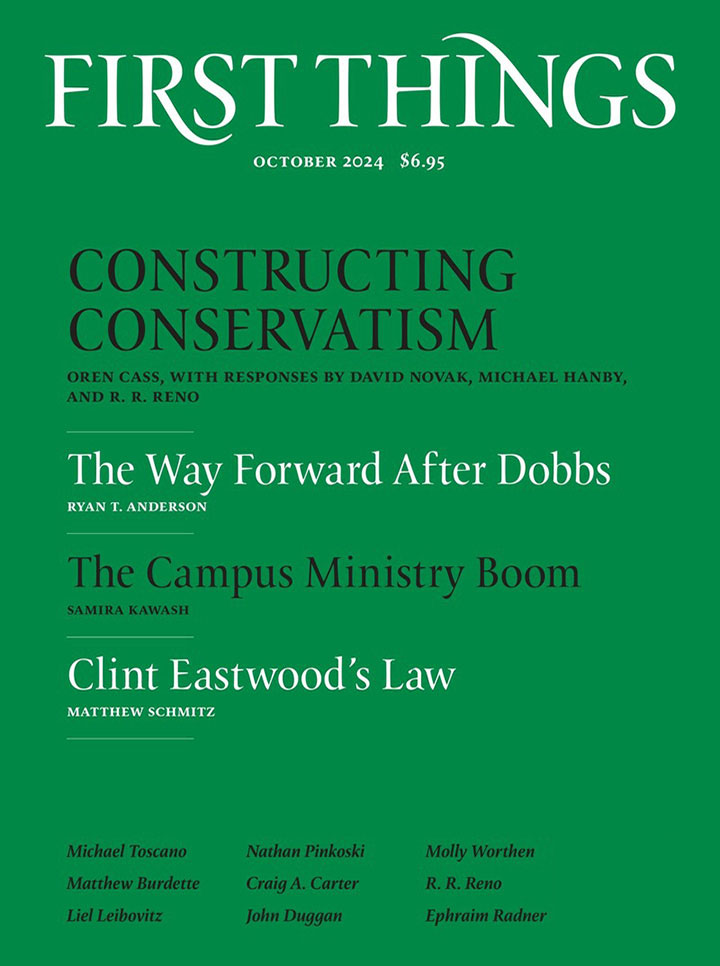
In this issue, we published the winner of the first annual First Things poetry prize, “Two Owls” by Josiah A. R. Cox. Second place went to Ryan Wilson for his sonnet “Gather Ye,” also published in this issue. Congratulations to both poets. Our founder, Richard John Neuhaus, recognized the significance of literary art. The politics of politics is an important affair, to be sure. But we can only vote for what we can imagine, which means that any publication with political interests (and First Things certainly has such commitments) worth its salt must leaven and refine our imaginations. Many thanks to the Tim & Judy Rudderow Foundation for its generous support in establishing this new prize.
Henri de Lubac (Paradoxes of Faith): “When the world makes its way into the Church itself, it is worse than just being the world. Of the world it has neither the greatness in its illusory glamor nor that sort of loyalty it has in mendacity, ill nature and envy, which are taken as granted as being its law.” Again: “When the ecclesiastical world is worldly, it is only a caricature of the world. It is the world, not only in greater mediocrity, but even in greater ugliness.” Yet again: “There is nothing more demanding than the taste for mediocrity. Beneath its ever-moderate appearance, there is nothing more intemperate, nothing surer of its instinct, nothing more pitiless in its refusals. It suffers no greatness, shows beauty no mercy.”
Sigrid Undset: “I have the sense that I am seeking my sea legs all alone in a world full of currents, and I long for a fixed point of reference that doesn’t alter or slide eel-like away; I long for the old Church on the rock, which has never claimed that a thing is good because it is new or good because it is old, but which, on the contrary, takes for its sacrament wine, which is at its best old, and bread, best fresh.”
A prescient Edward Luttwak writing in 1994:
What does the moderate Right—mainstream US Republicans, British Tories and all their counterparts elsewhere—have to offer? Only more free trade and globalisation, more deregulation and structural change, thus more dislocation of lives and social relations. It is only mildly amusing that nowadays the standard Republican/Tory after-dinner speech is a two-part affair, in which part one celebrates the virtues of unimpeded competition and dynamic structural change, while part two mourns the decline of the family and community “values” that were eroded precisely by the forces commended in part one. Thus at the present time the core of Republican/Tory beliefs is a perfect non-sequitur. And what does the moderate Left have to offer? Only more redistribution, more public assistance, and particularist concern for particular groups that can claim victim status, from the sublime peak of elderly, handicapped, black lesbians down to the merely poor.
♦ James Pogue penned an interesting report on the thinking of Connecticut senator Chris Murphy (“The Senator Warning Democrats of a Crisis Unfolding Beneath Their Noses,” New York Times, August 19, 2024). Here’s the senator’s assessment after spending the last two years observing debates in conservative circles, some conducted by anonymous Twitter provocateurs: “What I discovered, much to my chagrin, was that the right—some really irresponsible corners of the right—were having a conversation about the spiritual state of America that was in ways much more relevant than conversations that were happening on the left.” In discussions with Pogue, Murphy expressed worries (in Pogue’s words) “that the New Right was offering two things mainstream Democrats were not: a politics that spoke directly to feelings of alienation from America as we know it today and a political vision of what a rupture with that system might look like.” That’s exactly what we strive to offer in First Things.
♦ John Henry Newman: “I would rather have to maintain that we ought to begin by believing everything that is offered to our acceptance, than that it is our duty to doubt everything.” Newman is surely right. Newman is not advising blanket credulity. He is formulating a provocative juxtaposition of extremes so as to illuminate the foundation for a life of reason. To believe everything means taking on a great deal of falsehood, but truth as well. The opposite, the Cartesian approach, which so many presume to be the high road of reason, avoids error—at the expense of taking in truths. Better a credulous mind that adheres to truth at the cost of superstition, errant opinion, and foolishness than a mind too fearful of falsehood to close upon truth.
♦ Newman on the same theme, this time framed in terms of Christ’s return, which Scripture warns us will be sudden: “True it is, that in many times, many ages, have Christians been mistaken in thinking they discerned Christ’s coming, but better a thousand times to think Him coming when he is not, than once to think Him not coming when He is.” Where is the foolishness? Is it to be found in the pious man who reads the signs of the times and anticipates Christ’s return? Or in the man who notes the many false predictions of past believers and shuns the disposition of anticipation? “Now he must come one day, sooner or later,” Newman continues. “Worldly men have their scoff at our failure of discernment now; but whose will be the want of discernment, whose the triumph then?” Newman’s logic echoes Pascal’s wager. What could be more consequential than to meet our Lord’s return with an upturned heart? To be wrong a thousand times is as nothing compared to being right when everything is at stake.
♦ The early-twentieth-century Dominican Thomist A. G. Sertillanges makes a similar point: “We must give ourselves from the heart if truth is to give herself to us,” for “truth serves only her slaves.” Sertillanges again: “Truth visits those who love her, who surrender to her.” Pious acceptance is the foundation of truth-seeking, not today’s pseudo-virtue, “critical thinking.”
♦ I draw the Sertillanges quotes from The Intellectual Life: Its Spirit, Conditions, Methods. This wonderful book, which remains in print, should be read by anyone who wishes to bring into his life the discipline of serious reading and reflection.
♦ An astute observation by Mike Woodruff: “Modern society lacks a term for sin, so people are categorized as evil.”
♦ Adrian Pabst meditating on the West’s perverse combination of moral and spiritual aggression and disarmament (“Against the New Barbarisms,” Compact):
Rather than a productive critical reassessment of its past, the West now risks a suicidal betrayal. Parts of the elites and the population seem to hate the West more than its enemies, to the point of believing that sexual minorities should support Hamas. Protesters blame all evils of the world on the West while singing the praises of Hamas terrorists and their barbarous killings of innocent Israeli citizens—viewed as legitimate targets, just because they are all deemed to be “colonial settlers.” Western self-loathing is no less nihilistic than the barbarianism it legitimates.
♦ Aleksandr Solzhenitsyn (from one of his characters in In the First Circle): “Prosperity breeds idiots.”
♦ At times I feel dispirited. Dobbs exposed the extent of popular support for abortion. Legalized marijuana fills the streets of New York with the stench of weed. Wars grind on in Ukraine and Gaza. Illegal immigrants flow across the border, in spite of popular opposition. When I’m oppressed by the thought that mere anarchy is loosed upon the world, I return to another one of Solzhenitsyn’s insights: “It is up to us to stop seeing Progress (which cannot be stopped by anyone or anything) as a stream of unlimited blessing, and to view it rather as a gift from on high, sent down for an extremely intricate trial of our free will.” The same holds for Regress. Let’s stop wringing our hands and do what we can and must, leaving the ultimate disposition of the affairs of men in God’s hands.
♦ In my meditations above, I commend the phenomenon of cultural Christianity—and suggest that it’s likely to reflect a growing cohort of fellow travelers. If you know someone in this tribe of unbelieving, Christian-friendly dissidents from the Rainbow Reich, please give that person a gift subscription to First Things.
♦ Many thanks to Ramona Tausz for seven years of excellent editorial work at First Things. Ramona started as a junior fellow in 2017 and, after two years in that role, stepped up to become an associate and then deputy editor. For many years, she oversaw our web publications. At the opening of his 2023 Erasmus Lecture, Carl Trueman, a regular columnist, singled out Ramona as an editor who unfailingly made his writing clearer, sharper, and more penetrating. He was right to do so. Ramona has been a great asset to our editorial team. We will miss her talent—and her Missouri Synod Lutheran sangfroid.
♦ We have added two new junior fellows to the First Things staff. Jacob Akey is a graduate of Saint Anselm College. Germán Saucedo comes to us from Mexico City, where he recently completed a degree in law at Universidad Panamericana.
♦ Claire Giuntini has served as a junior fellow and assistant editor. She is taking a new role at First Things as director of the Editor’s Circle, our faithful company of supporters who contribute $1,000 or more each year.
♦ Our annual Intellectual Retreat in early August was a smashing success. Justin Shubow delivered a fine lecture detailing the good, the bad, and the ugly in America’s civic architecture. Eighty participants spent a day discussing faith and civic responsibility, a timeless topic that is especially timely right now. Brian Williams and his team of seminar leaders from Templeton Honors College at Eastern University led the discussions with expert skill. Sohrab Ahmari, Mark Bauerlein, and your faithful scribe commented and opined during a concluding panel discussion of the retreat’s themes. A special thanks goes to Taylor Posey, who designed a handsome volume of assigned readings.
♦ First Things devotees are reminded that our annual Erasmus Lecture is scheduled for Monday, October 28 at 6 p.m. (location: New York’s Union League Club). Paul Kingsnorth will deliver this year’s lecture: “Against Christian Civilization.” Visit our website to register for tickets.
♦ Erasmus festivities include a poetry reading on the Sunday before Paul Kingsnorth’s lecture (October 27). Our poet this year will be Adam Kirsch, poetry editor of the New Criterion. The reading begins at 5 p.m. and will take place at the First Things office: 9 East 40th Street, 10th Floor.
♦ The ROFTers group in El Paso, Texas is looking for new members. To join, contact Rene Nevarez: nevarez77@sbcglobal.net.
Stuart Atias would like to form a ROFTers group in the Mid-Suffolk area of Long Island. Contact him (satias1003@gmail.com), and become a founding member!
Dear Reader,
Can I be direct with you?
War abroad. Socialists on the rise. AI upending human life. Endless uproar online. The modern attention economy doesn’t want readers — it wants users enslaved to the tyranny of the present.
First Things is the antidote: literary excellence, timeless truths, and a fixed point of reference in a culture that has lost its bearings.
But we can’t do it without readers like you.
Our goal: Raise $150,000 by November 1 to sustain First Things in the year ahead.
Your gift anchors readers in the permanent things.
Make your Fall Campaign gift now using the button below.
If you have any questions or would like more information, please contact Giovanni Del Piero, Director of the Editor’s Circle, at gdelpiero@firstthings.com or 212-627-1985.


YOU MIGHT ALSO LIKE
Three TikToks in a Trench Coat
On today’s episode, Meagan O’Rourke joins Virginia and Germán. Reporting on Gen-Z trends has become trendy. It’s…
The Cold Beauty of Jan Morris
Jan Morris (1926–2020) was a writer of astounding gifts who not only recorded history but made it.…
The Survival of Evangelicalism
In the latest installment of the ongoing interview series with contributing editor Mark Bauerlein, Bonnie Kristian joins…
