
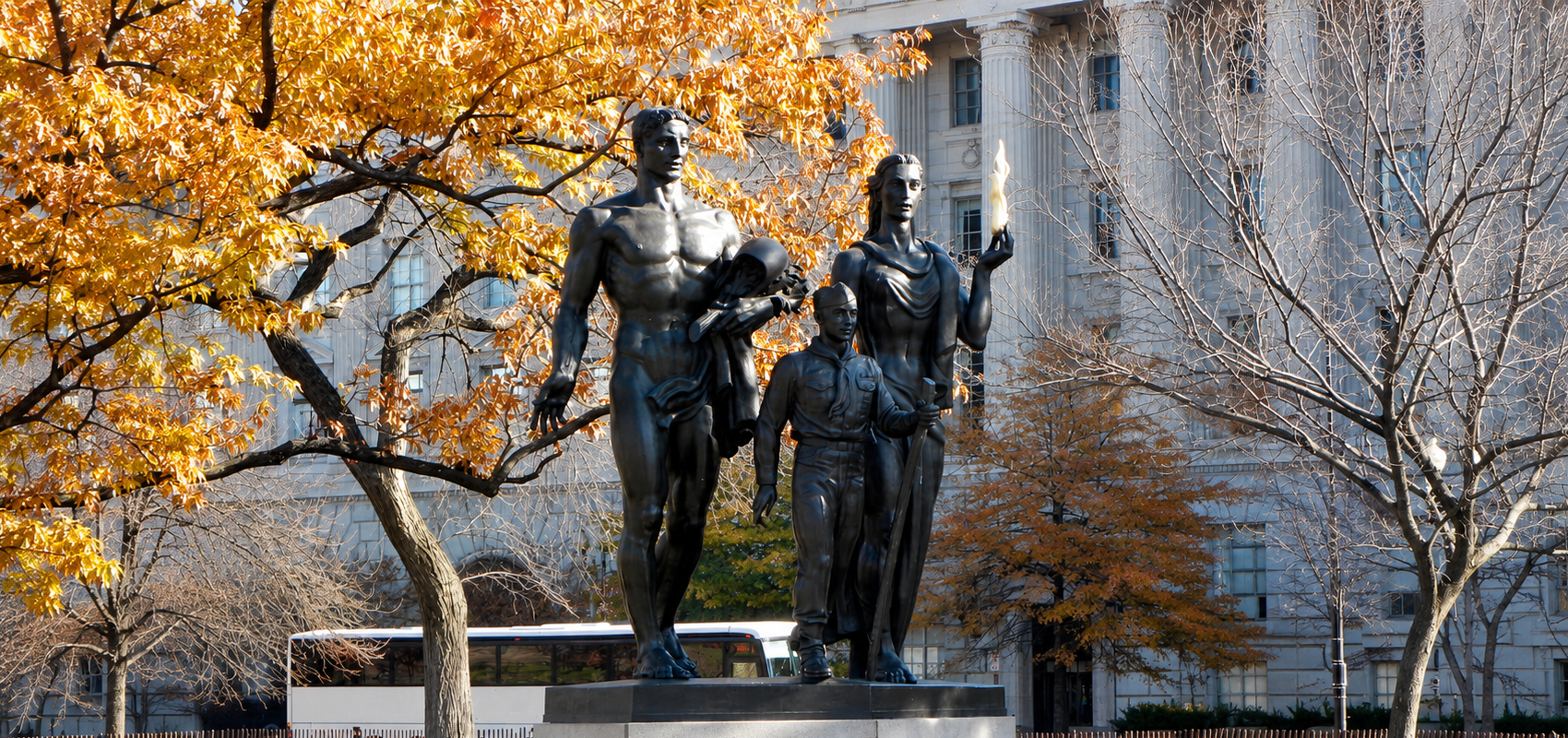
My six-year-old son wants to join the Scouts, but I have mixed feelings. As an Eagle Scout, I am sympathetic to his attraction to pocketknives, campfires, the fellowship of boys, and the great outdoors. My own life traced a more or less direct route from the parochial Boy Scout troop to a commission in the marines. The faith I received as a boy, reinforced in scouting, stuck. The Scouts served generations of American men well—me among them. But I’m unsure of Scouting America’s value for my own son.
For most of its history, the Boy Scouts of America—Scouting America’s predecessor—was more than a recreational program with outdoor branding. It was a character movement with an avowedly religious grammar. The movement’s British founder, Robert Baden-Powell, rejected the modern custom of regarding faith as just one among many dimensions of life: “There is no religious side to the [scouting] movement. The whole of it is based on religion.” Baden-Powell’s Scout Oath requires a boy to pledge “on [his] honour” to do his “duty to God,” to serve others, and to submit himself to a law not of his own making.
Baden-Powell, a career army officer, had seen combat in the Boer wars in South Africa. As his retirement from active service approached, he turned his attention to the future of British men. He was less than optimistic: “You cannot maintain an A-1 Empire on C-3 men.” He devoted the rest of his life to strengthening the men of Britain, to renewing the legacy of freeholder yeomen and their kin, both self-reliant and responsible for others, who through the centuries had helped make Britain the nation it was.
He knew that to make men he must begin with boys. In 1907, Baden-Powell held the first Scout camp at Brownsea Island with twenty-some boys of varying class backgrounds, a social oddity for the period. In 1908, he published his manual Scouting for Boys, which quickly became a bestseller. For Baden-Powell, the aim was to train boys in the “practice of Christianity in their everyday life and dealings, and not merely the profession of its theology on Sundays.” The scouting movement was born.
Across the English Channel, scouting was taken up by French Protestants, though the majority of its first boys were Catholics. The French Jesuit Jacques Sevin encountered the movement during summers in suburban London while perfecting his English. A student of pedagogy, he met with Baden-Powell in 1913 to explore scouting’s foundations and methods and discern what was “specifically British and [what was] simply human.” Despite French ecclesial suspicion of an English Protestant movement, Sevin and others were convinced scouting could be a powerful program for the formation of Catholic youth. Sevin resisted efforts to Gallicize it excessively, finding its methods needed little modification to help French Catholic boys “live as more perfect Christians.” Several troops were established in Paris, Nice, and elsewhere, and the movement grew rapidly in the ensuing years. By 1920, the French Catholic scouts were associated in a national federation. A similar trajectory unfolded in other European nations.
When the movement took institutional form in America in 1910, it did not dilute Baden-Powell’s religious emphasis. Indeed, American scouting added what became the twelfth Scout Law: “A Scout is Reverent.” Boys were instructed that a scout “is reverent toward God. He is faithful in his religious duties and respects the convictions of others in matters of custom and religion.” Scouting thus took on a distinctly American form, imbuing in boys a philosophy of religious liberty, with echoes of the First Amendment: conviction without coercion, pluralism without relativism.
James West, the first Chief Scout Executive in America, promoted the adoption of the twelfth Scout Law on the grounds that “there is nothing more essential in the education of American youth than to give them religious instruction.” Citing the Declaration of Independence, the Constitution, and the Founding Fathers, West urged that youth instruction should include reverence to God, fidelity to one’s religious convictions, and respect for the religious convictions of others. He saw these three as foundational to American democracy.
There followed a century of the Scouts’ adherence to religious values. Unshaken by the sexual revolution, Boy Scouts of America was unafraid to defend its religious character, and in 1998 the California Supreme Court upheld a local scout council’s decision not to allow a self-professed atheist to be a scout. In 2000, the Scouts defended their religious convictions, which included traditional sexual morality, all the way to the Supreme Court. A gay-rights activist had sued the Boy Scouts after a troop dismissed him from his role as assistant scoutmaster and revoked his membership. The Scouts and numerous amici noted with alarm the consequences to America’s religious bodies should they be forced to conform their tenets to government-imposed orthodoxy. In Boy Scouts of America v. Dale, a 5–4 Court recognized the Scouts as an expressive association protected by the First Amendment, holding that the state may not force a private moral community to accept leaders who would contradict the message it exists to teach. The decision anticipated the ministerial exception doctrine that was to be articulated in Hosanna-Tabor (2012).
Then came the tragedy. The Scouts won in the courtroom, only to surrender in the boardroom. In 2013, the organization reversed a 103-year-old rule proscribing open homosexuality among youth members. In 2015, under the leadership of former secretary of defense Robert Gates, it took the same step for adult leadership, voluntarily abandoning the policy it had vindicated at the Supreme Court. Gates defended these decisions as pragmatic, inevitable, and necessary for institutional survival. A decade and a half earlier, the Boy Scouts had told the Supreme Court that homosexual conduct was inconsistent with its fundamental moral code. Now, Gates reasoned, “the country is changing.” He published remarks downplaying the controversy and calling for unity.
A movement built on moral formation began to treat its moral framework as negotiable. Many scoutmasters and scouts—myself among them—took the move as a betrayal of the Scout Oath and Scout Law and left.
Not all, however, have rushed to snuff the wick. Earlier this year, Secretary of War Pete Hegseth announced an effort to renew the Pentagon’s relationship with Scouting America—a move akin to his re-grounding of the military chaplaincy in religious exercise. James West might see it as a bid for religious freedom, or Baden-Powell as an attempt to form the citizens required for the defense of a free nation. Hegseth may desire both. The military has a particular stake in Scouting America’s mission. Federal law names the Boy Scouts of America as eligible for unique endorsement and support from the armed forces—a rare statutory recognition that reflects scouting’s historical role in forming citizens with martial virtues. But such honors are predicated on continuity with the reasons for which they were first granted. Hegseth’s move seems to be testing the possibility that Scouting America can recover its moral and religious clarity.
If Scouting America is unable to restore the principles that once justified its special favor in law, it is fair to ask whether that favor should continue. Barring a reversal in its accommodation of today’s progressive and relativistic trends, Scouting America does not seem up to the task of reclaiming its moral convictions or the twelfth Scout Law’s embrace of religious liberty. If the Scouts are serious about Hegseth’s invitation to ressourcement, good. But realism is warranted.
Since 2015, Scouting America’s youth membership has fallen from more than 2.2 million to less than one million, despite the fact that it began opening groups to girls in 2018. The decline is lamentable. With Scouting’s membership plummeting, most youth don’t end up in a different character formation program—they end up in nothing. Scouting America’s reserves of religious and cultural capital cannot be replaced quickly at scale.
And yet there are hopeful signs for parents who want their boys to receive something of what the Scouts once gave. The classical school movement has marvelous potential to form youth in religion and virtue, though it lacks something of Baden-Powell’s vision—after all, a classroom is not the same as a camp. Though not approaching the scale of Scouting America, scouting alternatives inspired by Baden-Powell are growing. Religious families have founded faith-forward organizations, such as Trail Life USA, Troops of Saint George, the Federation of North American Explorers (which draws on Fr. Sevin), and other initiatives whose defining feature is not pinewood derbies but religious conviction and moral clarity. The scouting movement in Europe remains a stronghold of religious youth formation. Increasingly, moral formation is provided by institutions that are unafraid to exercise the freedom to impose moral and religious standards secured by Boy Scouts of America v. Dale. Whereas the Boy Scouts of America forsook their founding commitments, the new scouting movements are faithful to their convictions, regardless of whether “the country is changing.”
Scouting was not meant just to produce competent campers. It was founded to produce morally serious young people who understand duty as a matter of conscience before God and religion, and as a matter of service to neighbor and nation. I am grateful for the formation the Scouts gave me and sympathetic to parents who continue to rely on Scouting America, having judged their local troops able to impart to their children enduring truths and lasting virtues. They no doubt hope, as I do, that Scouting America will recover Lord Baden-Powell’s moral and religious confidence. If it can, the nation’s youth will be better for it. In the meantime, for my son, I’m exploring other trails.
Image by R01k, from Wikimedia Commons, via Creative Commons. Image cropped.
Dear Reader,
Can I be direct with you?
War abroad. Socialists on the rise. AI upending human life. Endless uproar online. The modern attention economy doesn’t want readers — it wants users enslaved to the tyranny of the present.
First Things is the antidote: literary excellence, timeless truths, and a fixed point of reference in a culture that has lost its bearings.
But we can’t do it without readers like you.
Our goal: Raise $150,000 by November 1 to sustain First Things in the year ahead.
Your gift anchors readers in the permanent things.
Make your Fall Campaign gift now using the button below.
If you have any questions or would like more information, please contact Giovanni Del Piero, Director of the Editor’s Circle, at gdelpiero@firstthings.com or 212-627-1985.

YOU MIGHT ALSO LIKE
Foucault’s Idol of Nothingness
Today marks the 100th anniversary of the birth of Michel Foucault. He was influential in his lifetime,…
Forget Odysseus. Aeneas Is the True American Hero.
Who is our Odysseus? Or more precisely, who is the most Odyssean hero of American film? Matt…
The Last Statesmen?
In the latest installment of the ongoing interview series with contributing editor Mark Bauerlein, Steven B. Smith…
