
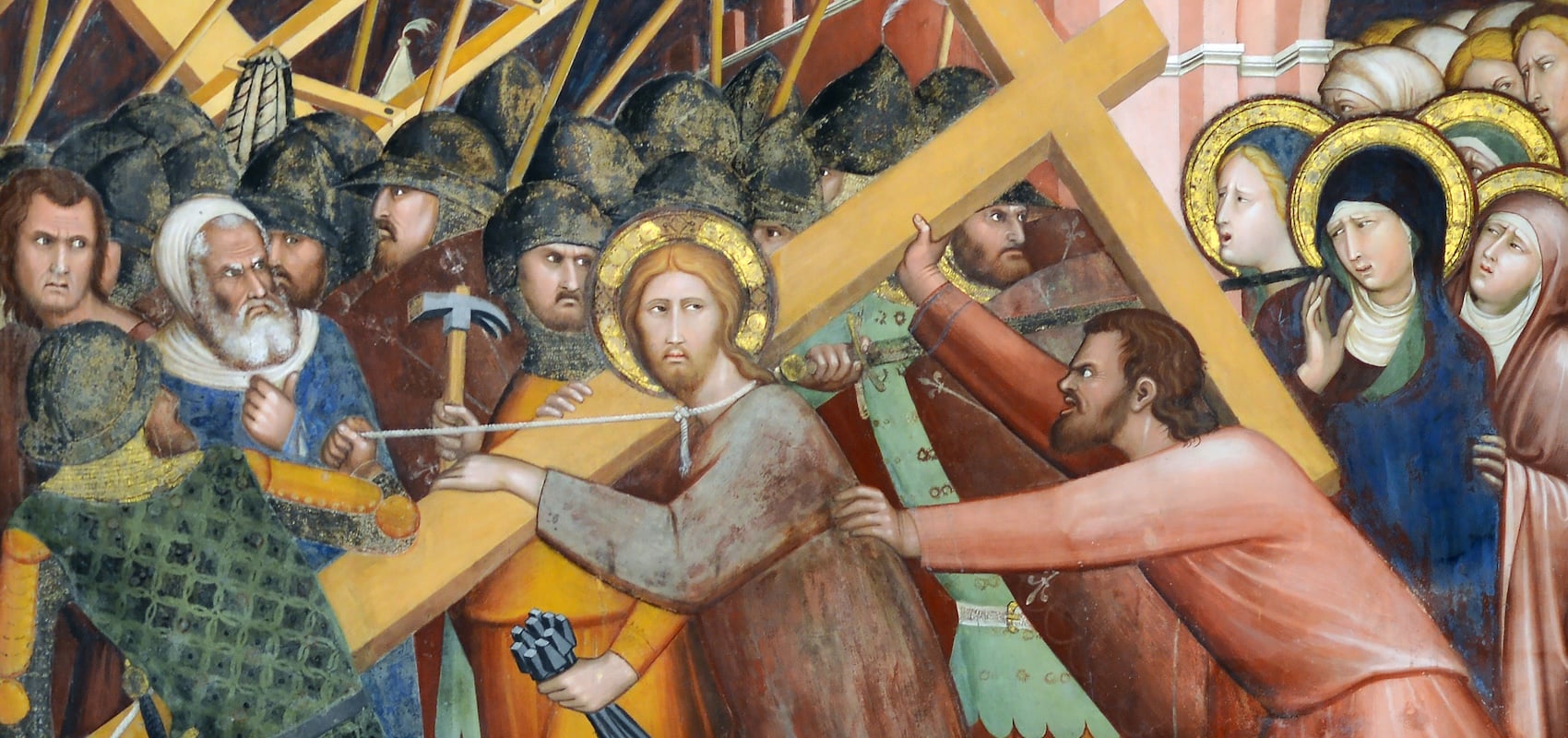
The Way of the Cross—and the third, seventh, and ninth stations in particular—has been an especially appropriate Lenten devotion this year. Every day, it seems, some new craziness erupts in the world, the country, or the Church. Every time we think we see rays of hope and possibility, we take another fall. So it’s good to remember this Holy Week, with Hans Urs von Balthasar, that we are empowered to get up and continue the journey because Christ got up from his three falls, which were caused by a spiritual weight infinitely greater than we are ever called to bear:
Our Lord was forced to suffer beyond human endurance. We truly understand this when we realize that in his extreme weakness he had to bear not only the burden of the cross but also of our sins—from Adam to the very last person. . . . We should not dwell too much on our own suffering which is nothing compared to what the Son of God suffered for us. Whenever we are able to share in a small way in Christ’s suffering, it is indeed a grace.
Three men I am privileged to call friends embody this grace of courageous suffering. They have configured their lives to the Way of the Cross in the sure hope that Calvary is the gateway to Easter and the new life in which we are enfolded in the divine love. Let me turn the balance of this Holy Week reflection over to them.
From Jimmy Lai, Catholicism’s most prominent prisoner of conscience, in a letter from the jail cell where he has spent over 1,800 days in solitary confinement:
Why is my mood not down at all, sometimes even quite lighthearted? I guess because so many people whom I have never even met have been praying for me is the main reason. I am always in God’s presence because of their prayers, I am so thankful . . . I am actually most grateful to God to have put me through this suffering in order for me to get closer to His presence. What a joy and treasure for this life and next. God’s action always confounds us but turns out to be marvelous for us.
From Bishop Erik Varden, O.C.S.O., in his recent presidential address to the Nordic Bishops Conference:
The world is caught up in a maelstrom of violence, fear, duplicity, and sheer madness. Yet over this chaos the Spirit hovers, not menacingly, but benignly. . . . Where worldly tendencies marked by sin pull what is whole apart, the Spirit unites . . . [and] by setting right boundaries, not by compromise. Our political and cultural climate is marked by fierce polarization . . . even among those who call themselves believers. But the Church must follow a different path . . . for it is her task to let God’s peace become flesh . . . Christ’s peace is no transaction, no pragmatic “deal.” It is the fruit of an all-encompassing sacrifice brought in love, accomplished once for all on Calvary, and renewed each day at our altars. What we must do now, above all, is to let that sacrifice work . . . in the confidence that God, through his holy Church, is still working out the salvation of mankind. God saves us from evil. He also saves us from ourselves.
And from Major Archbishop Sviatoslav Shevchuk, head of the Ukrainian Greek Catholic Church, at a recent priestly ordination in Rome:
Dear brothers and sisters in Christ, today I come to you from a freezing yet unbroken Kyiv as a witness to the resilience and steadfastness of our people . . . [many of whom are] without water, without electricity, without sanitation, without even the most basic means of survival. Yet I see the face of our people. Just last Sunday, a five-year-old boy shared with me his experience of living in Kyiv. I asked him, “Is it cold in your home?” He answered, “If I overcome the cold, Ukraine will win.” . . . I can testify that this extraordinary resilience and even joy, shown by people who face death each night, does not come from human strength alone. It is a gift of the Holy Spirit. Anyone with even basic Christian sensitivity understands that these people, this nation, are the least brothers and sisters of Christ, with whom He personally identifies Himself. . . . [And] what each of us has done for the least will become our passage to heavenly glory.
We adore you, O Christ, and we bless you, because by your holy cross you have redeemed the world—and given us the strength to rise from our falls as we embrace your injunction in Matthew 16:24: “If any man would come after me, let him deny himself and take up his cross and follow me.”
George Weigel’s column “The Catholic Difference” is syndicated by the Denver Catholic, the official publication of the Archdiocese of Denver.
Dear Reader,
Can I be direct with you?
War abroad. Socialists on the rise. AI upending human life. Endless uproar online. The modern attention economy doesn’t want readers — it wants users enslaved to the tyranny of the present.
First Things is the antidote: literary excellence, timeless truths, and a fixed point of reference in a culture that has lost its bearings.
But we can’t do it without readers like you.
Our goal: Raise $150,000 by November 1 to sustain First Things in the year ahead.
Your gift anchors readers in the permanent things.
Make your Fall Campaign gift now using the button below.
If you have any questions or would like more information, please contact Giovanni Del Piero, Director of the Editor’s Circle, at gdelpiero@firstthings.com or 212-627-1985.


YOU MIGHT ALSO LIKE
Why the Death Penalty Is a Sore Point for Papal Authority
Pope Leo XIV marked World Day Against the Death Penalty, observed on October 10, with the following…
Candace Owens and the Sin of Anti-Semitism
According to the online Encyclopedia Britannica, Sir Moses Montefiore (1784–1885) was “an Italian-born businessman who was noted…
The Myth of St. Francis
At the beginning of his 2020 encyclical, Fratelli Tutti, Pope Francis speaks of “an episode in the…
