
The mother of a fallen Ukrainian soldier cries into the crucified Christ depicted on her son’s burial shroud. It echoes the icons here at St. Mikhail Church, a short walk from central Kyiv. As the soldier’s burial shroud pays homage to his savior, the Ukrainian flag at the foot of his coffin honors his nation. Each day since Russia invaded Ukraine in 2022, the church has prayed for the Ukrainian army, their nation’s territorial integrity, and its suffering civilians.
Yet Ukraine’s government regards this church as a branch of the Russian hydra. I traveled to Kyiv to see if the allegations had any merit. Instead, I found a church committed to Ukraine’s defense but trapped in a cultural tug of war.
The very word Ukraine comes from ukraina, meaning “borderland” or “frontier.” As Orthodoxy has tied Ukrainian culture to the east for centuries, Ukraine’s Greek Catholic west has been its bridge to European civilization. “We know who we are only when we know who we are not and often only when we know whom we are against,” Samuel Huntington wrote in his monumental The Clash of Civilizations and the Remaking of World Order. In shaping a European identity, Ukrainian authorities have come to define it primarily by opposition to everything Russian, waging a nationwide campaign to exorcise the remnants of Russian civilization. Lev Tolstoy Square is now the Square of Ukrainian Heroes. Pyotr Tchaikovsky’s name was removed from the National Music Academy of Ukraine. Dostoevsky, Pushkin, and Tolstoy are being removed from libraries and school reading lists.
St. Mikhail’s has been forced to pay 200,000 Ukrainian hryvnias (approximately $4,500) monthly to the Ukrainian state since its protections as a religious organization were stripped away. When I visited, nuns hesitated to reveal their affiliation with the Ukrainian Orthodox Church (UOC) and its hierarch, Metropolitan Onufriy Berezovsky. I spoke to several people familiar with a Ukrainian Orthodox priest whose son was killed weeks ago in a drone attack on the frontline in Donetsk. The priest and his wife have taken it upon themselves to care for their son’s widow and year-old infant son. Yet they, too, are deemed pro-Moscow by the state.
Since 2022, the government of President Volodymyr Zelenskyy has seized church property and arrested clergy as part of a broader campaign targeting the UOC. It continues to label the UOC as the “Moscow Patriarchate,” despite the church declaring independence after the 2022 Russian invasion and condemning Moscow Patriarch Kirill’s support for the war. Instead, it has awarded these properties to the Orthodox Church of Ukraine (OCU). The OCU represents the culmination of decades of attempts to create a Ukrainian church hierarchy independent from Russian ecclesiastical authority, an achievement engineered by then-Ukrainian president Petro Poroshenko. Its recognition by Bartholomew, Ecumenical Patriarch of Constantinople, sparked Constantinople and Moscow’s ongoing schism. The government claims that only the OCU is truly loyal to the nation and alleges that the UOC’s prior ecclesiastical ties to Moscow make it a threat to national unity.
None of the dozens of UOC members I spoke with had positive words for Vladimir Putin. “The Ukrainian Orthodox Church has consistently supported and continues to support the territorial integrity of Ukraine,” UOC Metropolitan Onufriy declared even before the war began. Despite what the Ukrainian government asserts, the UOC’s official statements have consistently denounced Moscow Patriarch Kirill for his submission to Putin’s regime. Twice a day, every UOC church prays for peace. And, like the rest of Ukraine, UOC churches have been subject to attacks, blackouts, and the housing of refugees. When the war began in 2022, President Zelenskyy even publicly noted how Russian forces destroyed churches regardless of their status with the Moscow Patriarchate.
Despite this record, Zelenskyy’s government has defended its treatment of the UOC. Over two hundred cases have been opened against UOC priests, some of whom have remained in pre-trial detention for years. The government even revoked Onufriy’s Ukrainian citizenship. In two regions of Ukraine, UOC congregations have no property left to worship in, forcing these communities to secretly pray in homes. Erstwhile cheerleaders for the Ukrainian cause, from Pope Francis to the Biden administration, expressed concern over Ukraine’s conduct. In contrast, Ukraine’s Council of Religious Organizations unanimously endorsed the efforts.
Vitalii Kryvytskyi, bishop of the Roman Catholic Diocese of Kyiv-Zhytomyr, is a defender of the state’s tack. “Most of the church defends Ukraine,” he concedes, but it remains recognized as a subsidiary by Moscow. Nonetheless, he opposes the government’s seizure of the Lavra and other church property as unjust, comparing it to the actions of the Russian Empire toward the Catholic Church across centuries of Orthodox-led persecution. Ukraine lies on an “ideological, cultural, and political tectonic plate,” as Bishop Kryvytskyi put it, and “society has its head in the direction of Europe.”
Explaining their support for the ban on the UOC, a representative of the OCU told me, “This law in no way restricts the right to freedom of religion or prevents religious communities from carrying out their activities.” Yet UOC priests are prohibited from serving as chaplains, despite a pressing need to double the size of the Ukrainian military chaplaincy. Ironically, this has resulted in UOC priests being drafted to serve on the frontlines. While a grave violation of the Orthodox prohibition on priests bearing arms, the policy has also allowed draftees to offer spiritual assistance as de facto chaplains to the tens of thousands of UOC faithful in military service. Other UOC priests have volunteered in secret as unofficial chaplains. If discovered, their presence in a unit can lead to reprimands from the military’s top brass.
Archpriest Serhii Yushchyk serves closer to the frontline than any chaplain. Unable to take up arms out of priestly vows and barred from the chaplaincy, Yushchyk has served as an emergency medical responder. “We have wounded, dead, and missing priests of the UOC from among the ordinary infantrymen,” he told me. Yushchyk and others I spoke to all agreed that denominational factionalism evaporates when the bullets are flying. “There, everyone is on the same line of danger; everyone is united by the desire to survive and protect their homeland.”
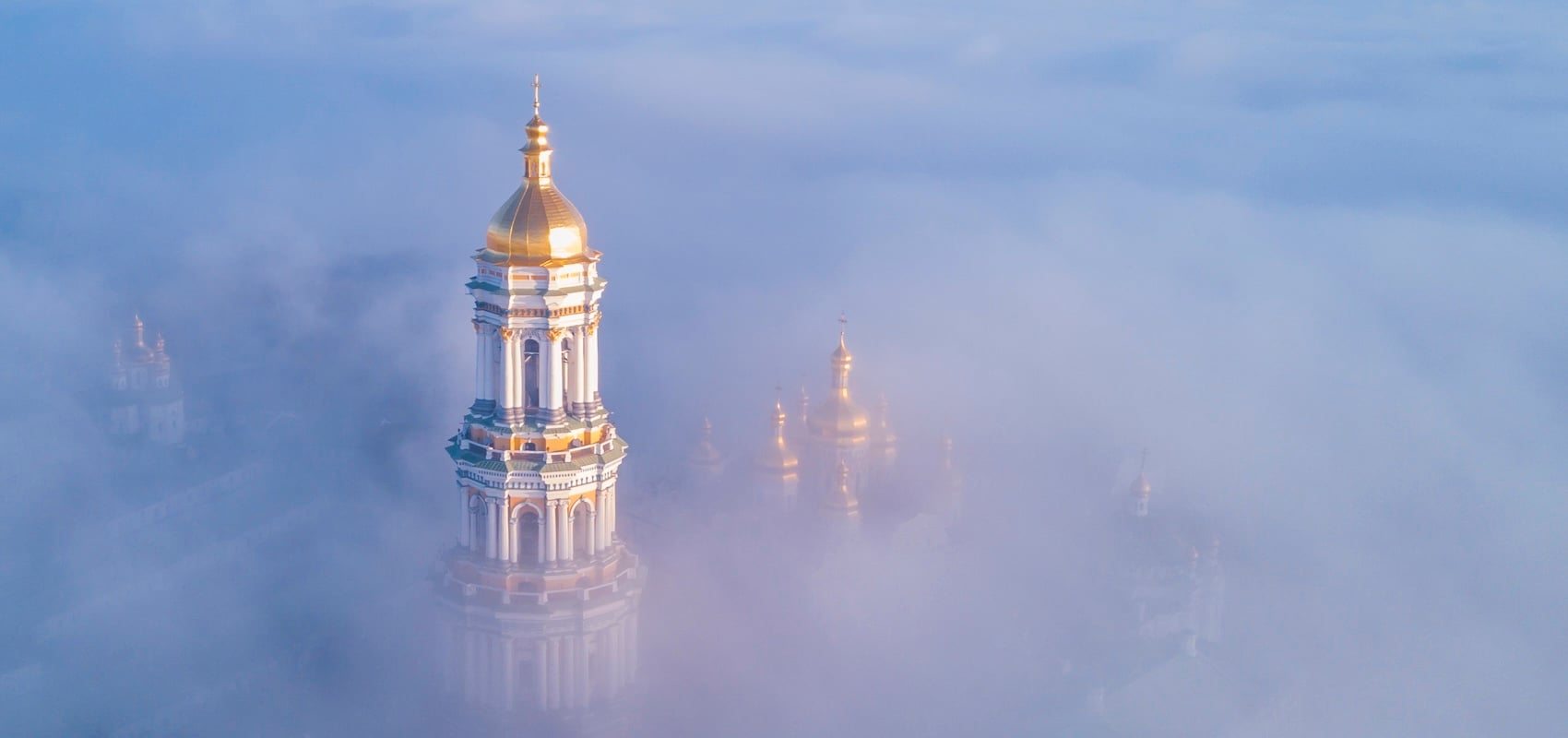
The conflict’s most disputed site is a civilizational fault line itself: the Kyiv Pechersk Lavra. The massive monastery was first built as the crown jewel of Christianity under the Kyivan Rus, whose contested legacy divides Russia from Ukraine today. While technically owned by Ukraine’s Ministry of Culture since the fall of communism, the Lavra was operated by the UOC under an indefinite lease.
When Russia invaded, Lavra’s monks brought humanitarian assistance near the frontline, fed soldiers alongside the poor, aided refugees fleeing Russian advances, and tended wounded Ukrainians. Yet the monastery’s abbot, Metropolitan Pavlo, failed to stop the singing of pro-Russian songs in November of 2022. He was later caught rejoicing over the Russian occupation of Kherson. After investigating Pavlo, the Ukrainian government went further, terminating the UOC’s lease and forcefully evicting all monks from the monastery. The premises were subsequently divided between the OCU and a state museum, leaving only three small chapels across the street in the church’s control.
Nikodim, one of the monks evicted from the Lavra, said the contested provinces of Donetsk and Luhansk are “obviously our [Ukrainian] territories.” He even conceded that some individual charges against priests were legitimate, as did every UOC clergyman I asked. But Nikodim represents the vast majority of the UOC in saying that “such acts as supporting the war and blessing of Russian weapons that kill innocent people in Ukraine,” as the Moscow Patriarchate does, “are obviously not Christian.”
The Moscow Patriarchate views the UOC’s institutional independence as a threat, clergy told me. In turn, Russian authorities have persecuted them fiercely. One UOC priest who was tortured by Russian authorities before leaving occupied territory noted that he was punished partly for commemorating Onufriy following the Ukrainian church’s denunciations of the Russian invasion. Onufriy has concurred, declaring “internal enmity is desirable for the enemy because it weakens us and gives him an additional chance for victory.” Metropolitan Kliment expressed concerns to me that Russian authorities intentionally made statements ostensibly favorable to the UOC in an attempt to encourage Zelenskyy’s persecution, dividing Ukrainian society and strengthening Putin’s casus belli.
In a sense, still, the UOC is pro-Russian—not the Russia of Putin, but the Russia of Dostoevsky. In the eyes of Metropolitan Onufriy, Russia’s crimes are “the sin of Cain.” He denounced the “fratricidal war” as vigorously as any other Ukrainian. But a brotherly national identity within Russian Orthodox civilization has become untenable in the face of Putin’s aggression.
Image by KyivMax via Creative Commons. Image cropped.

YOU MIGHT ALSO LIKE
Letters—November 2026
I appreciate J. H. H. Weiler’s desire for God’s mercy to be extended to Gentiles and his…
The Myth of St. Francis
At the beginning of his 2020 encyclical, Fratelli Tutti, Pope Francis speaks of “an episode in the…
Job and Her
It is said that Job lost everything, but she has lost more. All her possessions—the money, the…
