
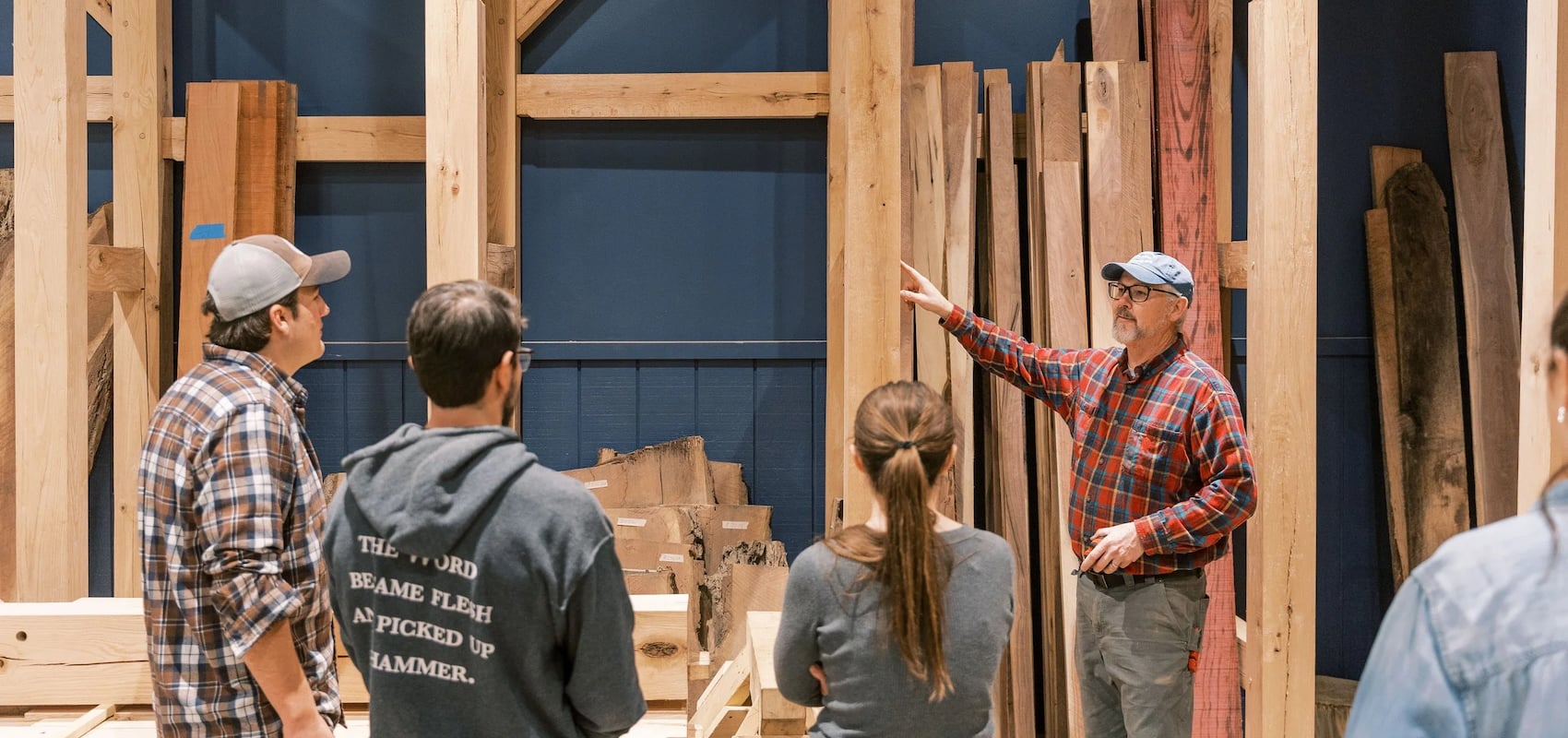
A year and a half ago, the College of St. Joseph the Worker, a new Catholic trade college in Steubenville, Ohio, opened its doors to its first students. Our facility was modest. For classrooms and offices, we shared space with the chancery of the diocese of Steubenville. We had a former print shop building refitted with carpentry equipment. We had purchased a couple of downtown homes and converted them into student dormitories. Our faculty and staff, however, were exceptional: people who were trying to build up the community with their whole being, as Catholics, scholars, entrepreneurs, tradesmen, husbands, parents, and friends. And we were convinced we had a good idea.
The divorce between the head and the hands has been terrible for people. It is analogous to the divorce between body and soul. As Christians, we find this divorce out of place in a religion where bodies are essential to worship and where God Himself became flesh. In education, we often talk about the “liberal arts,” unconsciously segregating the “servile arts” to other people—the servants. This is a modern mistake (and dare I also say an ancient one). But the medieval Christian educational tradition talked rather about the “manual arts,” which paired harmoniously with the more speculative arts. After all, God wedded the head with the hands in one body.
Since opening, we’ve had an eventful year and a half. Thanks to benefactors who believed in what we were doing, we acquired a main academic building—a former federal courthouse in downtown Steubenville. We purchased another workshop. We bought and began renovating future dormitories. Our first-ever students not only studied literature and history and Scripture, they helped rewire the lights, install the flooring, and build fire escapes for the incoming students’ future housing. They were proud to do it—proud to have carried the roofing and flooring that would shelter and support their future fellows.
Just last week, our college received a full-length profile in the New Yorker. Some people asked me why I thought the New Yorker—not normally inclined to give free publicity to Newman guide Catholic colleges—would feature our college so prominently, and be so generally positive in its coverage. Apart from the fact that our students will graduate without crippling debt, I have three answers to that question.
First, we are educating for a national need. All of our students will graduate with certification in plumbing, electrical work, carpentry, or HVAC. There is broad agreement that there is a need for workers with these skills. We are working to achieve a recognized public good: more tradesmen. And not just with a focus on quantity, but on quality as well, filling jobsites with laborers able to lead.
Second, we are providing hope and dignity in a place that has little. The Ohio Valley is one of the most depressed areas of the United States. In downtown Steubenville, where our campus is, the median household income is under $15,000 per year. We have selected the dilapidated downtown because here there is a transformational difference that we can offer for the good of neighbor and friend. All Americans love a comeback story; we’re seeing that the Ohio Valley has one.
Third, we are not only trying to educate our students; we are trying to give them an opportunity to do something good, something they can be proud of. We are importing students from across the country who are intellectually elite and academically advanced and placing them in the very context that demands them to see that their talents must be developed for the sake of others. We cultivate their minds to identify the good, and we cultivate their hands to be able to deliver it. Students are not just seeking a lucrative career but are empowered to better their communities. And it is working.
I was happy that the reporter for the New Yorker, Emma Green, spent a great deal of time with our students, whom she found “shockingly wholesome.” “It was all almost too much to believe,” she wrote, “except that the students seemed so earnest about their faith.” We know that young people want to do something for God today: They want to see that their education can empower them to help another person today. Giving young people not just an education but a workshop where they can do things for others feeds and inspires faith. We believe that the Word became flesh and picked up a hammer—that Christ himself taught this way. Our goal is someday to have a college of three hundred students, all of whom will treat Steubenville as a place where they learn to do good work. Then they will go home and do the same for their hometowns. We believe that insofar as we remain true to this vision, we will have a chance to earn people’s respect.
Christianity should shape the public square in America. But that does not only mean politics. The public square is also a place of commerce, a place of trade. Christian businesses are places where our skill, integrity, and commitment can be seen and evaluated by all. “I will show thee my faith by my works” is Holy Writ. Christian civilization consists not only of priests and kings but also of guilds: craftsmen and artists, masters and journeymen. We can do a little bit of that work here in Steubenville.
Dear Reader,
Can I be direct with you?
War abroad. Socialists on the rise. AI upending human life. Endless uproar online. The modern attention economy doesn’t want readers — it wants users enslaved to the tyranny of the present.
First Things is the antidote: literary excellence, timeless truths, and a fixed point of reference in a culture that has lost its bearings.
But we can’t do it without readers like you.
Our goal: Raise $150,000 by November 1 to sustain First Things in the year ahead.
Your gift anchors readers in the permanent things.
Make your Fall Campaign gift now using the button below.
If you have any questions or would like more information, please contact Giovanni Del Piero, Director of the Editor’s Circle, at gdelpiero@firstthings.com or 212-627-1985.

YOU MIGHT ALSO LIKE
Candace Owens and the Sin of Anti-Semitism
According to the online Encyclopedia Britannica, Sir Moses Montefiore (1784–1885) was “an Italian-born businessman who was noted…
De Gaulle Triumphant
The Second World War left Europe invaded and ruined, divided between Soviet and American occupations. Hitler’s defeat…
Meet the Post-Religious Right
There have been many books written about the online right and the Trump movement, most by people…
