
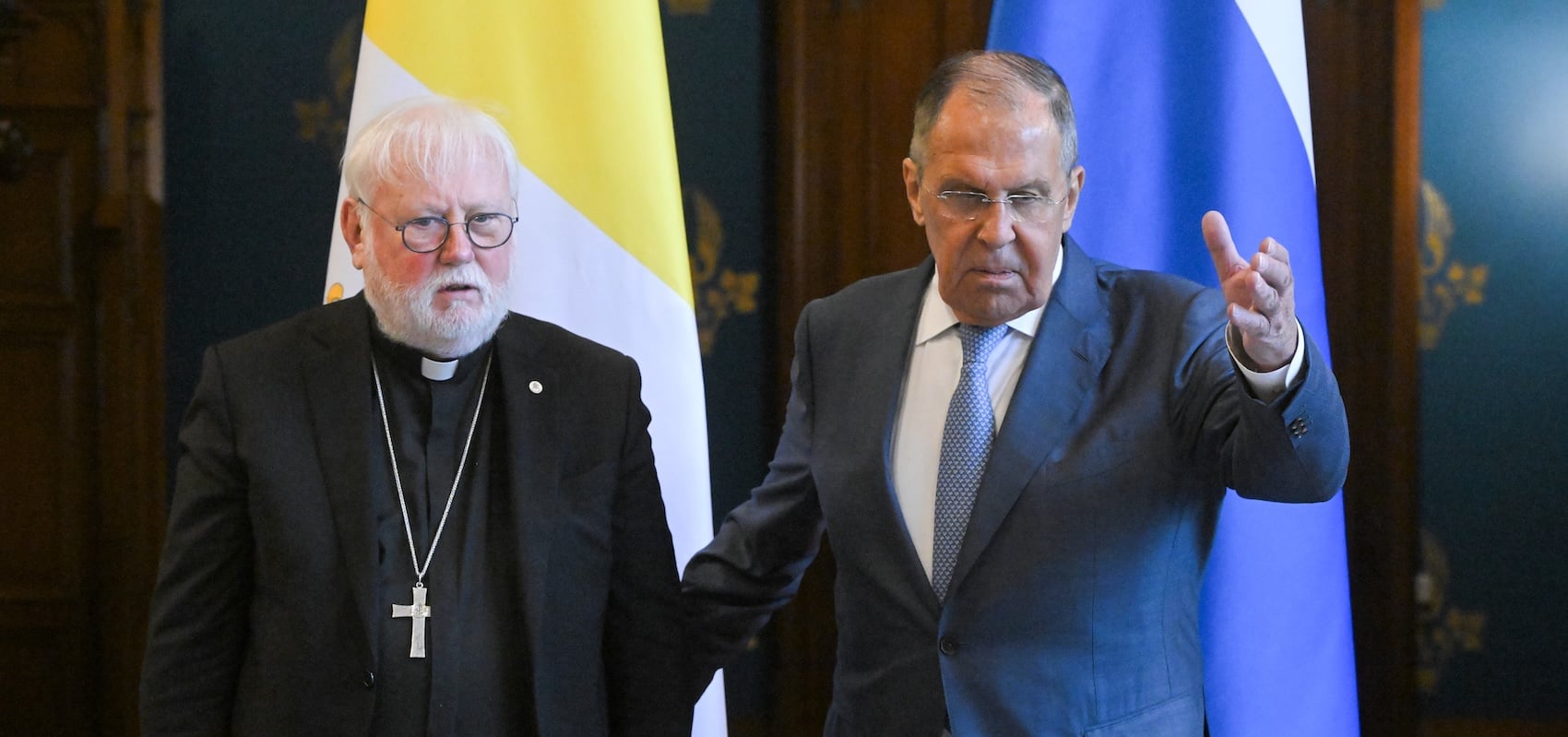
Archbishop Paul Gallagher, the Holy See’s “foreign minister” (Secretary for Relations with States and International Organizations, to use the official title), visited Moscow from August 24–28, meeting with senior officials of the Putin regime and the Russian Orthodox Church. Reactions to the visit were mixed.
A Ukrainian-American friend, who was in Ukraine at the time, found the visit “surreal”—perhaps because the Russians marked the archbishop’s diplomatic mission, not by any gestures toward peace, but by intensifying their murderous missile and drone strikes on civilian targets in Kyiv and other Ukrainian cities.
The head of the Ukrainian Greek Catholic Church, Major Archbishop Sviatoslav Shevchuk (whom the Russians would have assassinated had their blitzkrieg of Kyiv succeeded in February 2022), welcomed Archbishop Gallagher’s call for negotiations to end Russia’s aggression while describing the visit as akin “to a descent into Hades, when a sermon on the resurrection of the dead resounds from the depths of Hades.”
Russian foreign minister Sergey Lavrov was far more upbeat. In his remarks after meeting Archbishop Gallagher, Lavrov, according to an ACI Stampa story, “noted with satisfaction that, despite the profound changes that have taken place in the geopolitical context . . . relations between the Russian Federation and the Vatican continued to be marked by trust, friendship, and pragmatism.” Lavrov also said that he thanked his colleagues at the Holy See “for their balanced position on the situation in Ukraine and the surrounding areas.”
Lavrov is an experienced and polished liar, who ought not be believed if he announced that the sun will rise in the east tomorrow morning. Nonetheless, his choice of words was instructive, if only in demonstrating what he thought he could get away with in the presence of a very senior Vatican official. A changed “geopolitical context”? That sets a record for euphemism when describing Russia’s brutal war of aggression against Ukraine and its hybrid war against Ukraine’s European allies (finally acknowledged as such in early September by Germany’s interior minister). And what was that business about “pragmatism”? Was Lavrov suggesting that Holy See diplomacy is devoid of moral principle or foundation?
As for the Vatican’s “balanced position on the situation in Ukraine and the surrounding areas,” well, that was another tacit insult, suggesting as it did that Archbishop Gallagher, Cardinal Pietro Parolin (the Holy See’s secretary of state), and Pope Leo XIV do not understand who invaded whom in February 2022, and with what intent.
Vatican diplomacy must sometimes endure such shameless prevarication to achieve humanitarian ends, such as the release of prisoners of war or the return of Ukrainian children kidnapped by Russia. There is a cost to be paid for such forbearance, however, if the lies go unchallenged indefinitely.
Archbishop Gallagher also met with Metropolitan Antonij of Volokolamsk, responsible for the “external relations” (meaning both ecumenism and international relations) of the Russian Orthodox Church. In a Vatican News interview after his Russian sojourn, Gallagher said that “there is a very cordial, fraternal relationship” between “Metropolitan Antonij and the Holy See.” The archbishop acknowledged that “a different view remains on some questions,” especially about the international situation, “but at the same time we seek to encourage one another to follow the path of the Gospel,” so all in all, it was a “very encouraging meeting.”
Two and a half weeks before the Gallagher mission to Moscow, I published a Houses of Worship column in the Wall Street Journal, reflecting on a new book by Patriarch Kirill, head of the Russian Orthodox Church. In his book, Kirill defended Putin’s war on Ukraine in what can only be called heretical and blasphemous terms—which is not only my view, but that of Ecumenical Patriarch Bartholomew of Constantinople, first among equals in the leadership of Eastern Orthodoxy. And in that column, I noted the blindingly obvious: In dealing with Kirill, Vatican officials are not dealing with a religious leader but with a front man for the Kremlin who has subordinated his Church to Russian state power and betrayed the gospel in the process.
It seems highly unlikely that Metropolitan Antonij, who owes his position to Kirill, is of a different cast of mind than the patriarch. So just how is a “very cordial, fraternal relationship” possible under those circumstances? Doesn’t that very suggestion further forestall the day when a serious ecumenical theological conversation with Russian Orthodoxy is possible?
Today’s world is desperate for serious moral leadership: a leadership transcending “pragmatism” and speaking truth to power. That power of moral witness is the only real power the Holy See has in world politics. Roman thinking about Vatican diplomacy should begin with that fact, and nowhere else.
George Weigel’s column “The Catholic Difference” is syndicated by the Denver Catholic, the official publication of the Archdiocese of Denver.
Image by Sergey Guneev / Sputnik via AP. Image cropped.
Dear Reader,
Can I be direct with you?
War abroad. Socialists on the rise. AI upending human life. Endless uproar online. The modern attention economy doesn’t want readers — it wants users enslaved to the tyranny of the present.
First Things is the antidote: literary excellence, timeless truths, and a fixed point of reference in a culture that has lost its bearings.
But we can’t do it without readers like you.
Our goal: Raise $150,000 by November 1 to sustain First Things in the year ahead.
Your gift anchors readers in the permanent things.
Make your Fall Campaign gift now using the button below.
If you have any questions or would like more information, please contact Giovanni Del Piero, Director of the Editor’s Circle, at gdelpiero@firstthings.com or 212-627-1985.


YOU MIGHT ALSO LIKE
Why the Death Penalty Is a Sore Point for Papal Authority
Pope Leo XIV marked World Day Against the Death Penalty, observed on October 10, with the following…
Candace Owens and the Sin of Anti-Semitism
According to the online Encyclopedia Britannica, Sir Moses Montefiore (1784–1885) was “an Italian-born businessman who was noted…
How Sweden’s Immigrant Vote Toppled the Right
For decades, Sweden had perhaps the most open immigration policy and the strongest commitment to tolerance and…
