
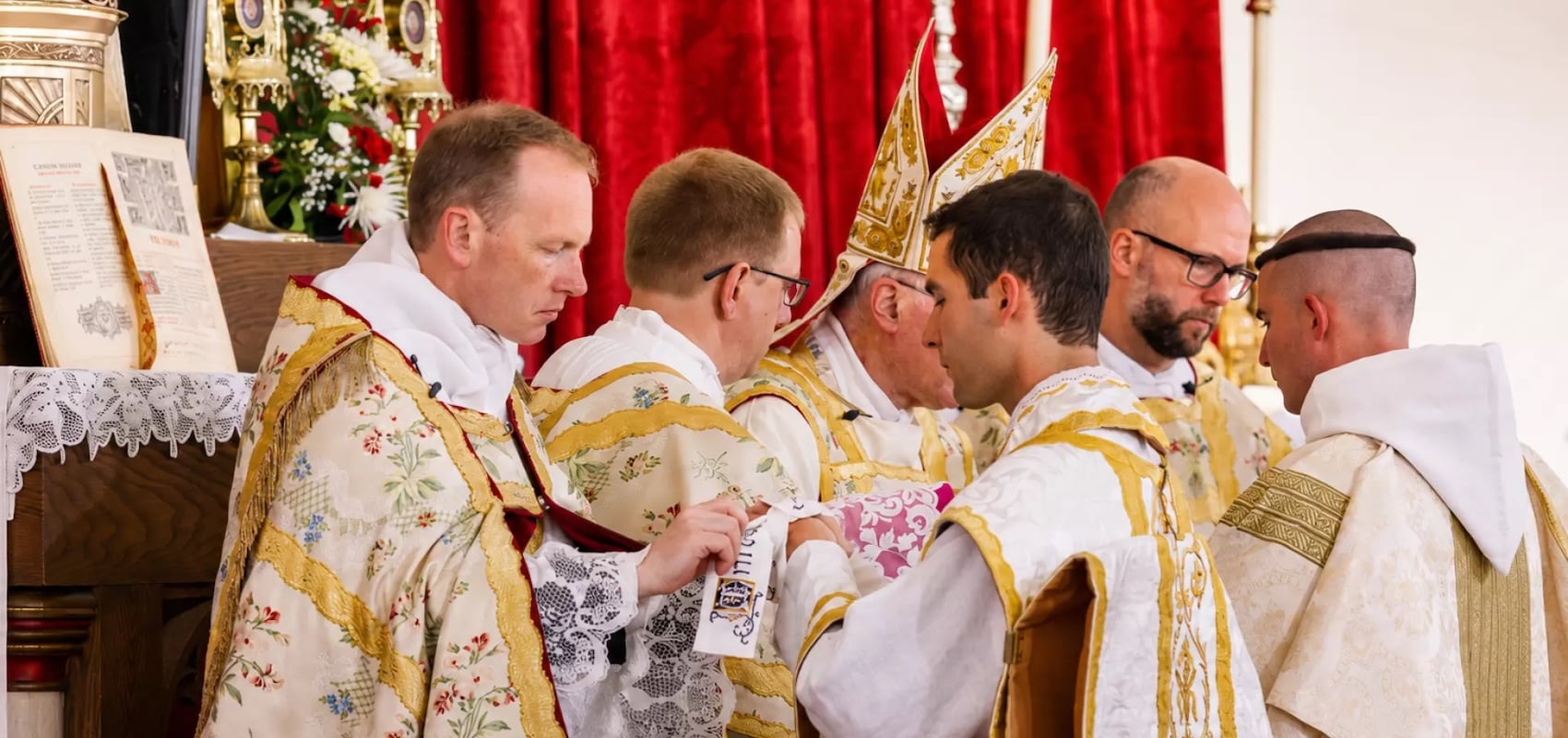
The Holy See has declared that, if the Society of St. Pius X (SSPX) proceeds with the ordination of bishops in July without a papal mandate, those involved in these illicit ordinations are automatically (latae sententiae) excommunicated—that is, excommunicated by their own acts. One may, indeed one should, hope that it does not come to that. But even if the SSPX hits the brakes at the last moment and doesn’t commit formally schismatic acts, the grave problem posed by the SSPX will continue.
That was made rather clear by the May 14 “Declaration of Catholic Faith Addressed to Pope Leo XIV,” in which the SSPX leadership declares, wittingly or not, that it does not share the faith of the Catholic Church.
Take the declaration’s very first sentence, in which the SSPX declares that “Our Lord Jesus Christ . . . rendered the Old Covenant definitively null and void.” That would have shocked St. Paul who, wrestling with the tangled question of the relationship between Israel’s election and the New Covenant incorporating the Gentiles into God’s plan of salvation, wrote, under divine inspiration, “They are Israelites, and to them belong the sonship, the glory, the covenants, the giving of the law, the worship, and the promises” (Rom. 9:4). Not “belonged,” but “belong.” Two chapters later, Paul insists that “as regards election they [the Jewish people] are beloved for the sake of their forefathers. For the gifts and the call of God are irrevocable” (Rom. 11:28–29). God does not repent of his promises, and the Old and New Testaments form a unity, as the Church has consistently affirmed for two millennia. The SSPX declaration denies this.
The declaration goes on to claim that “every man must be a member of the Catholic Church in order to save his soul, and there is but one baptism as the means of being incorporated into her. This necessity concerns the whole of humanity without exception and embraces without distinction Christians, Jews, Muslims, pagans, and atheists.” SSPX hell is thus quite well populated, and includes your Lutheran, Anglican, Jewish, Muslim, and nonbelieving friends and relatives. This, however, is precisely the extreme distortion of the old maxim extra ecclesiam nulla salus (no salvation outside the Church) for which Fr. Leonard Feeney was excommunicated in 1953, the theological ground for that sanction being laid by a 1949 statement of the Holy Office approved by Pope Pius XII.
Ironically, the SSPX declaration affirms that “the denial of even a single truth of the Faith destroys faith itself and renders radically impossible all communion with the Catholic Church.” Yet that is precisely what the SSPX does in declaring God’s promises to the Jewish people “definitively null and void” and by giving the most extreme possible interpretation to extra ecclesiam nulla salus. The SSPX thus contradicts the teaching of such giants as St. Augustine and St. Thomas Aquinas, the papal condemnations of Jansenism, and the teaching of Blessed Pius IX in Quanto Conficiamur Moerore on the availability of grace beyond the sacraments.
It has long been obvious that the root of the movement begun by Archbishop Marcel Lefebvre, which continues today in the SSPX, was not simply the archbishop’s rejection of the postconciliar liturgy, but a rejection of the Second Vatican Council’s teaching on the Church, salvation, religious freedom, Church–state relations, and the Church’s relationship to other religions. In this connection, it should be remembered that Archbishop Lefebvre was a supporter of Marshal Henri Pétain and the collaborationist Vichy regime in France during World War II: a regime that rejected modernity root and branch. Elements of Vichy eventually careened into a lethal anti-Semitism that grew in part from the rejection of Romans 9–11 that the SSPX declaration also rejects. To raise even the faintest echo of that tawdry history amid today’s anti-Semitic outrages is, to put it gently, frighteningly obtuse.
In May, a distinguished Italian historian noted, with reference to the episcopal ordinations the SSPX intends to carry out and the excommunications that will automatically follow, that “what is set to happen in July will not be the building of a bridge but the creation of a new chasm between [the SSPX world] and the Holy See.” True enough. That will only happen, however, if the 700+ priests, 200+ seminarians, and hundreds of thousands of laity involved in the SSPX continue to acquiesce, cult-like, in the heterodoxy of the SSPX leadership, whose claim to be the only true Catholics is what will detonate ecclesial bridges and create whatever sorry chasms follow. The people who find spiritual nourishment in SSPX Mass centers deserve better than that.
George Weigel’s column “The Catholic Difference” is syndicated by the Denver Catholic, the official publication of the Archdiocese of Denver.
Dear Reader,
Can I be direct with you?
War abroad. Socialists on the rise. AI upending human life. Endless uproar online. The modern attention economy doesn’t want readers — it wants users enslaved to the tyranny of the present.
First Things is the antidote: literary excellence, timeless truths, and a fixed point of reference in a culture that has lost its bearings.
But we can’t do it without readers like you.
Our goal: Raise $150,000 by November 1 to sustain First Things in the year ahead.
Your gift anchors readers in the permanent things.
Make your Fall Campaign gift now using the button below.
If you have any questions or would like more information, please contact Giovanni Del Piero, Director of the Editor’s Circle, at gdelpiero@firstthings.com or 212-627-1985.


YOU MIGHT ALSO LIKE
Why the Death Penalty Is a Sore Point for Papal Authority
Pope Leo XIV marked World Day Against the Death Penalty, observed on October 10, with the following…
Candace Owens and the Sin of Anti-Semitism
According to the online Encyclopedia Britannica, Sir Moses Montefiore (1784–1885) was “an Italian-born businessman who was noted…
The Myth of St. Francis
At the beginning of his 2020 encyclical, Fratelli Tutti, Pope Francis speaks of “an episode in the…
