
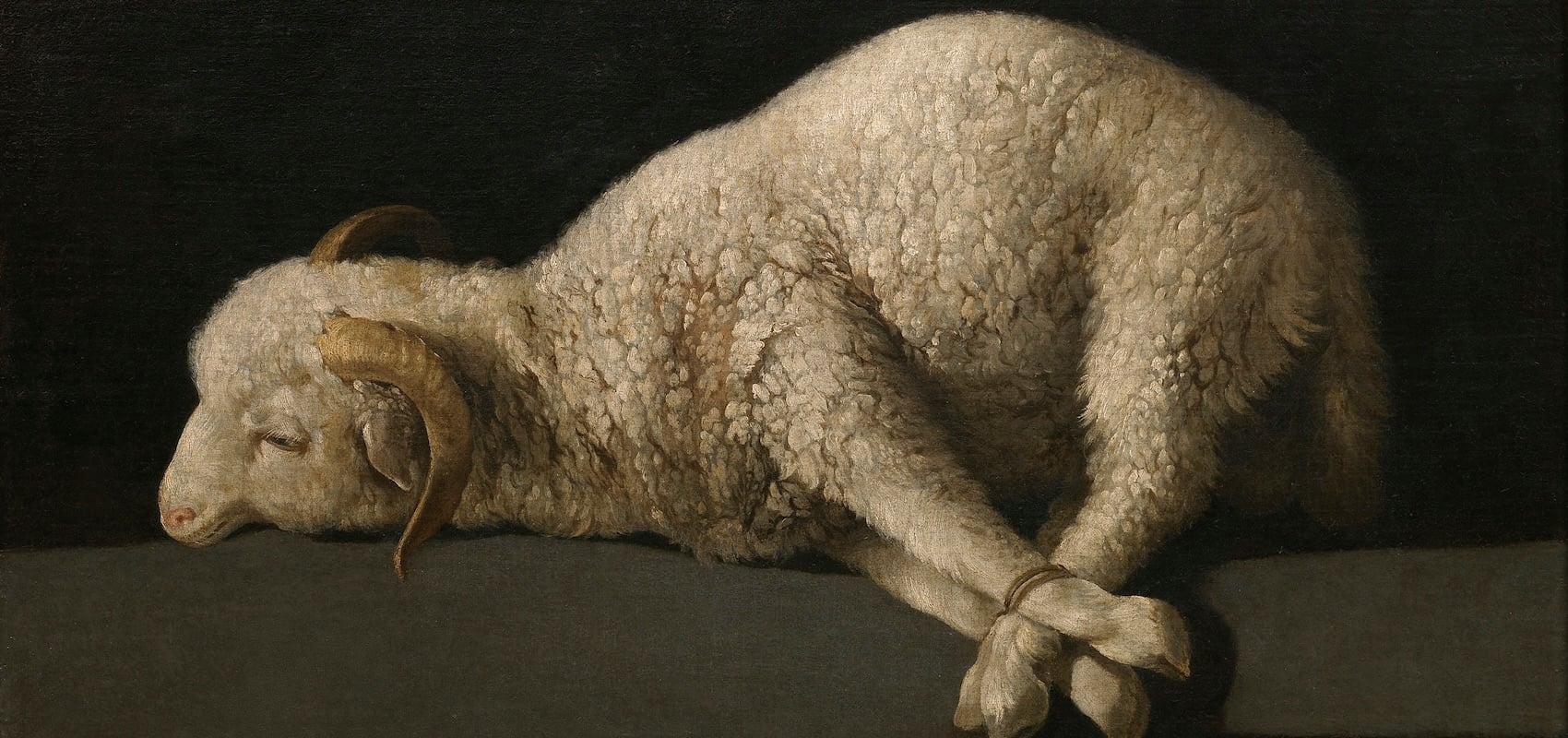
Throughout the summer, I visited the National Gallery in London at least once a week. This is not my usual practice, but I found myself unexpectedly drawn to the Zurbarán exhibition, which closed at the end of August. Something about the paintings kept calling me back.
Francisco de Zurbarán (1598–1664) is perhaps the greatest religious painter of the seventeenth century. He was fascinated by spiritual conflicts and the dramas of the soul that are ultimately more important than any events in the physical world. This is not to say that he was immune to sensual pleasures: After all, he fathered at least nine children. Yet he does not give the impression of immoderate self-indulgence in any aspect of his life—not even in his love of color and light.
Most old masters’ depictions of saints’ lives and gospel scenes can be appreciated from a nonbeliever’s point of view. Nietzsche brilliantly appropriates Raphael’s Transfiguration in the fourth section of The Birth of Tragedy to illustrate how Apollonian culture functions. No doubt Raphael would have been aghast at this misuse of his work, but there is nothing in the image itself that successfully resists Nietzsche’s anti-Christian reading. Zurbarán’s approach to sacred subjects was radically different; it is difficult to see how even Nietzsche could reread his religious images as something other than expressions of sincere devotion.
This is not to say that Zurbarán’s pictures are immune to misreading, of course. J.-K. Huysmans was one of the most perceptive art critics of the nineteenth century, although his aesthetic judgment became increasingly eccentric after Christmas 1890, when he decided to re-embrace Catholicism. In The Cathedral, he describes
a picture by Zurbarán . . . in the gallery at Lyons, a Saint Francis of Assisi standing upright in a habit of grey sackcloth, the cowl over his head, his hands hidden in his sleeves. . . . It was a wonder how this corpse, of which nothing was left but the bones, could hold itself up, and a terror came over one at the thought of the excessive mortifications and appalling penances that had exhausted this body and lined the sad and ravished features of this face. This painting evidently derived from the relentless and terrible mysticism of Saint John of the Cross; it was the art of the torture chamber, the delirium tremens of divine intoxication here on earth; yes, but what a note of adoration, what a cry of love, stifled by anguish, sprang from this canvas.
Huysmans was not entirely accurate in his description, perhaps because he did not know what Zurbarán was really trying to depict. Pope Nicholas V visited the tomb of St. Francis of Assisi in 1449 and is said to have had a miraculous vision of the saint’s uncorrupted body standing upright in the crypt. Zurbarán painted this subject at least three times. In addition to the original version that Huysmans saw at Lyon, there is an inferior copy at the Museum of Fine Arts in Boston and a decent one at the National Art Museum of Catalonia. All three of Zurbarán’s depictions of this scene give the viewer the uncanny sensation of a real vision: The illusion is, in the original sense of the term, awful.
No doubt Huysmans would have been delighted by Zurbarán’s shocking 1628 painting of St. Serapion, from the collection of the Wadsworth Atheneum in Hartford, Connecticut. St. Serapion, a Mercedarian friar, was gruesomely martyred in 1240 while trying to free Christians who had been enslaved. Zurbarán shows the saint still alive, but unconscious. He has been badly beaten; his face is swollen, and he stands upright only because he has been hung from his wrists by ropes and chains.
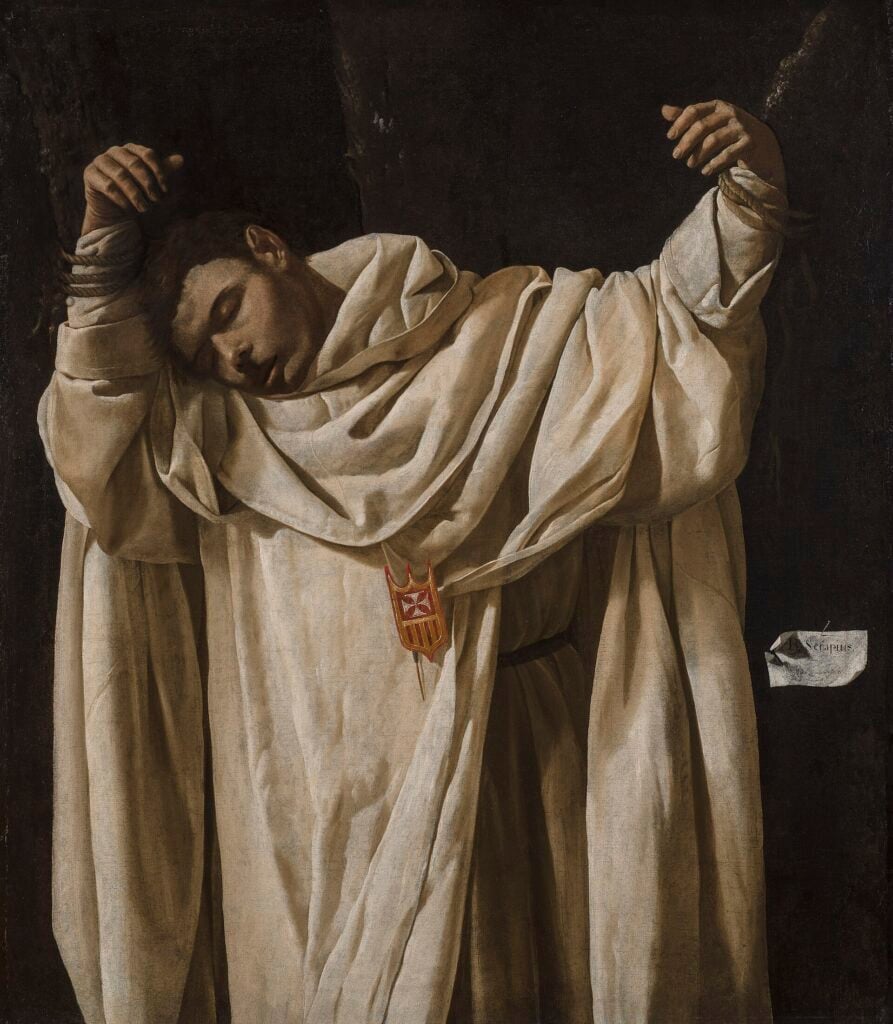
This picture illustrates the paradox of Zurbarán’s finest work: His images are utterly convincing even though the anatomy and perspective are often visibly faulty. Zurbarán cannot accurately paint a foreshortened forearm; nor indeed is there any sense of a torso beneath the stiff white cloth of the martyr’s habit. The painter was a master at depicting the effect of light on textiles, and he loved the texture of rough, dirty sackcloth just as he took delight in heavy embroidery and damask silk, although he was less successful at painting lightweight fabrics. Despite his skill at creating dramatic lighting effects, he failed to determine the source of light in his pictures, or where shadows ought to fall. Even his most ambitious canvases, such as The Interment of Saint Bonaventure in the Louvre, suffer from this. Yet the total effect is so striking that most viewers rarely notice this sort of defect, or mind it.
Zurbarán’s greatest weakness seems to have been anatomy. Hands, especially fingers, are rarely painted with due attention, and in his depictions of kneeling saints (for example, the magnificent Saint Francis in Meditation owned by the National Gallery in London) the shins and feet are often missing. Likewise, Zurbarán’s compositions can be awkward, and his sense of architecture downright amateurish. Certain recurring features are sometimes jarring—not least the heads of cherubs that seem stacked up like cannonballs. He pays little attention to female beauty. Overall, there is a laziness about much of his work. Why does none of this seem to matter?
Viewers seeking to criticize Zurbarán for his technical imperfections should inspect his composition, Christ and the Virgin in the House at Nazareth. He painted this more than once during the 1630s; the best-known example can be found in the collection of the Cleveland Museum of Art in Ohio. Zurbarán appears to have invented this subject himself. Jesus, who is perhaps eleven years old, pricks his finger on a crown of thorns he has been plaiting in his lap; the Virgin Mary looks up at him from across a table, weary with sorrow. Once the flaws have been cataloged, it seems difficult to account for how and why this is such a moving work of art. No sensible connoisseur would deny that it is a masterpiece.
Zurbarán seems to have been particularly attracted to St. Alonso Rodriguez, a Jesuit lay brother who had a special devotion to the Sacred Heart of Jesus. For all its naivete, Zurbarán’s painting of him in the Academy of San Fernando in Madrid is an unexpectedly convincing vision of Jesus and Our Lady directing their love toward the simple-minded Rodriguez. Zurbarán creates a harmony of color that directs the viewer’s gaze upward to Jesus himself. Here is the secret to his greatness.
Zurbarán had a difficult life. Although he was brought up in a prosperous home and enjoyed early success, his first two wives died young, in 1623 and 1639. His beloved son Juan, a noted still-life painter in his own right, died of the plague in 1649. Indeed, most of Zurbarán’s children did not survive their father. From the mid-1630s onward, the painter faced mounting disappointments, professional setbacks, financial distress, and personal humiliation. All this forms the background of a small picture that may be a self-portrait and probably dates to 1650, after Zurbarán seemed to have lost everything.
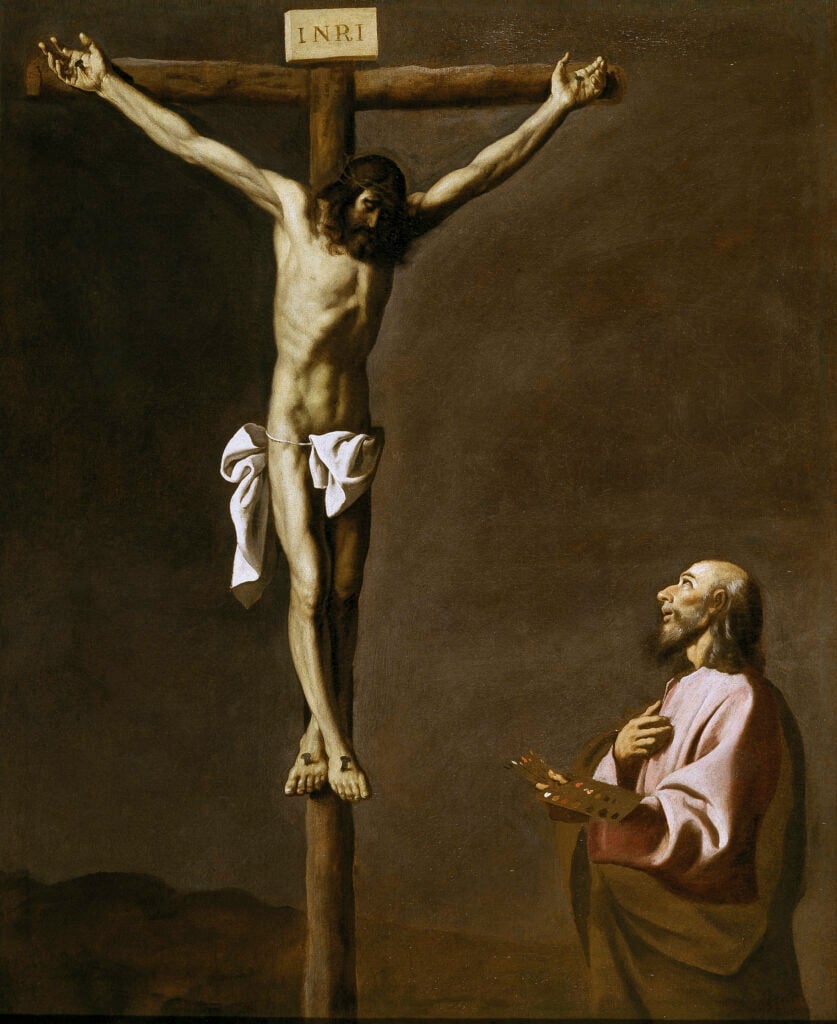
Zurbarán painted at least half a dozen of the most powerful crucifixions in the history of art. Saint Luke as a Painter before Christ on the Cross is arguably his most haunting. St. Luke, the patron saint of artists, holds a palette and brushes in his left hand and touches his heart with the right as he looks up in loving contemplation of Jesus on the cross, who almost seems to bow to the painter, who is illuminated by the light of Christ himself. Whatever Zurbarán suffered in his life, it does not seem to have mattered to him.
Those of us who admire Zurbarán without reservation will concede that his talent remained raw in many respects. It would be false to claim that his originality somehow results from his technical defects, his lack of formal training. The power of what he created lies in his ability to make us see reality and to help us remember that what is real is not always visible. His art was not merely an aid to contemplation or prayer: It was prayer in and of itself.
Dear Reader,
Can I be direct with you?
War abroad. Socialists on the rise. AI upending human life. Endless uproar online. The modern attention economy doesn’t want readers — it wants users enslaved to the tyranny of the present.
First Things is the antidote: literary excellence, timeless truths, and a fixed point of reference in a culture that has lost its bearings.
But we can’t do it without readers like you.
Our goal: Raise $150,000 by November 1 to sustain First Things in the year ahead.
Your gift anchors readers in the permanent things.
Make your Fall Campaign gift now using the button below.
If you have any questions or would like more information, please contact Giovanni Del Piero, Director of the Editor’s Circle, at gdelpiero@firstthings.com or 212-627-1985.

YOU MIGHT ALSO LIKE
Souls at Stake
As the realistic English novel was emerging in a glorious birth amid the intellectual and moral tumult…
A Woman’s East of Eden
Zoe Kazan’s seven-part Netflix adaptation of John Steinbeck’s East of Eden brings a woman’s sensibility to a…
Why the Death Penalty Is a Sore Point for Papal Authority
Pope Leo XIV marked World Day Against the Death Penalty, observed on October 10, with the following…
