

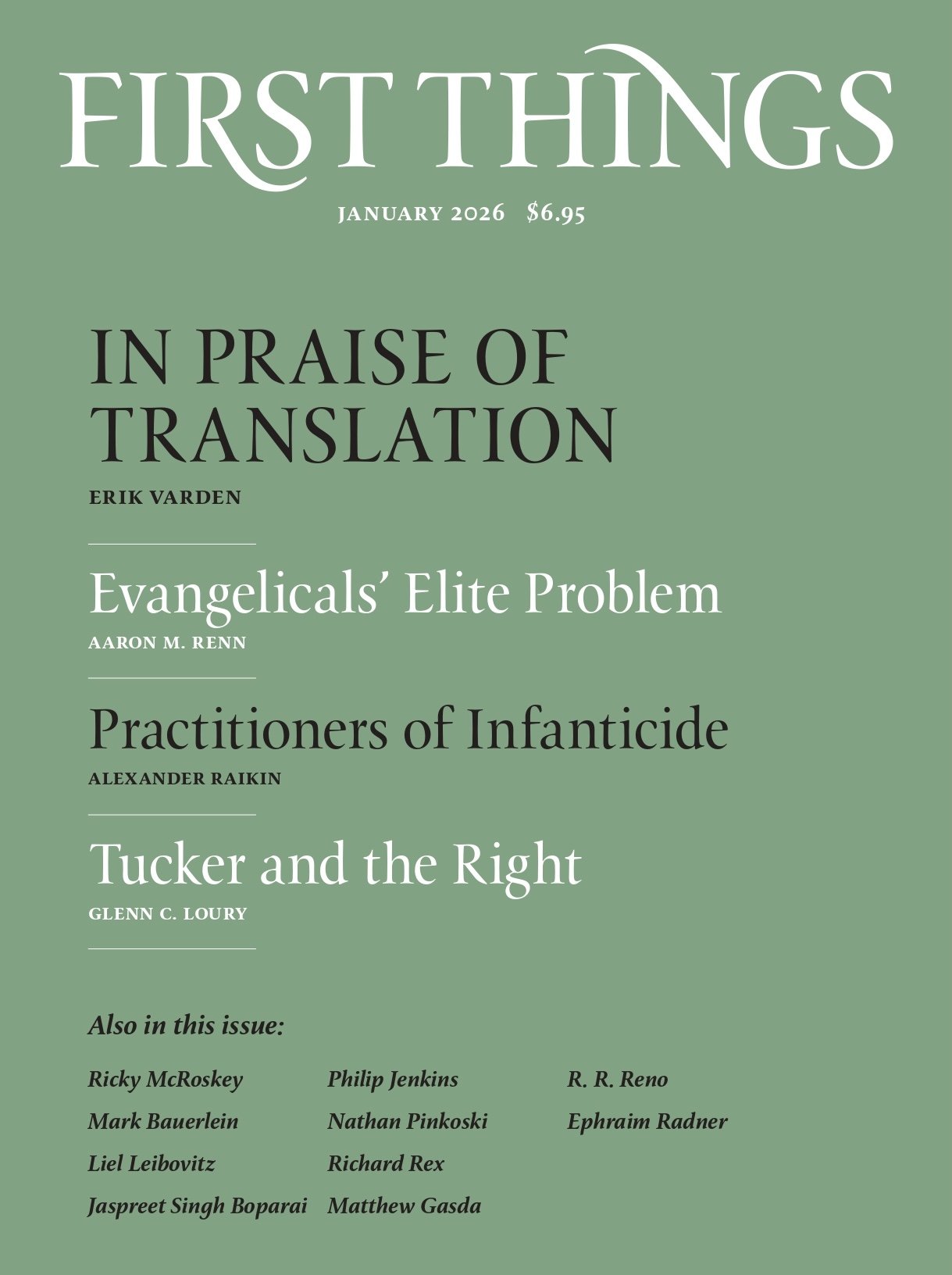
The problem with the evangelical elite is that there isn’t one. All too few evangelical Christians hold senior positions in the culture-shaping domains of American society. Evangelicals don’t run movie studios or serve as editors in chief of major newspapers or as presidents of elite universities. There are no evangelicals on the Supreme Court. There are hardly any leading evangelical academics or artists. There are few evangelicals at commanding heights of finance. The prominent evangelicals in Silicon Valley can be counted on one hand. There are not even many evangelicals leading influential conservative think tanks and publications, despite the fact that evangelicals are one of the largest and most critical voting blocs in the Republican coalition.
Two domains are exceptions that prove the rule: politics and business. Many evangelicals have been successful in politics. Glenn Youngkin, the governor of Virginia (and the rare evangelical who held a top position in high finance, as co-CEO of the Carlyle Group), is one; Jim Banks, the junior senator from Indiana, is another.
There are also many evangelical business leaders and entrepreneurs. But they tend to cluster in profitable but prosaic industries with limited cultural influence: restaurants (Chick-fil-A), retail (Hobby Lobby), distribution (Gordon Food Service), or oil and gas. Contrast Rupert Murdoch’s media empire, or Google, or BlackRock. Major media shape beliefs and cultural narratives; Google’s algorithms determine what we see online; BlackRock’s investing criteria prompt CEOs to take action. Few businesses with that kind of influence are run by evangelicals.
D. Michael Lindsay’s 2007 book on evangelical elites, Faith in the Halls of Power, largely confirms these observations. Though Lindsay’s tone is optimistic, his examples of evangelical elites are concentrated in politics and in businesses with little cultural leverage. And those evangelicals who are involved in culture-shaping institutions operate at the margins. For example, most of Lindsay’s evangelical academics are scholars of evangelicalism.
To be clear, there are some evangelical elites in the true sense of that word, such as Francis Collins (a geneticist), Ben Carson (a pediatric neurosurgeon), and even Justin Bieber (a musician). But evangelicals are underweighted in elite realms relative to their share of the population.
How can we explain this lack of representation in the halls of power? One reason is that evangelicals do not typically understand “elite” in these terms. Ask evangelicals who their elites are: the bulk of the names will be pastors, theologians, and other professional Christians. Pose the same question to Catholics and far more lay leaders will be on the list.
I asked R. R. Reno, and he noted that the last two editors in chief of the Wall Street Journal have been serious Catholics. Charles Taylor, arguably one of the three or four most influential living philosophers, is Catholic. Leonard Leo, the architect of Donald Trump’s remaking of the judiciary, is Catholic. And then there are the vice president and six of the nine justices of the Supreme Court.
This is also how the culture more broadly perceives things. Artificial intelligence is trained to operate as a cultural summarizer. A Grok AI query for the top fifteen evangelical elites in America returned a list that was 100 percent pastors and other professional Christians, whereas only 20 percent of the names from an identical query about Catholic elites were clergymen.
Evangelicals themselves have wondered why they punch below their numeric weight. Historian Mark Noll wrote of “the scandal of the evangelical mind,” noting the movement’s anti-intellectualism. Evangelicalism is strongly populist, and this orientation conduces to suspicion of institutions and elites.
Evangelical theology neglects creation and, unlike historic Protestantism, does not have a tradition of natural law. Emphasis falls on the saving of souls. Evangelical culture also tends to emphasize the role of women in family life, and this emphasis works against the emergence of female elites. Evangelicals are too often cocooned within their parallel institutions, such as Christian colleges, which direct them away from elite pathways and networks. They are deeply suspicious of power and its use. In a real sense, to become elite amounts to a betrayal of evangelical culture, if not of evangelical convictions.
History also plays a role. In a socioeconomically, ethnically, and racially stratified American Protestant landscape, evangelicals have long been socially subaltern. For a long time, evangelicals could become elite by moving into more socially prestigious mainline denominations. An old quip has it: The average American starts out as the son of a Baptist farmer, becomes a Methodist when he gets a white-collar job, and becomes a Presbyterian when he gets his first promotion. For generations, Protestantism contained a pathway for the ambitious evangelical to attain elite status while maintaining biblical faith.
The collapse of the mainline and the WASP establishment robbed Protestantism of its elite center. The old status escalator, to the extent that it still functions, now delivers rising evangelicals either to secularism or to Roman Catholicism, which retains an elite stratum, one that has grown more influential as the WASP elite has declined.
These developments are well known, and I do not wish to add still more to the analysis of evangelical underperformance. What is needed are answers to two key questions. First, does it matter whether there are evangelical elites? Second, if it does matter, how might an evangelical elite be reconstructed?
As to whether it matters: Evangelicals are roughly one-quarter of the American population. When a group so large fails to contribute its share of leaders, we should expect a leadership deficiency in society. Moreover, if we believe (as we should) that Christian formation adds an important dimension to leadership, then the deficiency is not just numerical but also substantive. Indeed, we see that today America is believed to be suffering from a crisis of leadership, and trust in institutions is in decline.
It’s notable that America’s leadership crisis emerged in the wake of the collapse of the old WASP class. That class had many well-known defects. Its caste-like behavior excluded Jews and Catholics. WASP elites cultivated a hauteur that undermined democratic culture. They often tolerated mediocrity in their own ranks, preferring men from “good families” above demonstrated competence. All true. However, the formerly subordinate groups that now dominate America’s elite positions have, for the most part, failed to replicate WASP virtues and competencies. The disastrous Biden administration, for example, was largely devoid of WASPs at its top levels, a fact noticed by secular publications like the Washington Post. (There is a story to tell about the rise of Jewish elites, especially in academia, and then their decline into secular assimilation, but that’s for another time.)
The United States remains culturally Protestant, even as it becomes more secular and diverse, and many of its institutions were created by Protestants on the basis of Protestant principles. This fact suggests that Protestant elites play a crucial role. They are well positioned to lead in ways that are suited to the character of the country. A diverse nation requires a diverse leadership class. We need talent from all quarters. But a national elite that includes few of those citizens who are historically the cultural roots of the nation cannot be healthy for the body politic. Perhaps our present political and cultural troubles stem in part from the failure of evangelicals to occupy elite positions. America needs Protestants to take on the leadership burdens of society, and in view of the dramatic decline of mainline Protestantism, they must come from evangelical ranks.
As to whether an evangelical elite can be created: The cultural conditions of evangelicalism augur against it. However, an elite by definition is numerically small, so there is no need to transform evangelicalism itself. We need only create a space within it from which elites can emerge.
An elite must emerge organically as young people in evangelical churches entertain high aspirations. As a subset of individuals achieve elite status, they are likely to form networks and institutions with like-minded colleagues. It is this social framework at the highest levels of society, a framework that combines high status earned by recognition of excellence in secular vocations with forthright identification as evangelicals, that will create a proper milieu for Protestant elite development over the long term.
To craft networks and institutions as a method of manufacturing an elite would be a fool’s errand. But we can create conditions that will improve the likelihood of an elite’s organic emergence.
One way to begin is by cultivating flagship churches. Historically, most cities have had a few churches, often large and wealthy, attended by elites. Often called “tall-steeple” churches, they once were mainline Protestant. Today most of these congregations are theologically liberal and therefore useless as focal points for an evangelical elite.
There remain a few theologically traditional “tall-steeple” churches. Some are stubbornly orthodox mainline congregations, and others are more forthrightly evangelical. Examples include Redeemer and Central Presbyterian in New York City, Church of the Advent (Episcopal) in Boston, Capitol Hill Baptist in Washington, D.C., Highland Park Presbyterian in Dallas, Covenant Presbyterian in Nashville, and Epic Church in San Francisco. These churches play an important civic role. They provide Christian fellowship for elites and spiritual and moral formation for leaders at the local or national level. Churches with this status should embrace these functions and expand their civic footprints.
One element of the spiritual and moral formation these churches must provide is an expanded theology of vocation. Evangelicalism, especially under the influence of dispensational theology, has prioritized evangelization over the creation mandate. Vocation is valued, if at all, strictly for the purpose of generating money to fund evangelism. In its American evangelical expression, Protestantism, which rejected the Catholic idea of religious vocations, ironically ended up resacralizing them under terms like “evangelist.”
The sociologist Andrew Lynn studies the evangelical “faith and work” movement, which seeks a robust theology of vocation. In Saving the Protestant Ethic, he notes that the movement’s own practitioners “see their religious tradition as completely devoid of any theological frameworks that confer value on secular work.” Faith and work leaders have attempted to fill this lacuna, but they have been only partially successful. Their movement assigns a value to secular vocation, but it has a limited vision of what Christians should aspire to do in their vocations. The faith and work movement stresses conducting business ethically, doing high-quality work, sharing the gospel in the marketplace, practicing love-your-neighbor relationships with colleagues, and taking a “redemptive” approach to business or entrepreneurship. These are all good things, but they can and should be done by all Christians at all levels of society. What’s needed is a theological mandate for leadership at the top of the key domains of society.
The only work depicted in the Bible prior to the Fall is Adam’s naming of the animals. This structuring and ordering activity imitates God’s initial creation: establishing day and night, the greater light and the lesser light, and so forth. Adam takes up this work. It is important to see that this structuring and ordering work is not just for this age, but for the age to come, with Christians to be reigning over the earth (Rev. 5:10) and judging angels (1 Cor. 6:3). Notably, Adam doesn’t ask God what to name the animals—it happens the other way around. God brings the animals to Adam to be named. God doesn’t want Adam to carry out his instructions mechanically; he wishes Adam to exercise dominion over the realm proper to his discernment and judgment.
The active, confident structuring and ordering of the world is what people in the top positions of society do. As Charles Coulombe wrote in Palladium magazine, “A true elite creates and re-creates its institutions, rather than merely staffing them.” At present, to the extent that evangelicalism has a theology of vocation, it does not encourage this kind of creative and re-creative leadership—or even give permission to seek the capacity to exercise it.
One exception is the dominionist theology associated with the New Apostolic Reformation and other such movements, particularly the “seven mountains” mandate, which encourages Christians to take over religion, the family, education, government, media, the arts, and business. It is a largely middle-class Pentecostal phenomenon, associated with populist leaders who sometimes style themselves “apostles.” These leaders sometimes obtain political positions, though often these positions are less consequential than their titles suggest. Trump’s faith adviser, Paula White-Cain, a prosperity-gospel preacher who does not personally claim the title apostle but is sometimes accorded it by others, is one example. Rather than serving as a theology of vocation for those who might become elites, the New Apostolic Reformation is more likely to discredit the pursuit of leadership positions among mainstream evangelicals. Dominionism is not the path forward.
The most widely cited book in mainstream evangelicalism that links faith and work is the late pastor Timothy Keller’s Every Good Endeavor: Connecting Your Work to God’s Work. This book marks a significant advance in vocational theology. It describes Adam’s naming of the animals, and discusses the work of structuring and ordering. Keller writes, for example, “Work not only cares for creation, but also directs and structures it.” He goes on to say, “That is the pattern for all work. It is creative and assertive. It is rearranging the raw material of God’s creation.”
Unfortunately, structuring and ordering make up only a small portion of Keller’s book, and he offers no example of a person in a recognizably elite position engaging in structuring and ordering activity. Of the book’s many examples, none involves a positive portrayal of a person engaged in elite activity who uses the central power of his role to direct, shape, reorder, or restructure some element of society. Instead, Keller gives examples of elites behaving badly, or people abandoning high-powered positions in search of fulfillment or more ethical work.
Every Good Endeavor was an important step forward, but its approach must be extended. Evangelicalism needs a theology of vocation that comprehends the exercise of power—that validates and valorizes people who reform public policy, invent new technologies, become presidents of elite universities, acquire major media properties or foundations, organize research teams, or serve as Supreme Court justices. It is especially important that the pursuit of such achievements and positions be prized by Protestantism’s flagship churches.
Evangelicals need more than a better theology of vocation. They also need a patronage system. It is difficult to reach senior levels of society without patronage. The concept of patronage extends beyond hiring (although hiring is important). It comprehends mentorship, introductions, recommendations, public and private championing, admission to exclusive groups or institutions, and financial sponsorship.
Evangelicalism does not provide patronage construed in this way. Evangelicals overwhelmingly fund and support people who focus on Christian ministry. There are pathways to sponsorship for missionaries, church planters, and campus ministers, but not for people engaged in secular domains and activities. Moreover, being populist in orientation, evangelicalism is structured around charismatic leaders and their loyal followers. Evangelical leaders often resist providing patronage to people outside their “mafias,” people with whom they have weak ties and over whom they have limited control. Outsiders are often viewed with suspicion or as rivals.
With no patronage network, evangelicals often depend on support from non-evangelicals. One example is Brad Littlejohn, a Millennial evangelical ethicist and political theorist with a PhD in the political theology of the English Reformation from the University of Edinburgh. His jobs in Washington have come from an Orthodox Jew (Yoram Hazony of the Edmund Burke Foundation), a Catholic (Ryan Anderson of the Ethics and Public Policy Center), and a secular Jew (Oren Cass of American Compass). The Davenant Institute, a think tank Littlejohn founded to revive the study of the works of the Reformers, failed to raise significant financial support from evangelical funders during the decade in which he ran it.
Whereas Catholicism enjoys a network of interlocking academic programs, activist organizations, and funders, there is no patronage or intellectual ecosystem for evangelicals within Washington’s conservative establishment. The fact that evangelicals often receive support from generous Catholics rather than from their own people is likely a factor in the tendency of rising evangelical elites to convert to Catholicism.
In his final white paper, “The Decline and Renewal of the American Church,” Tim Keller called for the creation of a patronage system as part of his “Christian mind project.” He proposed the creation of a think tank, the endowment of chairs at top universities, the creation of grants for young Christian scholars, and the establishment of a Christian equivalent to the Federalist Society. These initiatives are potentially useful. But a new attitude is also critical. Evangelicals must be willing to provide personal, institutional, and financial support to talented and ambitious people of good character who are outside of their own factions or tribes. Without a patronage system of this kind, it is unlikely that many evangelicals will reach senior levels of society outside of politics and business. Those with high ambitions may well convert to Catholicism on their way up.
An updated theology of vocation and a patronage system are important. But as I’ve noted, good planning and strategic investments cannot by themselves create an elite. Talent, aspiration, and grit are key, and they are qualities of individuals. Those who possess such qualities will become evangelical elites if they also possess heartfelt adherence to Christian orthodoxy. Whence might these individuals emerge?
In my estimation, what’s past is prologue. Tomorrow’s evangelical elites will most likely come from their historical origins, the high-status churches that have a long tradition of feeding their talented young people into elite institutions and professions. They are the Anglican and Presbyterian denominations, both of which have splinter groups, some long-standing, that adhere to orthodox doctrine. These forms of American Protestantism prize intellectual achievement and presume that their most accomplished members will shape the future of America.
Most evangelicals have little or no knowledge of mainline Protestantism. They simply assume that its churches and members are functionally apostate and politically very liberal. In fact, many mainline members, and indeed entire churches within the liberal denominations, are theologically traditional. Politically, mainline Protestants are purple, and denominations like the Presbyterian Church (USA) are substantially Republican. To the extent that theologically traditional Protestant elites exist in America today, they are concentrated in mainline denominations or evangelical splinter forms such as the Presbyterian Church of America and the Orthodox Presbyterian Church, and Continuing Anglican groups such as the Anglican Church in North America.
To achieve a critical mass of leaders, it will be important to break down the psychological and cultural barriers that separate lay mainline Protestants from evangelicals among a theologically traditional elite. Though aspiring evangelical elites need not switch to mainline churches, engaging lay elites in mainline congregations would be beneficial. The reverse is true as well. Orthodox mainline churches should understand their potential as hubs for nurturing faithful evangelical elites. An orthodox Episcopalian knows that the traditional WASP institutions long ago betrayed their Protestant heritage. Today’s Protestant elite should maintain an openness toward people from all Protestant backgrounds.
The new denominational and institutional landscape means that much depends upon individual discernment. There is no functioning “system” for elite production among Protestants with orthodox commitments. Therefore, Protestant laymen, especially evangelicals, who wish to reach elite status and generate a new class of Protestant elites will need to reorient themselves as individuals, and do so across several dimensions.
Obviously, ambition for high-level accomplishment is critical. It entails competence and credentials, the ability to navigate pathways to power and influence, and an awareness of our vocation to structure and order society. But other shifts are important as well.
Protestant elites need to be forthright about their Protestant identity, in the way many Catholics are. Catholic identity is central to the public personas of Vice President JD Vance, Supreme Court Justice Amy Coney Barrett, Harvard law professor Adrian Vermeule, and Notre Dame political scientist Patrick Deneen. One is hard pressed to identify a Protestant of similar status who leads with his religious identity.
The breaking down of barriers between mainline Protestant and evangelical laymen would help in this regard. Evangelical ardor can help mainline Protestants overcome their reticence. There are impressive, theologically traditional Protestant elites, most of them Episcopalian. But they rarely make their religion central to their public identity. Some have never publicly mentioned their faith at all. Existing Protestant elites have to stop putting their lamps under a bushel. Having public role models for younger aspirants to admire and imitate is critical.
In turn, mainline Protestants can fortify evangelicals. Mainline Protestants take for granted their roles in society. They have a long history of producing secular leaders in all fields. This social confidence can help evangelicals resist the temptation to “pass” as they rise in social status.
Cross-fertilization requires an openness to collaborating on the basis of a shared theological traditionalism—that is, agreement on such essentials of the faith as the Nicene Creed, the centrality of the gospel (salvation by faith alone), and the Christian moral framework. As lay Christians working in secular domains, Protestant elites should not treat women’s ordination, young-earth creationism, or other denominational particularities as boundary issues. This kind of cooperation was the key to WASP ascendancy, which did a great deal to perpetuate America’s distinctively Protestant character in the early and mid-twentieth century.
As they aspire to and attain elite status, evangelicals should accept Protestant fragmentation and stratification. They need not seek to please or be in active relationship with all of evangelicalism. Some movements and communities are ill suited to the pursuit of elite positions and national leadership. Some—such as fundamentalism, dispensationalism, the Anabaptist tradition, as well as those motivated by particular views of the end times—may even be hostile to these pursuits. There is no reason to criticize these movements. They can be powerful forces of evangelization and witnesses to Christian faithfulness. But evangelical elites should not be burdened by deference to those who have very different orientations and points of view.
At the same time, it is crucial that evangelical elites not countersignal against other evangelical groups or define themselves in opposition to them, just as Catholic elites don’t countersignal against low-status Catholics. One is hard pressed to find polemics against ordinary Catholics who vote Republican or denunciations of recent immigrant Catholics who vote Democrat. In American Catholicism, bare-knuckle battles are among Catholic elites: George Weigel took aim at Joe Biden; JD Vance tangled with the bishops. There is no “punching down.” By contrast, embarrassed by evangelicalism’s populist roots, many evangelicals in prominent positions are vociferous public critics of the evangelical masses who support Donald Trump. Aspiring evangelical elites can learn a better way from their Catholic counterparts.
Most importantly of all, evangelicals must become culturally confident. Talented people of all stripes are rightly encouraged to participate in elite culture and institutions. Evangelicalism should offer that encouragement while at the same time inculcating a degree of critical detachment from present-day elite culture, which has been secularized. But more than critical detachment, evangelicalism must encourage a positive elite vision, one that views Protestant Christianity as crucial to moral, cultural, and political renewal. Catholic elites are comfortable in elite milieux while believing that Catholicism and its social doctrine can inform a better and more humane public policy. Catholic elites seek to be agents of change within elite institutions. Again, a new generation of Protestant elites, confident in their identities, can learn from their Catholic brethren.
Evangelical cultural engagement has not accomplished the goal of shaping elite culture from within. To some extent, this failure is the result of a naive interpretation of sociologist James Davison Hunter’s teachings on cultural change. Hunter recognized that change occurs by means of networks of elites connected through institutions at the cultural center. But one’s mere presence in these domains does not make one an agent of change. Evangelicals have focused on getting a seat at the table, but they lack a vision for implementing big projects. This is why the evangelical presence in spaces such as the Ivy League makes so little impact. It certainly made no impression on JD Vance at Yale Law, as he mentions only Catholics and Mormons (and Peter Thiel) in his conversion narratives.
Contrast this approach with—for instance—that of Patrick Deneen, who was willing to declare forthrightly that liberalism had failed. His book became a subject of serious secular elite consideration, earning even a positive mention from President Obama. Protestants need to find a way to operate in this mode.
Finally, aspiring evangelical elites must adopt the mindset of being a minority in a pluralistic elite. America’s historic Protestant elite was a hegemonic majority. Today the old WASP establishment is long gone. Protestants are a minority in America, albeit still a plurality. They are a tiny minority among the American elite. The rising generation of evangelical elites must achieve a group consciousness, a sense of unique purpose as Christian leaders in a country very different from that overseen by the once all-powerful WASP elite. They must be comfortable operating in a pluralistic society. Attaining this combination requires two things: a thick skin and recognition of their unique and indispensable role in shaping America’s future.
Sen. Mitt Romney is a good model of the combination of pluralism and deep conviction in an elite man of faith. Romney has a track record of accomplishment across multiple domains, having co-founded Bain Capital, been elected a governor and senator, and overseen the turnaround of the troubled Salt Lake City Olympics. In these roles he worked with many people of different ethnic and religious backgrounds. A Mormon, he was subjected to taunts and attacks during his political campaigns, particularly his 2012 presidential run. Prominent evangelicals such as Robert Jeffress called the LDS Church a “cult.” Progressives attacked Mormonism’s social conservatism. But Romney took the high road, not deigning to respond to most attacks, not letting them distract him from his mission. Neither did he say or do anything that might suggest that he was distancing himself from his church or his convictions. Though a gulf separates the LDS Church from orthodox Nicene Christianity, there is much that evangelicals can learn from Romney.
Whether a Protestant elite—either evangelical or updated mainline—will emerge in America is uncertain. I hope it will happen, and I hope these reflections will make a contribution toward this goal. For America needs its evangelicals to lead the regeneration that our nation and our institutions so obviously require. America needs a faithful Protestant elite again.

YOU MIGHT ALSO LIKE
Turned Away on Palm Sunday
In politics, diplomacy, war, or pretty much any field of human interaction, one must contend not only…
Timothée Chalamet Is Right About Art (ft. Suzy Weiss)
In this episode, co-founder and reporter for the Free Press, Suzy Weiss, joins Virginia and Germán to…
Via Crucis, 2026
The Way of the Cross—and the third, seventh, and ninth stations in particular—has been an especially appropriate…
