
On Saturday night, as the final seconds ticked down on the Knicks’ improbable NBA championship run, New York City erupted in jubilation. Throngs of New Yorkers flooded the streets to jump, hug, weep, sing, dance, and shout, moving as one body yet in all directions, drawn together by a victory fifty-three years in the making. For one June evening, the Knicks elevated their city’s tolerant coexistence into a rare civic communion.
For three generations, the Knicks have tried the patience of one of sports’ most loyal yet most frustrated fan bases. Countless disappointments and dashed hopes formed the city’s collective opinion of its basketball team. Following the Knicks through it all required a stubborn faith that New York’s greatness was not yet behind it.
At its best, sport allows a city’s residents to set aside their differences in the collective effort to beat a rival. In New York, where there are few unifying institutions beyond the subway and Central Park, Saturday’s game drew New Yorkers into the Knicks’ story, whether they were diehards or newcomers. As the excitement grew, it pulled in even those on the margins of fandom. Like the workers in the vineyard, all shared in the same reward, no matter how late to the game.
Even I, admittedly not much of a sports fan, felt a surge of pride and excitement for my home team as the final buzzer sounded. Watching the game from my front porch on my normally placid corner of northwest Queens, I immediately heard shouts from the end of my block. Unable to resist the spectacle erupting across the city, I rushed down Ditmars Boulevard to the neighborhood’s busiest sports bar. Along the way, the streets became increasingly crowded with like-minded pedestrians and shouts of “Knicks, Knicks, Knicks!”
When I arrived, thousands of revelers in blue and orange filled the street from sidewalk to sidewalk. Children perched on their parents’ shoulders, engrossed by the sea of waving arms and raised phones. Fireworks erupted from the roof of the apartment building above the bar as residents leaned from their windows and cheered. Firetrucks rolled through with flashing lights and blaring horns as the firefighters inside waved and pumped their fists to the crowd’s shouts.
For someone who has lived here his whole life, the experience evoked a surreal sense of novelty. Past moments of New York unity had come in response to crisis or tragedy. But Saturday’s victory gave most New Yorkers their first taste of shared exaltation, a common love and loyalty to their home city that briefly transcended its usual difficulties and divisions.
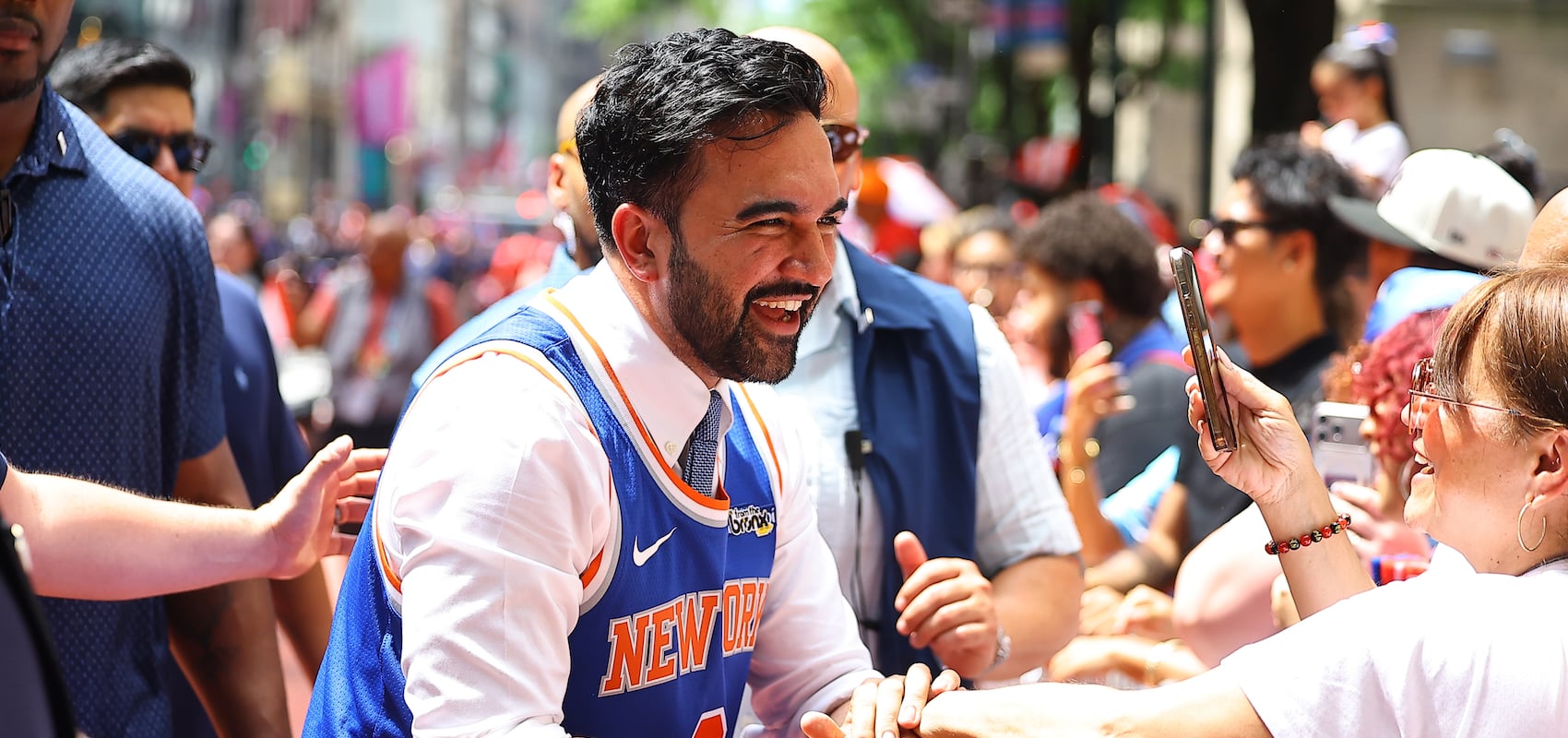
Zohran Mamdani celebrated in the West Village until 3:45 a.m., while his leftist supporters were quick to credit him for the city’s joy. For the mayor, the Knicks’ win capped a mostly trouble-free first six months in office, marked by good vibes and deferred hard decisions. He navigated his first budget by securing from Albany a bailout and tax increase on luxury second homes, easing his pressure for just a year. Most notably, Mamdani re-amortized a decades-old pension liability, lowering contributions in the near term but shifting even higher costs onto his successor.
Meanwhile, his deftly curated social media presence has persuaded many New Yorkers of his administrative prowess. Whether that image can survive the tradeoffs that come with a revenue crunch is one of the central risks of his mayoralty.
Another is a potential surge in crime and disorder. Some acts of vandalism marred Saturday’s otherwise peaceful celebration. Nine yellow school buses carrying World Cup fans were abandoned as crowds surged around them. Five were ultimately destroyed, one set ablaze and four battered as revelers climbed atop and struck them with bats.
NYPD reported sixty-three arrests on Saturday night for offenses ranging from assault on officers to possession of a weapon, resisting arrest, and criminal mischief. A gunman struck a seventeen-year-old just off Times Square. On Monday, Mamdani denounced the conduct as “frankly unacceptable” and said the police officers had “handled themselves appropriately.”
So far, the mayor has largely let the highly capable Police Commissioner Jessica Tisch run the department as she sees fit. Like Bill de Blasio’s initial appointment of William Bratton, Tisch’s permission to continue her traditional approach to policing signals Mamdani’s recognition that crime and disorder could derail his mayoralty. His defense of Tisch’s decision to add a second patrol in the Bronx—requiring an increase in officer headcount—has opened a rift with his allies in the Democratic Socialists of America. As the peak summer season for crime and disorder nears, these tensions are bound to intensify.
New York’s unity will fade after Thursday’s victory parade down the Canyon of Heroes, but generations of New Yorkers will hear about Anunoby’s tip-in, Brunson’s 45-point game, and that magical Saturday in June when their city finally earned its crown.
Image by ASSOCIATED PRESS
Dear Reader,
Can I be direct with you?
War abroad. Socialists on the rise. AI upending human life. Endless uproar online. The modern attention economy doesn’t want readers — it wants users enslaved to the tyranny of the present.
First Things is the antidote: literary excellence, timeless truths, and a fixed point of reference in a culture that has lost its bearings.
But we can’t do it without readers like you.
Our goal: Raise $150,000 by November 1 to sustain First Things in the year ahead.
Your gift anchors readers in the permanent things.
Make your Fall Campaign gift now using the button below.
If you have any questions or would like more information, please contact Giovanni Del Piero, Director of the Editor’s Circle, at gdelpiero@firstthings.com or 212-627-1985.

YOU MIGHT ALSO LIKE
Foucault’s Idol of Nothingness
Today marks the 100th anniversary of the birth of Michel Foucault. He was influential in his lifetime,…
Forget Odysseus. Aeneas Is the True American Hero.
Who is our Odysseus? Or more precisely, who is the most Odyssean hero of American film? Matt…
Meet the Post-Religious Right
There have been many books written about the online right and the Trump movement, most by people…
