
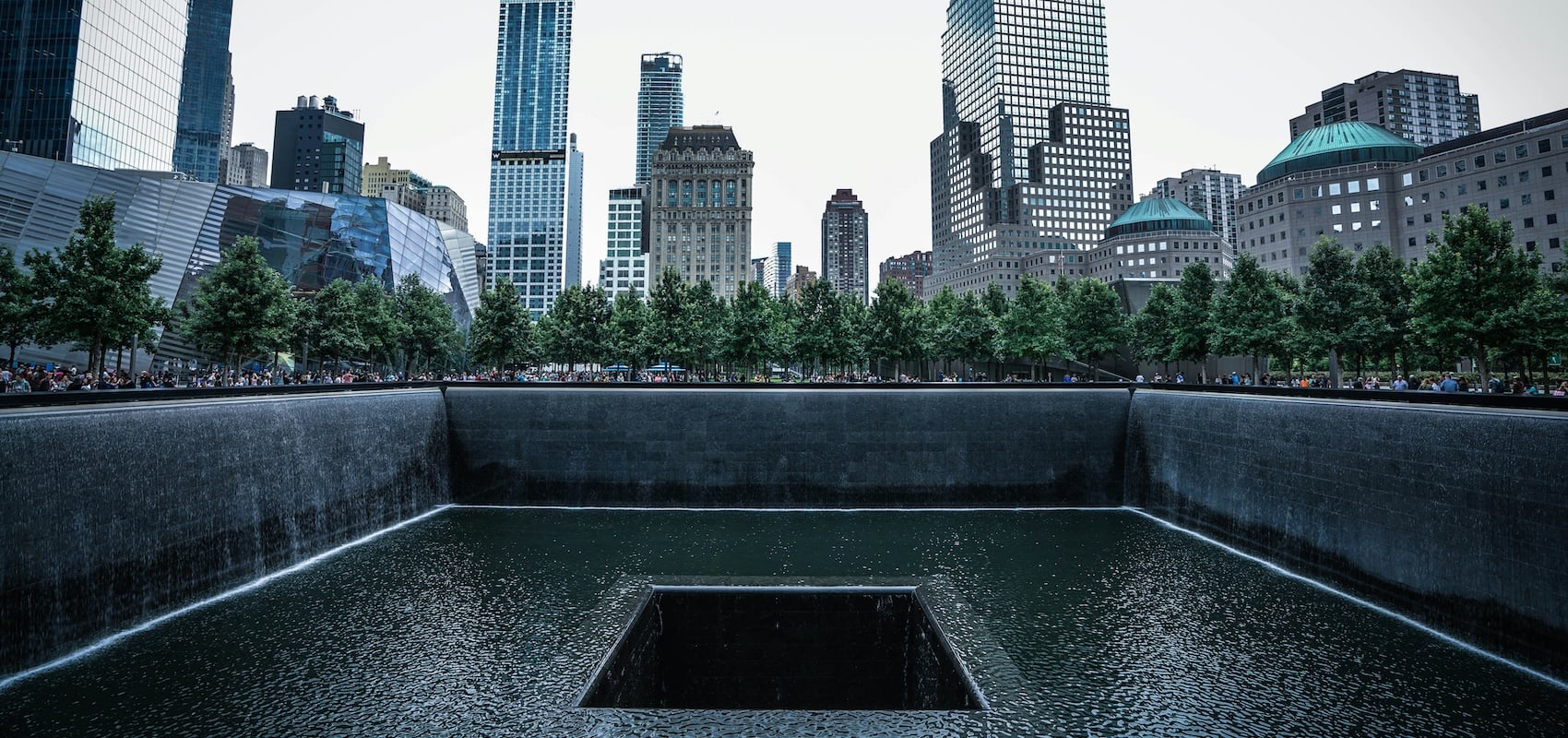
Rush-hour traffic emerged from the Battery Tunnel and roared up West Street on that gray, overcast afternoon as I made my way through the narrow, temporary passageways that snake around partially constructed buildings and deep foundation pits. My ticket for the National September 11 Memorial at the World Trade Center site gets checked one last time at the temporary entrance on the southwest corner, and then I feel my heart rate climb and my throat constrict.
Designed by Michael Arad, the central foci of the memorial are two deep, square pools that mark the footprints of the two destroyed buildings. A delicate screen of water cascades down the sides, evoking the thin vertical strands that were the main architectural feature of the two towers that once dominated the skyline of lower Manhattan. The pools of water drain into still deeper shafts at their centers. Bronze railings surround the two pools of falling water, and into them are inscribed the names of those who died on September 11, 2001, not just at the World Trade Center, but also at the Pentagon and on the airplane that crashed into the Pennsylvania countryside.
I am looking for the names of the three men who were my college classmates.
A sign points the way to computers that provide locations for specific names. I fumble for a while. A memorial volunteer hovers nearby. But I soon grasp the simple system, and find my three classmates. The machine prints out tasteful, individualized cards with their locations on the brass railings clearly marked. The volunteer asks if I need any help. Uncertain whether I can actually speak, I croak out, “I’ve got my names.”
Thomas Irwin Glasser, panel S-49. I stand in front of his name and look into the south pool. Inwardly I see Tom pitching forward and crumpling into an exhausted heap as he crosses the finish line at an indoor track meet at Swarthmore College in 1982. I gaze at the falling curtains of water on the sides of the pool. The downward plunge evokes the collapsing buildings. The central drains look bottomless, reinforcing the feeling of perpetual disintegration.
Douglas Benjamin Gardner, panel N-38, and Calvin Joseph Gooding, immediately to his right, panel N-39. Their names are on the southeast corner of the north pool. As I look again at the cascading water and the central, bottomless, pitiless drain into which the water inevitably, inexorably flows, images of freshly dug graves flash before my mind. Then, for the briefest moment, I see myself hurtling down into the abysmal pit of destruction. “Death, Death, Death,” chant the 2983 names around the railings, echoing in the water falling into the sunken pools and disappearing into the gaping mouths of the hungry drains. The annihilating power of death—at this moment it seems not the main thrust of the memorial; it is the only thrust.
Then I turn and look up at the huge American flag draped on the side of One World Trade Center, the massive, partially completed building towering above the south pool. My emotions shift. In the inner ear of my imagination I hear bugles rallying the troops. Tom and Doug and Calvin and I merge into a larger loyalty. Yes, they are dead—as I will be—but together in my mind’s eye we are rising in strength rather than collapsing into a pit of nothingness. For a brief moment my soul hardens with resolve, and I feel an emotion of consolation that neither cancels nor denies nor forgets the inescapable personal reality of death, but instead draws it into something larger, something durable, something noble.
The flag on the side of One World Trade Center is not actually part of the 9/11 Memorial. The building is owned by the Port Authority of New York and New Jersey, and on September 10, in advance of the 9/11 ceremony, Port Authority administrators made what a spokesman described as “a spur-of-the-moment decision.” They decided to hang the flag (which, being the Port Authority, they had on hand to hang from the stanchions of the George Washington Bridge). So there it was, one of the largest American flags in the world, providing visitors like me with release from the 9/11 Memorial’s death-focused nihilism.
Apparently my patriotic reveries were contrary to the intentions of those responsible for the planning and design of the 9/11 Memorial. For the official site contains no flags, nor any other national symbols, nor religious symbols for that matter. The reflecting pools, the austere stone benches, and the solemn rows of trees: The design amounts to a tasteful memorial park, a non-religious site to remember those whom we have lost. It’s all about the deaths of these individuals, the 9/11 Memorial says. It’s not about our life as a nation.
The setting reinforces this turn away from any national solidarity and common purposes. The Memorial will be surrounded by the glassy modernism of the new buildings rising at the site. They will look exactly like other tall buildings of the sort one finds today in Shanghai and Dubai. Moreover, on the island of Manhattan, the Memorial stands at the center of global capitalism, itself a powerful, perhaps the most powerful, atomizing force in our postmodern world.
The overall effect is to downplay our citizenship and accentuate our shared, naked humanity. Surrounded by a faceless international style of architecture and stripped of national symbolism, the 9/11 Memorial offers no public meaning. There is nothing to dissent from—and nothing to consent to.
Instead, we are invited to contemplate the annihilating abyss of death, a sad, inevitable destiny we all share. And to remember the dead individuals—or, as the brochure for the soon-to-open museum encourages, to tell our own personal stories.
The emphasis on the personal comes as no surprise. Maya Lin was a prominent member of the building committee for the 9/11 Memorial, and her widely acclaimed Vietnam Veterans Memorial on the National Mall in Washington takes a similar approach. The long, sunken black wall that constitutes the main feature of that memorial is also inscribed with names, the names of those who died in the jungles of Southeast Asia.
Yet what succeeds in Washington fails in New York. National symbolism saturates the Mall. Whatever one thinks of the design, the Vietnam Veterans Memorial marks a national endeavor, one that invariably engages our patriotic emotions: the Gulf of Tonkin Resolution, Soviet expansionism, napalm, My Lai, Kent State, South Vietnamese democracy and North Vietnamese communism, the Pentagon Papers, the boat people. So easily do we slip back into the old patterns of thought and remember the rancorous national debates.
It is important to realize that criticism of and regrets about our nation are just as warmly engaged in national identity as are boosterism and misty-eyed sentimentality. Patriotic emotions can be sour as well as sweet. Those who wrote Amerika on their placards were intoxicated with collective emotions, just as much as those who marched in their American Legion uniforms. Both saw Vietnam through the lenses of solidarity, one dark and the other rose colored. Was the war an expression of arrogant imperialism—or a defense of freedom? At stake was the identity of our nation, not the lives of individuals.
Maya Lin’s genius was to arrest these collective trains of thought. The individual names force us down to the human reality of the Vietnam War’s terrible toll. Her design re-saturates our anxious collective memories with thoughts of concrete and particular lives. Each man’s name echoes with a personal story: with parents, with wives and lovers, with families and children, with hometowns and friends. We’re reminded that our patriotism is not an end in itself. Our nation is worthy of our loyalty—and perhaps needs our criticism—insofar as it does justice (or fails to do justice) to our humanity.
In this way, the Vietnam Veterans Memorial purifies patriotism rather than undermining it. The names inscribed there tether our collective memories and feelings of national solidarity to fundamental human realities, reminding us that a nation may be greater than the particularity of any one life, or even the sum of them all, but it is so because it serves to protect and enrich our lives rather than submerging or erasing them.
Unfortunately, the 9/11 Memorial’s use of particular names has a very different effect. It atomizes rather than individualizes, severing the personal from the patriotic rather than rejoining them. After all, unlike the names on the Vietnam Memorial, Tom and Doug and Calvin were not drafted to serve in the Twin Towers. No chain of command linked them to the Pentagon, and then to the White House and Capitol Hill. Purposely devoid of national symbolism, the 9/11 Memorial presents Tom, Doug, and Calvin only as they were in the moments before the planes struck the towers—as individuals going about their daily lives.
Men do not erect public monuments and memorials to serve as objective, dispassionate records of historical events. At their best they shape our consciousness of the past for the sake of our common life in the future. Therein lies the failure of the 9/11 Memorial. A quiet, peaceful place of repose amidst a busy city—it will be cherished by future Wall Street workers as a nice place for lunch on a sunny day. But its design serves no future, conjuring instead the blank, perpetual, unchanging power of death, and encouraging the atomizing particularity of personal memory.
It is true that the victims whose names are inscribed on the brass railings died as we all must die, as individuals, but they did not die simply as individuals. The airplanes piloted into the buildings were not like the car that killed another classmate of mine a couple of years ago as he was changing his bike tire on the roadside, nor were the collapsing towers like the avalanches that have killed friends in the mountains, or the cancer that killed my mother.
Tom and Doug and Calvin, and almost three thousand others, died because Osama bin Laden planned a terrorist attack, not on them as individuals, but on us as Americans. They died as citizens and residents of a global superpower. It is dishonest to suppress this fact, as the 9/11 Memorial does.
It encourages us to see their deaths as solely personal—or as coldly and abstractly universal. That’s why, as I stood before their names, I saw only their faces, felt only their absence, and entertained thoughts of my own mortality.
Dear Reader,
Can I be direct with you?
War abroad. Socialists on the rise. AI upending human life. Endless uproar online. The modern attention economy doesn’t want readers — it wants users enslaved to the tyranny of the present.
First Things is the antidote: literary excellence, timeless truths, and a fixed point of reference in a culture that has lost its bearings.
But we can’t do it without readers like you.
Our goal: Raise $150,000 by November 1 to sustain First Things in the year ahead.
Your gift anchors readers in the permanent things.
Make your Fall Campaign gift now using the button below.
If you have any questions or would like more information, please contact Giovanni Del Piero, Director of the Editor’s Circle, at gdelpiero@firstthings.com or 212-627-1985.



YOU MIGHT ALSO LIKE
A Muslim Answer to Muslim Immigration
Modern America worships at the altar of youth and eagerly tracks in polls and market research its…
New Founders Wanted
It’s now 250 years since America declared her independence and embarked on the experiment of fashioning a…
Forget Odysseus. Aeneas Is the True American Hero.
Who is our Odysseus? Or more precisely, who is the most Odyssean hero of American film? Matt…
