
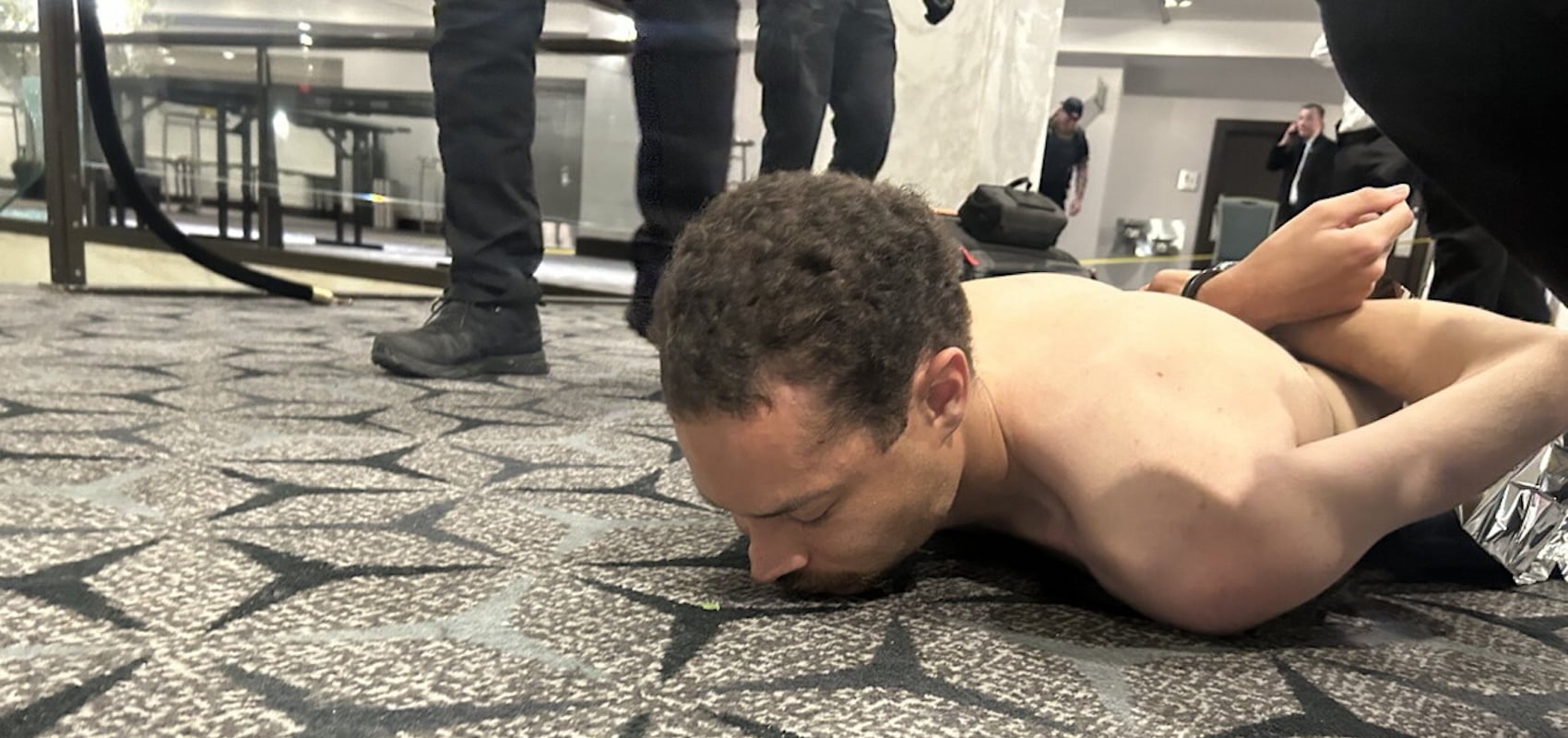
The most terrifying and telling contemporary piece of American writing is about a thousand words long. It wasn’t composed by one of our better poets or novelists, nor was it expressed by a richly compensated comic on late night TV or an articulate journalist on a popular podcast. It was shared, without much fanfare, by Cole Tomas Allen, a teacher from Torrance, who minutes later grabbed his shotgun, a handgun, and a few knives, rushed toward the ballroom of Washington’s Hilton Hotel, and attempted to assassinate the president of the United States.
What can we learn from Allen’s manifesto? For one thing, four years at Caltech, his alma mater, did not provide Allen with the instruction necessary to write a simple, coherent English sentence. Imagining himself in conversation with an unnamed objector to his plan, Allen responds: “Rebuttal: I need whoever thinks this way to take a couple minutes and realize that the world isn’t about them.”
“Whoever” here serves as the subject of its own subordinate clause. Some may quibble that “whomever” is the proper form in this position, but let’s allow the colloquial use, making the sentence technically correct. Nonetheless, it is convoluted and poor. The sentence starts out rigid and formal—the “rebuttal” at the beginning reads like something out of an official debate tournament’s proceedings—and then slides into sloppy slang with formulations like “a couple minutes.” And the objection to killing a country’s leader posed by the imaginary friend is, of course, never answered. It is waved away with an irrelevant platitude.
Okay, I hear you snickering: This is a would-be assassin we’re talking about, and would-be assassins are not a subspecies we usually applaud for eloquence or the ability to think clearly. True enough! But compare Allen to other political shooters, failed or otherwise, and a gnawing truth emerges, revealing Allen to be different and much more dangerous.
How so? Consider his predecessors. Examine our rogues’ gallery of politically motivated shooters, and you’ll see that they largely come in two flavors. Some are schizoid maniacs, like John Hinckley Jr., who truly believed the way to win actress Jodie Foster’s heart was by putting a bullet in Ronald Reagan’s. Others are wannabe revolutionaries. Shortly before assassinating two young employees of the Israeli embassy in Washington last year, Elias Rodriguez penned a dull, anti-Semitic treatise on how he was compelled to free Palestine . . . by slaughtering two people at a reception in America.
We’ve seen plenty of both kinds of nutjobs. But Allen is a different breed. As his manifesto and curriculum vitae both make clear, he’s neither a lunatic nor a hardened ideologue. He’s simply a young man from a good family with a great education who became convinced that storming into a ballroom, guns blazing, with the purpose of killing the commander in chief is a perfectly normal, even commendable, thing to do. Allen, in other words, is something we’ve never seen before: a wholesome, well-groomed shooter rooted deeply in the soil of our current cultural moment.
How did it come to pass that we produce people like Cole Tomas Allen? Easy. We grow them by making jokes like the one Jimmy Kimmel shared on his show just a few days before Allen’s attack, quipping that first lady Melania Trump had “a glow like an expectant widow.” We grow them by sharing political rants like the one former California congresswoman—and current gubernatorial hopeful—Katie Porter sent to her supporters just hours after the shooting with the subject line “F**k Trump,” arguing that Trump is willing “to kill people in the streets” and must be stopped by good people willing to do whatever it takes. We grow them by applauding ghouls like Hasan Piker, the internet star who famously quipped that America deserved 9/11 and that the streets should run red with the blood of the rich—and who was rewarded for his wisdom by the New York Times, the Democratic Party, the mayor of New York City, and just about everyone else on the left.
Reflect on these examples, and many others like them, and you’ll understand something truly shocking. Allen’s manifesto doesn’t read like an unhinged screed; it reads like standard Democratic talking points, the kind you find in mainstream newspaper columns or cable news segments.
“I am no longer willing to permit a pedophile, rapist, and traitor to coat my hands with his crimes,” Allen wrote, sounding every bit like Rep. Ted Lieu of California, who, earlier this year, spoke publicly about “highly disturbing allegations of Donald Trump raping children” and threatening to kill them.
“I would still go through most everyone here to get to the targets if it were absolutely necessary,” Allen explained before embarking on his violent quest, “on the basis that most people *chose* to attend a speech by a pedophile, rapist, and traitor, and are thus complicit.” Earlier this year, Democratic senator Cory Booker delivered a thundering speech arguing that America is in the throes of a “constitutional crisis” and that, therefore, “silence is complicity.”
And anyone attending the anti-Trump “Hands Off” rallies last year—a roster that included a long list of Democratic lawmakers, including representatives Ilhan Omar and Jamie Raskin—saw an abundance of signs that read, simply, “Hands Off or Heads Off.” Allen obviously agreed.
It’s of little use, therefore, to write doleful opinion pieces advocating civility or to issue statements calling on both sides of the political aisle to turn down the temperature. In the first place, what we have here isn’t a both-sides problem: It’s the rapid and terrifying descent of one political party and its satellite institutions into a state of boundless bloodlust, which is why we’ve had three attempts on the president’s life. Very little effort has been made to change the cultural tenor or consider the consequences of such unbridled incitement. And second, what we’re witnessing here isn’t a political crisis but a moral one. People like Allen—a Christian, as his manifesto makes clear—choose to abandon their common sense and their faith alike, subscribing instead to some dark, atavistic, and entirely pagan worldview that preaches tribal loyalty and consecrates violence.
This choice is pure evil, and evil is difficult, if not impossible, to cure. We must offer prayers for those who succumb to this ideological inflammation and a helping hand to those who may still be saved. But we need to do more: Let us put an end to the madness now with steely determination and great fury.
How, exactly? This very important question should become the chief concern of those in positions of authority, from legislators pondering what to do with speech that leads directly to violence to law enforcement officials who must now orchestrate some societal-scale version of the broken windows theory—call it broken minds, or broken hearts—and nip small acts of lawlessness in the bud before they bloom into something big and bloody. Well-paid radicals disrupting the work of federal agents, rich kids tossing bespoke Molotov cocktails at police cars while engaging in recreational Marxism, Free Palestine marauders waving the Hamas banner while blocking access to hospitals or airports: Treat them all with the full severity of the law, not to neutralize a minor nuisance but to cut out a cancer about to metastasize.
The necessary official response, however, is just the beginning. To stop the descent into a madness that sees murder as a moral imperative, it’s incumbent on the rest of us to grasp the true proportions of this epidemic and act accordingly. A political crisis may be resolved with good-faith dialogue, with attentive listening, with reasonable allowances and concessions. A moral crisis, as America’s own history has painfully taught us, can only be resolved by offering a complete, utter, and resolute rejection of depraved actions and beliefs. It’s time for universities, foundations, and institutions such as the New York Times to treat individuals like Porter, Jeffries, Booker, and Omar as what they are: dangerous zealots who wish to end our 250-year-old experiment in self-governance by encouraging a few well-placed shots.
We can’t afford to tolerate such moral cretinism and malice. We must end this madness before a thousand more Cole Tomas Allens emerge.
Image by Dana Verkouteren via ASSOCIATED PRESS.


YOU MIGHT ALSO LIKE
The Boys on the Brink
In the latest installment of the ongoing interview series with contributing editor Mark Bauerlein, Leonard Sax joins…
Serial Liar, Serial Comma
How would you write a public letter that you know will become front-page news? Would you write…
Who Killed the Clancy Children?
After a Massachusetts jury failed to convict Lindsay Clancy of strangling her three small children to death…
