
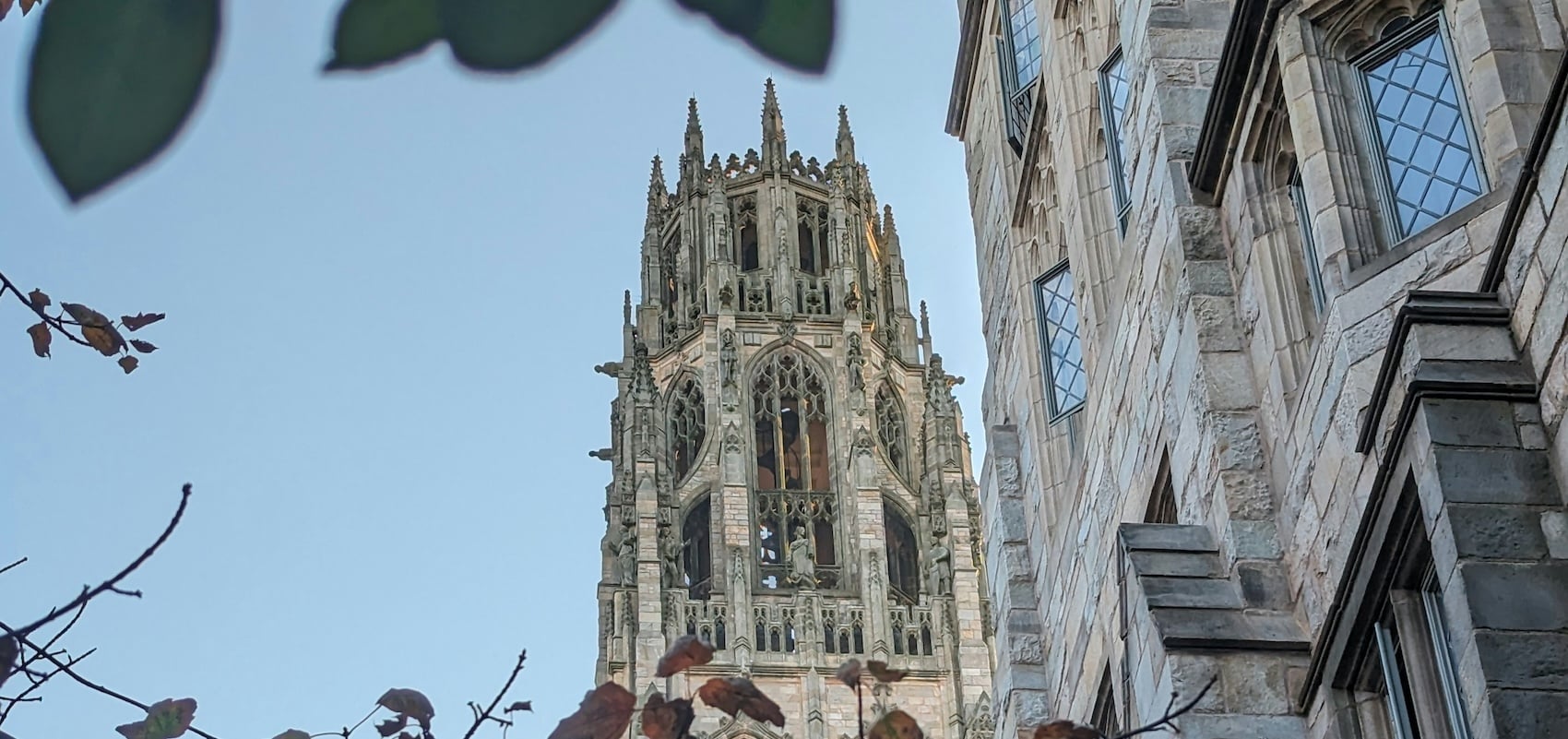
During the fall semester of 2013, I began to teach a new course here at Yale: The Catholic Intellectual Tradition. Even though the course had no track record (and therefore no student evaluations), around twenty students dared to take it. Thirteen years later, the enrollment was up to eighty-five, making it the most popular undergraduate course offered by the history department. Yes, history.
This surprising enrollment fact was made known in Slate by Sergio Infante, one of the teaching fellows assigned to the course: “I Teach at Yale. There Are Gen Z Catholics All Around Me. I Know What Must Be Done.” The subtitle of the essay assertively declares: “Universities need to do more to connect with an increasingly religious student body.” As one might expect, the essay has drawn a bit of attention from the world beyond downtown New Haven.
Ever since 2013, this class has attracted highly motivated students who are eager to explore a dimension of thought previously hidden from them, simply because the texts we read and discuss have not been part of their education. Surprisingly—and shamefully—this applies to Catholics who have attended Catholic schools from kindergarten through high school as much as to those who haven’t. Unsurprisingly, it also applies to Protestants, non-Christians, and others with no religious affiliation. It is easy to notice the intensity with which students in this class grapple with the reading, regardless of their background. I have always gotten the impression that for a large number of them, the reading is more than an assignment. Of course, this can happen in other classes too. But I’ve been teaching for over fifty years, and I’ve never felt or seen this kind of intensity in any other course of mine, including those, many years ago, in which all the students were monks and seminarians.
This course is one of the best things that has ever happened to me, in many ways. I say it “happened” to me because its creation was an unplanned collaborative effort. My partner in crime was my colleague Jeff Brenzel, a philosopher. He’s the one who provided the flint and spark with which the fire was kindled. It all began as a conversation, initiated by him, about what kind of course could best introduce Yale students to Catholic thought. After several conversations, the two of us and a third colleague who joined us, literary scholar Giuseppe Mazzotta, agreed that the best approach would be to immerse students deeply in the reading of primary texts—the real stuff written by great minds—and then ask the students to analyze them and put these texts in conversation with one another as well as with present-day concerns.
From the start, we agreed it would also be best to expose the students to multiple strands of Catholic thought, that is, to texts written by theologians, churchmen, philosophers, mystics, poets, novelists, historians, artists, social and political activists, and authors who defy categorization. Simply put, we hoped our class would awaken the students to how truly catholic Catholic thought is, in every sense of that lowercase word.
Coming up with a title that students might find alluring is always a challenge, but since we didn’t have funding to hire an advertising consultant, we settled on “The Catholic Tradition,” which was generic enough to stir up curiosity while relaying basic information. But something odd happened. When the official class listings were posted, I was shocked to see that someone had inserted “Intellectual” into the course title, right in the middle, between “Catholic” and “Tradition.” I never asked anyone how that word got there. I took it to be providential and a very great thing, a wonderful thing, to have that bit of clarity and truth in the course title. That additional word instantly turned the course title into a positive assertion of something that our secular age loves to deny or deride.
Sure enough, I quickly received proof of the enduring prejudice that can surround all things Catholic, even at the highest levels of our culture. Upon learning of the course’s existence, one colleague asked: “Catholic Intellectual Tradition? Isn’t that a contradiction in terms?” Some weeks later another puzzled colleague asked: “Why are you teaching that course? You’re not Catholic.” When I informed that colleague that I was indeed a Catholic, astonishment was the immediate facial response, followed by a brief silence, and then some stuttering: “But . . . but . . . you’re so tolerant!”
The course attracts seekers of all kinds, from a wide variety of backgrounds, and from every continent except Antarctica. What are they seeking? Hard to say. I reckon that there are as many different good things being sought as the sum total of all the students who have enrolled in the class for the past thirteen years. A solid core of the students enrolled every year is Catholic, yes, but I don’t have any numbers or percentages to cite. I’ve never polled the class members on their religious upbringing or faith identity, or asked whether or not they are religious in any way. That’s not my business, and those issues don’t matter to me. Besides, identity issues should not in any way determine what is read, or what is said or not said in lectures or in our weekly discussion sessions.
Occasionally, some students will reveal their religious identity—or lack of it—without prompting, spontaneously. What I have learned from them is that the identities in this class run the gamut from hardcore atheists to mystics who claim to have visions. Somewhere in between those two extremes, many of the world’s religions are also represented. All the big ones, plus small ones too, including occultists and bold seekers drawn to religion through psychedelic drugs.
What do we read? All of the texts are chosen for their significance and also for the range of opinions they have to offer. Week after week, without fail, the students encounter paradox after paradox, the very essence of Catholic thought, which runs like a red thread through all the texts we sample. And, for good measure, we also read some texts written by heretics. Stark contrasts place essential elements of Catholic thought in high relief. In fact, at another university, I once snuck in a survey course in the history of Christian thought past a dean who had previously opposed it by masking it with the title “History of Heresy.”
At the start of every semester, I always tell the class that the essence of Catholic thought can be summed up as “two thousand years of thinking about the deepest and most perplexing questions about human existence, especially mortality and the existence of evil.” This brief description applies to the tradition’s universal appeal. Then I turn attention to what is distinctively Catholic about it, adding that all this thinking “ultimately centers on the life and teachings of Jesus, and on how best to remain true to him and to a community of fellow believers that stretches over two millennia.” Catholicity, or universality, I stress, doesn’t only refer to space, that is, to the geographical reach of Catholic Christianity; it refers simultaneously and inextricably to time, to a community that consists of the living as well as the dead. This last bit about transcending space and time always seems to strike a chord. After half a century of teaching, one learns to read facial expressions fairly accurately.
So, yes, I agree with what Sergio Infante had to say. There is a hunger out there among Gen-Z students for what this course has to offer. No doubt about it. Are we talking about the vast majority of students? No, of course not. But there are still many young people out there in private and public institutions of higher learning who would greatly enjoy enrolling in a course like this one. The fact that they might be a minority shouldn’t matter. The seekers are out there, everywhere. If you offer the courses they need, they will surely come in droves.
Dear Reader,
Can I be direct with you?
War abroad. Socialists on the rise. AI upending human life. Endless uproar online. The modern attention economy doesn’t want readers — it wants users enslaved to the tyranny of the present.
First Things is the antidote: literary excellence, timeless truths, and a fixed point of reference in a culture that has lost its bearings.
But we can’t do it without readers like you.
Our goal: Raise $150,000 by November 1 to sustain First Things in the year ahead.
Your gift anchors readers in the permanent things.
Make your Fall Campaign gift now using the button below.
If you have any questions or would like more information, please contact Giovanni Del Piero, Director of the Editor’s Circle, at gdelpiero@firstthings.com or 212-627-1985.

YOU MIGHT ALSO LIKE
Why the Death Penalty Is a Sore Point for Papal Authority
Pope Leo XIV marked World Day Against the Death Penalty, observed on October 10, with the following…
Foucault’s Idol of Nothingness
Today marks the 100th anniversary of the birth of Michel Foucault. He was influential in his lifetime,…
Candace Owens and the Sin of Anti-Semitism
According to the online Encyclopedia Britannica, Sir Moses Montefiore (1784–1885) was “an Italian-born businessman who was noted…
