
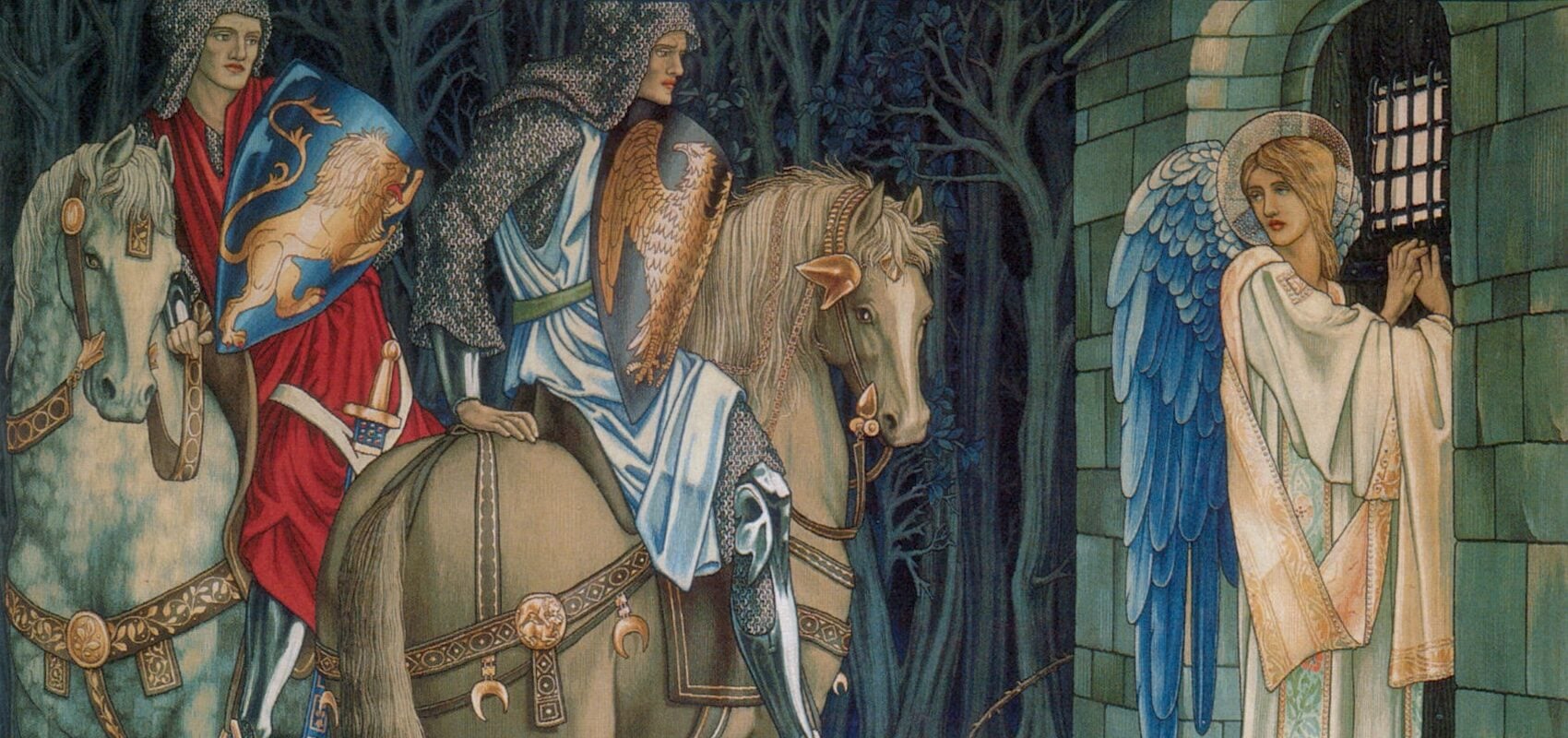
Fifteen centuries ago, in a land whose frontiers had collapsed, whose fields were overrun, and whose monarch was a fool, there was a man who held the darkness at bay. For thirty years, his soldiers few and his enemies many, he fought, cajoled, and bargained. He won improbable victories; he suffered inevitable defeats. At the hour of greatest crisis, when a horde of invaders under an invincible foe rolled across the land, assembled a fragile coalition, faced the enemy in open battle—and won. Three years later, the monarch he had served faithfully for his whole career stabbed him to death in a fit of jealousy. His name was Flavius Aetius, “the last of the Romans,” the only man ever to beat Attila the Hun on the field. He fought and died in the light of history, and you’ve almost certainly never heard of him.
Less than a century later, a Brittonic Celtic–speaking warlord achieved a similar feat on a much smaller scale, outside the scope of written history. The Saxons, who had been raiding British shores since the third century and settling them since the fifth, had been driving the Celtic Britons ever westward. Arthur, almost certainly a war leader rather than a king, turned the tide. He won twelve victories, later writers said, the last and greatest of which was at Mount Badon (location unknown). Much later, he fell in battle at a place called Camlann (location also unknown) along with one Medraut, who may or may not have been his opponent. His name was Arthur, and you’ve definitely heard of him.
You probably know a very different Arthur. The Arthur who was the son of Uther Pendragon, High King of Britain. The Arthur who drew the sword from the stone with Merlin’s help, who reigned in wisdom and righted wrongs. The ruler of Camelot, the presiding genius of the Round Table, the king whose knights found the Holy Grail. The Arthur who married Guinevere, was betrayed by Lancelot, and was mortally wounded in battle with Mordred. Taken to the Isle of Avalon by Morgan le Fay, he slept there until the hour of Britain’s need.
I grew up reading these stories, too. Indeed, I read them in Arthur country. The gentle green hills, gray capes, and watery plains of southwest England are thick with Arthurian legend. Here the Brittonic Celtic kingdom of Dumnonia and its rump state of Kernow were the last part of England to fall to the Saxons. Here a Brittonic language (Cornish) survived into the eighteenth century and was successfully revived in the twentieth. Here, too, are the legendary places of Arthur’s conception and burial—Tintagel and Glastonbury—and the location of his court in the oldest sources, at Kelliwic in Cornwall. It does no violence to the sources to reconstruct as the historical Arthur a Dumnonian prince whose heartland lay in southwest England and south Wales, but whose battles spanned the length and breadth of the island. His gains were ephemeral. After his death, the Saxon advance resumed, and more of his countrymen sought refuge across the sea in Brittany.
Traces of Arthur over the following five centuries are scant and found in Welsh or Latin rather than Cornish or Breton. A sixth-century poem from northern England, the ninth-century Historia Brittonum, and the tenth-century Annales Cambriae all mention him. Among the earliest surviving works of Welsh prose, Culhwch and Olwen, from the eleventh or twelfth century, features him prominently along with such familiar heroes as Kay. But relatively few of the protagonists and incidents in the surviving Welsh sources feature in the main story of “the Matter of Britain,” as Arthur’s tale would eventually be called.
The story we know comes down to us from two distinct twelfth-century versions. Geoffrey of Monmouth’s pseudo-historical Historia Regum Britanniae (c.1135), the first work to incorporate Uther and Merlin and to make a major character of Mordred, deals with Arthur’s war against a fictitious Roman emperor. The familiar story of quests, Lancelot, and the Grail first appears in works by the French poet Chrétien de Troyes from 1170 onward. All subsequent medieval and Victorian retellings of the story, from Wolfram von Eschenbach to Thomas Malory to Alfred Tennyson, take place in Chrétien’s chivalric setting rather than Geoffrey’s political one. Both Geoffrey and Chrétien appear to have drawn on an extensive but now-lost Breton tradition which must have passed into French and entered wider circulation by 1100. The earliest artistic representation of Arthur, on the cathedral at Modena in northern Italy, dates to around 1120, and the story it depicts has been lost from the literature.
For the rest of the Middle Ages, the Matter of Britain enjoyed a popularity in Europe greater than the Greek myths and second only to Bible stories. Arthur became the beau ideal of the Age of Chivalry, outshining Charlemagne, Roland, and Siegfried, as well as Hector, Achilles, and Odysseus. From Wales to Bohemia, Sweden to Portugal, his stories were sung, translated, read, and retold: endlessly woven and rewoven into the imagination of Western Christendom and later the modern world. Each retelling and each author bring out something new—a character, a relationship, an adventure—adding luster and depth to the whole.
Arthur transcended history, and he did so despite apparently heavy handicaps. His stories spent six centuries on the wet western margins of Europe, passed down in languages no self-respecting aristocrat would speak, by ungovernable peoples everyone made jokes about. No historians recorded them; no people claimed them as their epic. They were never taken up by a poet of genius like Homer, nor embedded in Holy Writ like the stories of the Old Testament. No saints feature in them, no pope gave sanction to them, and the religious mystery at their heart—the quest for the Holy Grail—had, if any precedents, heretical or pagan ones. Last but not least, the Matter of Britain ended in failure, betrayal, and the deaths of almost everyone involved.
So why, given all of this, did Arthur come to shine so brightly and for so long? The current scholarly trend, to rationalize him as a propaganda figure in twelfth-century power politics, misses the point. Those politics were as irrelevant to Thomas Malory or Alfred Tennyson as they are to us—as they were, indeed, to contemporaries in Italy or Scandinavia. Geoffrey’s Arthur the Conquerormay have offered kings a flattering mirror, but that wasn’t the Arthur who passed into the popular imagination: The story of the war against Rome becomes progressively less important in subsequent retellings, and the knights—particularly Lancelot, Tristan, and the Grail knights—displace Arthur as protagonists.
Instead, perhaps, we should look at the apparent handicaps of the Matter of Britain as hidden strengths. Its accumulative nature, the absence of a canonical text, allowed it to keep only what was enduring and to adapt for new audiences. The Welsh had plenty of cause to tell stories in which the Saxons were the villains, but the surviving Arthur tales in The Mabinogion are largely about the deeds of individuals in Arthur’s court and don’t feature Saxons at all. In “The Dream of Rhonabwy,” as in much of Malory, Arthur is notable for the heroes he gathers around him. Their names have very little overlap with the romances, but the spirit is the same. These are not men whose task is to do Arthur’s will or to represent his authority, but individuals who retain their own freedom of action. Indeed, when Arthur offends one of them, Owain ap Urien of the northern kingdom of Rheged, he gets the worse of the encounter. An elegy for Owain survives, giving a sense of how Arthur’s contemporaries spoke of their heroes:
The soul of Owain, Urien’s son—
May the Lord note its needs.
Rheged’s prince hidden deep under heavy turf—
No shallow matter to sing his praise.
An underground cell for this glorious hero—
His spear in flight like the wings of dawn.
You’ll find none to compare with him
Prince of joy, prince of brilliance.
The Matter of Britain concerns individuals. It has no interest in collectives or institutions, features no res publica or abstract state, and in this remains thoroughly Celtic while being congenial to a medieval reality that fell short of this ideal. Every individual owes fealty only to other individuals, to his own heart, and to God. Malory’s Arthur has no power to prevent all the knights of the Round Table from devoting themselves to the Grail Quest. He tries to stop them, all too aware how many will never return, but they retain the freedom to seek a greater good than the well-being of his court and a prize beyond earthly glory.
In this, they resemble less the knights of their own age, who sought and needed lords to serve, than the Irish monks who left home and kin on Erin’s shores to sail where God’s winds blew them. Seeking the green martyrdom of solitude and the white of exile, some made retreats on distant, empty shores—Iceland, the Faroes, the Azores. Some brought Christianity to the Hebrides and learning to feud-ridden Frankish courts. Some found only their end in the sea’s maw. So, too, Arthur’s knights set out into dark forests and sorcerous castles, each to face peril and temptation alone. In this they are all of us. The great joys and sorrows of life, the transitions, the mystery of death and what lies beyond may be the easier for company and the less terrifying for belief, but they can be endured only in our own selves. Of this realm of feeling and experience, history, with its consequentialist metric of success, has nothing to say and no wisdom to offer.
Arthur’s knights are like us, too, in that they have no map to life and, with the exception of the superhumanly virtuous Galahad, no explicit divine guidance at every turn.They stumble through the world as best they can, fighting brothers and friends they fail to recognize, taking on battles they can’t win, and falling in love with women they can’t marry. Sooner or later they come up against their own limits, as Palomides does when he realizes Iseult will never love him, Lancelot when he is allowed only a glimpse of the Grail, or Gawain on his deathbed seeing too late the deadly consequences of his anger. Indeed, Gawain, with his litany of failings, is perhaps the most universal character in the whole cycle.
The compass of the knights is not success but integrity, which necessarily takes different forms for each of them. Gawain must deal with the Green Knight (a story from a northern English tradition, not found in Malory) within the constraints of chivalry, which preclude any form of trickery. Were Odysseus, an inveterate trickster, confronted with the same situation, it would be no conflict with his values to resort to a stratagem. We form our opinion of characters not only by their adherence to the external values we might share, but also by how they stay true to their internal values. We are even led into sympathy for Lancelot’s adulterous love of Guinevere—which leads him to lie and provokes the final, fatal breakdown of Arthur’s fellowship—because Lancelot never breaks faith with her, treats his devotion lightly, or chases other women when she banishes him in fits of temper. One love may not be substituted for another, even with the best of intentions, as Tristan finds out with Iseult of the White Hands.
The individualism of the Matter of Britain, while Celtic in origin (Celtic battles were settled when possible by duels between champions, not by mass slaughter on the Roman model), is also a reflection of the age in which the stories suddenly caught fire and spread across Europe. The twelfth century also saw the ideals of courtly love and chivalry transform thugs into paladins and allow women to be properly seen for the first time. This is an individualism distinct both from its modern forms and from popular caricatures of the Middle Ages. It exists in the service of higher values: chivalry, friendship, and, most transcendently, the Holy Grail.
The Grail is an extraordinary and enduring newcomer to the cultural imagination in the Matter of Britain. Unlike the Holy Lance, with which it is associated, it had no great presence as a Christian relic before this, and its power as a symbol extends far beyond modern Christianity. We may search for its origins in Eastern mystery religions or Celtic legends and find harbingers there of its coming. But it is far more than the sum of its origins. In the Arthurian cycle, it is the climax of the whole, the achievement of a spiritual adventure for which all the outward adventures were only preparation. This quest, an interior journey into another world where mere skill at arms is no longer enough, is only possible in the world Arthur has built. The virtues fostered by his kingdom allow his knights the chance to seek a purely spiritual goal.
Here, again, we encounter the inadequacy of history as a source of meaning. From a purely historical standpoint, whether that of Marx or Bismarck, the Grail Quest is an absurdity: the kingdom stripped of its defenders for a magic bauble. How does that help the balance of power, or even the common good? It doesn’t. We are in a more radical—and radically Christian—world where the integrity of individuals and the salvation of their souls are the highest goods, and the calculations of brutal ideologues or Machiavellian powerbrokers are of no importance at all. It is a world, incidentally, from which the twelfth century, with all its faults, was much less distant than our own age of “sophisters, economists, and calculators,” ever obsessed with numbers, majorities, and abstractions: the individual as atom in a collective.
Arthur’s reign exists in a time of its own, and the Grail Quest in a timeless moment within it, another sign of its kinship to those journeys into otherworld or underworld that occur in all great stories. Lancelot, the most accomplished knight in the world, fails to achieve the quest: He may only glimpse the Grail. Others become lost or are struck down in moments of madness by their fellows. One French version has Gawain reproached for having unwittingly killed no fewer than eighteen of his fellow knights. Those who have not cultivated spiritual virtues as well as martial ones will never come close to the Grail. In Malory, the qualifying virtue is purity, though other Grail stories, such as Wolfram von Eschenbach’s Parzival, place the emphasis elsewhere. In Celtic precursors of the Grail story, the sacred vessel will not serve a coward or breaks to pieces in the hands of a liar and may only be made whole by words of truth.
The Grail stands against history, not within it. To borrow an apposite phrase from W. H. Auden, it “calls into question / All the Great Powers assume.” Of Malory’s three Grail knights, Galahad and Percival withdraw from the world to die in a state of grace, leaving only Bors to return with the story. He later takes the cross and dies in the Holy Land on Good Friday.
The Grail Quest accomplished, we move into the final act. Here the story of Arthur, the historical experience of his people, and the arcs of our own lives combine to strike a single chord. The ending of the Matter of Britain is more final than any of its peers. The Iliad and Odyssey, the Aeneid, and the Gospels all end with most of the protagonists still alive and many great works still to come. Not so the Matter of Britain. Lancelot and Guinevere’s infidelity, Gawain’s anger, Arthur’s impulsiveness, and Mordred’s treachery create the perfect storm, which destroys them all in the end. The carnage associated with Camlann is one of the few details common to the historical sources, the Welsh legends (which count only three survivors), and the chivalric romances (“a hundred thousand dead”). By fatal mischance, Lancelot and his kindred arrive too late to help, but a melancholy coda chronicles their deaths and Guinevere’s in the wintry years that follow.
Here the Matter of Britain walks beside history, if not in step with it. The Britons had already lost their island once, to the Romans. In the century after Camlann, they lost it again to the Saxons and would lose it even more thoroughly to the Normans and the English. For them, the experience of most of the last two millennia had been one of defeat, oppression, and the heartfelt loss of all they held dear. In this they resemble the Jews. Neither people could fool itself that History (or her medieval counterpart, Fortune) was on their side. Denied the easy equation of present success with providential favor, both peoples had to look deeper and make meaning from misfortune. Lives lost, defeats suffered, and lands seized could not be absorbed into a flattering narrative of adversity overcome by willpower, God, or manifest destiny.
But the deaths of young men fighting in a hopeless cause could not be left without meaning. Like the penitential psalms and the lamentations of Jeremiah, Welsh poetry transmutes loss into beauty. The oldest extant Welsh poem, Y Gododdin, which contains the first reference to Arthur, is a series of elegies for the dead of a lost battle, each for an individual warrior. A thirteenth-century lament for the death of the last prince of Gwynedd conveys the agony of a people for whom ills seemed boundless and the whole order of the world upturned. How in all justice could the English and their rapacious, vindictive king have triumphed yet again, and with such finality?
See you not the sun hurtling through the sky
And that the stars are fallen?
Do you not believe God, demented mortals?
Do you not see the whole world’s danger?
Why, O my God, does the sea not cover the land?
Why are we left to linger?
There is no refuge from imprisoning fear
And nowhere to hide—O such abiding!
Whatever bardic elegies were written for Arthur have been lost. But the medieval poets and romance writers knew well that his story was a tragedy. Even though only the very end of Malory’s work concerns the fall of the Round Table and Arthur’s death, that part gives the whole its title. Le Morte d’Arthur is a tragedy with another, incomplete tragedy (Tristan and Iseult) nested within it, along with a series of adventure romances and the inner journey of the Grail Quest. In any version of the story, the moment we hear the names Uther, Merlin, or Arthur, we know Guinevere, Lancelot, and Mordred are on their way. We know where the road ends, but we still consent to walk it.
And why? Because, in the Matter of Britain, earthly success was never the highest good. We arrive at Camlann fortified by the brightness of the Round Table and the mystery of the Grail, borne on a Christian understanding of life with very deep roots. But this is both a Celtic and a Christian story, and the Celts believed in other worlds and other lives before Christianity ever came to their shores. Finding the long view into eternity far more familiar than had the time-bound Romans, both the Britons and the Irish adopted the faith without coercion. Nor do they seem to have shared the expectations of the Romans and Anglo-Saxons that it was essentially a magic formula for victory.
As a result, while the ending of the Arthur story is wintry and elegiac, it’s never as bleak as King Lear. Lear lives and dies in a classically pagan universe of indifferent gods, in the same spirit as Macbeth’s time-haunted “Out, out, brief candle!” In Malory’s version, unlike Geoffrey’s, Arthur dies, but his story goes on: Rex quondam rexque futurus. Requiems are sung for Gawain, Guinevere, and Lancelot, their earthly errors commended to the mercy of God. Neither judgment nor doom hangs over the ending: Lancelot takes the habit from a sense that his knightly life is done, not in fear of hell. Death is not the end for any of the characters, and even though Lancelot’s sins may keep him from attaining the Grail, we trust in his salvation. When he dies, there is a smile of joy on his face. Unlike the classical epics or even the Old Testament, in which life after death is a shadowy half-existence in Hades or Sheol, the Matter of Britain is suffused by the life of the world to come.
What it does have in common with the Trojan Cycle and the Bible is an origin from the courts of kings and the preoccupations of empire. Homer’s Achaeans were pirates and raiders, opportunistic gadflies at the edge of the Bronze Age world. The word Hebrew derives from various roots, but they all have the sense of “stranger, wanderer, nomad, someone from across the river,” dismissed like Galilee was by Jerusalem. The “Great Powers” of their days were equally contemptuous of them all. And though Macedon spread Greek culture across half the known world and Byzantium preserved it, neither produced in those long imperial centuries any literature with such lasting power. All through their most fertile epochs, the Greeks, like the Jews and the Celts, were marginal, divided, and quarrelsome, nuisances to the order of settled empires.
Yet their stories, their poets, and their prophets are the ones we still know. Rome adopted the Jewish God, Italy Greek myths, France Breton lays. English folklore is overshadowed by a Welsh warlord, while neither Roland nor Siegfried ever transcended his native language like Arthur did. The early literature of these people of the edge speaks to the human soul across boundaries of language and culture, in a way their more prestigious neighbors, and indeed their own later efforts, did not.
This may be in part because legacies of defeat and loss mirror the arc of life more truly than those of collective triumph. Standing in the way of easy answers, they force both literature and faith into deeper engagement with the human experience. It may also be because these cultures never lost sight of the importance of the individual, nor were they prepared to give up that individuality for a collective dream of power. Celtic kingdoms were fragile, fissile things, waxing and waning from one generation to the next, because authority was something every leader had to earn afresh on his own merits. Power depended on character, and at death it either disappeared or passed into legend. If we know little more about Dumnonia or Rheged than we do about the historical Arthur, it’s because those kingdoms as polities were less significant in the Celtic worldview than the heroes who led them. This attitude permeates Y Gododdin and is explicit in the title of another sixth-century poem, Rheged, Arise, its Lords are its Glory.
Even though Arthur failed, even though the Britons’ lands were lost, they told stories about him, his exploits, and the heroes from various parts of the Brittonic world who fought at his side. They remembered him not for his successes in statesmanship, but for his qualities as a man; not for the prudence of his policies, but for the character of his companions. They remembered him for universal virtues such as courage and generosity, and for familiar failings such as anger and impulsiveness. They did not judge him against impossible standards of achievement, nor find him wanting for falling short of perfection. So well did they remember him, and so powerfully, that when their stories were at last translated, centuries later, even their enemies adopted him as one of their own.
This is the core of why we remember Arthur and not Aetius. The stories of Arthur’s deeds, real or fictional, are told because of who he was, not because of which state he served or even what he accomplished. His people remembered him in terms of his relationships. In doing so, they made it possible for others, including us, to have a relationship with him, too. We speak of him and weave new tales about him. So do the Welsh, who are still here when their more celebrated and historically “successful” foes—Romans, Saxons, Normans—no longer recognizably exist. To tell the stories (not the histories!) of your own people, to hold true to your own language or your own faith even in the face of failure and defeat, is to bequeath a far greater treasure to your posterity—and to the world—than the delusions of empire. Arthur’s people and their descendants never lost sight of those goods, and we are all the richer for it.

YOU MIGHT ALSO LIKE
After Disenchantment
What does the phrase “disenchantment of the world” mean? Disenchantment is easy to identify and even easier…
Form vs. Monsters
The nature and aims of Catholic fiction have been a matter of debate for generations now. What…
Seeking God, Finding the Devil
On the wedding night of his second marriage, August Strindberg (1849–1912), the Swedish writer, painter, polymath, and…
