
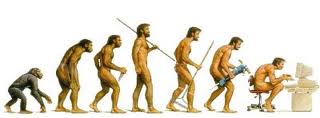
 I am not engaged in the Darwin wars, but sometimes advocating for human exceptionalism rubs hulls against some theorists who take Darwinism out of biology, and into subjective realms of human culture and behavior—as if we are slaves to implacable natural forces. Here’s an example. David Sloan Wilson, a professor of biology and anthropology argues that a new social Darwinism should be pursued that promotes equality rather than inequality, as in the former version.
First, he explains why Darwinism and public policy has a bad reputation. From the column:
Why is the concept of evolving the future so new? One reason is that evolution has traditionally been used to justify social inequality and the status quo; evolutionary change requires winners and losers, and helping those who have ”lost” in life’s struggle, so the argument goes, is plain contrary to nature. This is an idea that came to be called Social Darwinism.
Well, at least he admits it. How often do we see some defenders of Darwinism deny that history? Back to Wilson:
Not only can genetic change take place in a single generation, but cultural change counts as an evolutionary process in its own right. Even when evolution has made things that are hard to change, we need to know about these more enduring aspects of human nature so that we can design our current environments accordingly. We design zoos so that wild animals will feel at home so why not our own environments?
But that isn’t evolution, which is random, purposeless, and has no end goal. It is, if you will pardon the use of a controversial term, intelligent “design.” What a hoot.
Wilson is arguing we should look at scientific understandings of human behavior to help fashion policies—which is fine. But I suspect that he is also saying, at least between the lines, that evolutionary science backs his politics. How convenient. Be that as it may, this is clearly wrong in my view:
Evolutionary theory embodies our best scientific understanding of what living organisms are and how they came into existence. For every other animal it seems obvious that the body and brain of that animal were designed in particular ways because of the environments in which they evolved. It is hubris to think that we humans are an exception.
To the contrary. It is ridiculous to think that we haven’t to some degree escaped the impersonal and environmental forces that forge and drive the natural world. Sure, physically we are the sum of our biological history. But we are concomitantly, much greater than the sum of our biological parts.
Humans are exceptional, in part, because we have subjective capacities to choose the kinds of cultures and societies in which we want to live—the very task to which Wilson is calling us. In other words, we are not just gene machines reflexively reacting to stimuli like jukebox ball bearings hit by the paddles. We have free will. We are conscious. We are rational. We are moral agents. We create.
Even if blind natural selection solely caused us to evolve into our unique inherent natures, the consequences of that process have clearly been unprecedented. We are the exceptional species that no longer simply reacts to environment. We make the environment react to us.
Dear Reader,
Can I be direct with you?
War abroad. Socialists on the rise. AI upending human life. Endless uproar online. The modern attention economy doesn’t want readers — it wants users enslaved to the tyranny of the present.
First Things is the antidote: literary excellence, timeless truths, and a fixed point of reference in a culture that has lost its bearings.
But we can’t do it without readers like you.
Our goal: Raise $150,000 by November 1 to sustain First Things in the year ahead.
Your gift anchors readers in the permanent things.
Make your Fall Campaign gift now using the button below.
If you have any questions or would like more information, please contact Giovanni Del Piero, Director of the Editor’s Circle, at gdelpiero@firstthings.com or 212-627-1985.

YOU MIGHT ALSO LIKE
The Church in the Age of Therapy
In 1966, Philip Rieff wrote in The Triumph of the Therapeutic that “Religious man was born to…
Canada’s Deadliest Blind Spot
On September 20, the Daily Mail ran a story with the provocative headline, “Our 83-year-old Christian grandmother…
The Faithful Joy of Dolly Parton and Fulton Sheen
Dolly Parton and Fulton Sheen seem to have had little in common. She favored rhinestones; he wore…
