
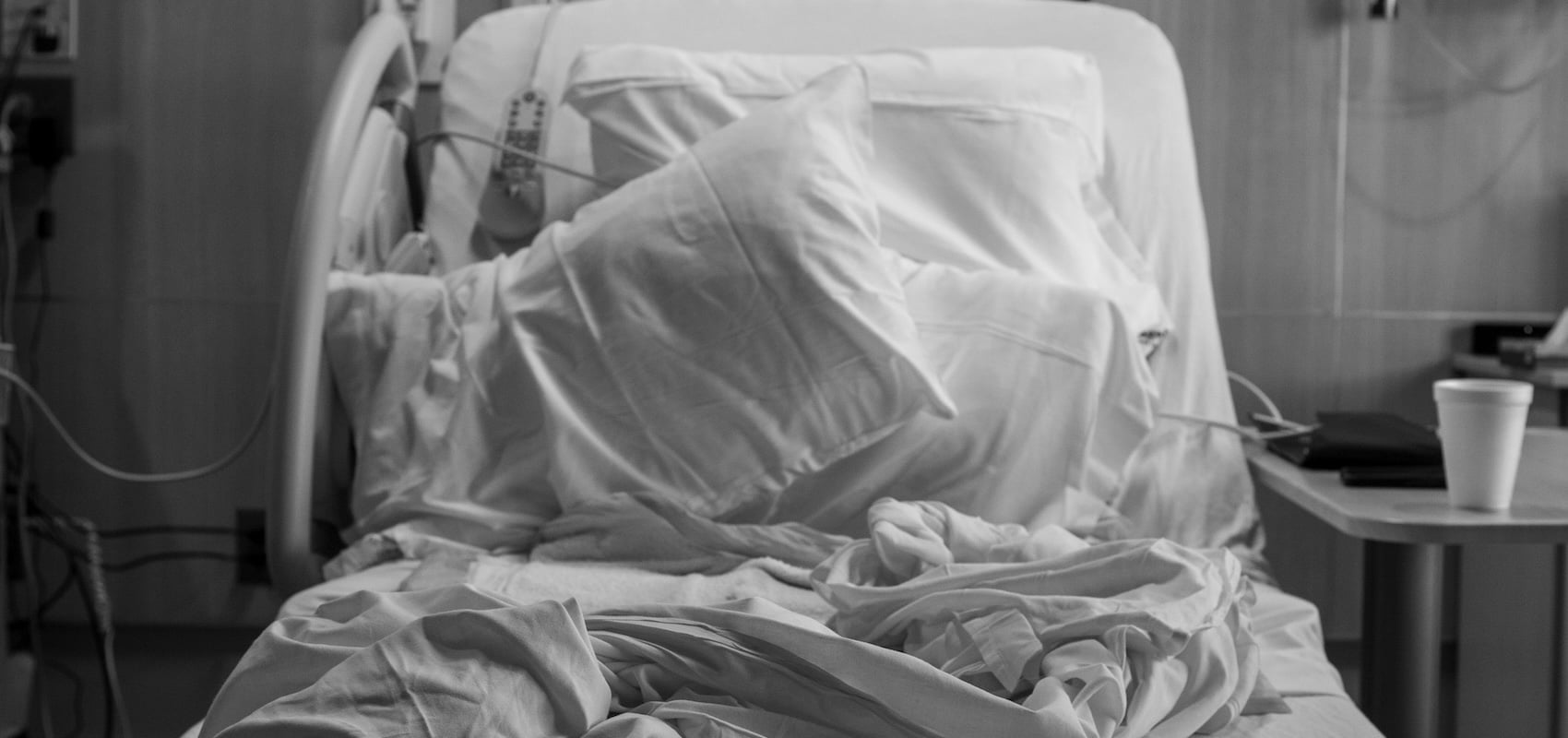
On September 20, the Daily Mail ran a story with the provocative headline, “Our 83-year-old Christian grandmother was euthanised against her will under Canada’s assisted dying system—she died covered in blood with her hands clasped in prayer.” The old newsroom adage “If it bleeds, it leads” is obviously still very much in effect in the U.K.
By now, the details of the case have been well rehearsed on multiple platforms. Eleven days following the death of her grandmother, Brigitte Kranendonk wrote a long Facebook post that laid out the sorry saga. In mid-August, a local news outlet was interested enough in the story that it interviewed Kranendonk and published the audio (although the page has been removed in the past forty-eight hours). Following the recent Daily Mail article, more international press outlets, including Fox News, took up the story.
Three months ago, eighty-three-year-old Brigitte “GG” Stegemann of Belleville, Ontario, was living in a residential long-term care home. She was in the last stages of stomach cancer, hard of hearing, and suffering from cognitive impairment. But Stegemann had clearly and regularly expressed both her desire to die free of pain and her refusal of, as she called it, the “death shot.” Despite this, Stegemann died by lethal injection on July 10.
By all accounts, the week or so preceding the death was confusing and exhausting. Healthcare workers claimed that Stegemann had consented to the MAiD (medical assistance in dying) procedure. But according to Kranendonk, paperwork was either missing or undisclosed, the care team refused to hand over medical records, and the team and the family were working at cross-purposes.
At the center was a distraught family stuck between a rock and a hard place: their desire to protect the emotional well-being of their dying grandmother, and an implacable system that had seemingly determined a MAiD death was the preferred outcome. At one point of tension, when Kranendonk asked who had raised the topic of MAiD with her grandmother, a nurse told her, “I’m just trying to advocate for her. I’m just trying to do what’s right for her.” In the hierarchy of Canadian healthcare, MAiD takes pride of place.
Kranendonk, who held the power of attorney of care for her grandmother, has since formally requested the death be investigated by the office of the chief coroner. She alleges the care home and attending physician acted in contravention of her grandmother’s wishes and either ignored or sidestepped several key requirements of the MAiD protocol. She specifically cites three areas of concern: Stegemann’s lack of capacity at the time of the MAiD assessments, the bypassing of the authority of the power of attorney, and the failure to obtain the required final verbal consent from Stegemann. Kranendonk simultaneously filed a report with the Belleville Police, and, according to an email received by the Daily Mail, the “incident is currently open and under investigation” with the Criminal Investigations Division.
In the days since the Daily Mail article was published, the Canadian online narrative has followed a depressingly familiar pattern. Former premier of Alberta Jason Kenney was first out of the gate on X: “If the claims made here are credible, the Crown must charge those responsible for the murder of Brigitte Stegemann.” Once Pierre Poilievre, leader of the official opposition, weighed in, it was game over: “The Liberal government must strengthen and enforce safeguards to protect vulnerable Canadians from pressure and abuse.” Suddenly the story became political. Everyone from the director of labor relations of a provincial nursing union to a university professor was saying it was all trumped-up lies, lies amplified by fascist U.S. media outlets that hate Canada and are beholden to Trump.
Somehow, in Canada, it always comes back to Trump—an easier target, I guess, than dealing with the obvious fact that Canada has a problem, and its name is MAiD. The international press, and not just the tabloid or right-of-center outlets, has repeatedly held up a mirror to Canada. In most instances, Canada has chosen to turn away.
Those accusing Kranendonk and her family of lying, citing all the magical safeguards and “peaceful” MAiD deaths they have witnessed, seem to shut their eyes to the cortège of tragic cases that have been occurring on an almost monthly basis. Twenty-six-year-old Kiano Vafaeian suffered from Type 1 diabetes, blindness in one eye, and depression. He had been denied MAiD by doctors in his own province but was approved by a doctor in British Columbia. His mother alleges her son was able to “shop around” the country to find a doctor who would sign off on his desire to die—which he did, by MAiD, in December 2025. A 2022 Spectator article entitled “Why is Canada euthanising the poor?” brought many such cases to an international audience—and proved to be the prestigious British magazine’s most-read story of the year.
Last year, the not-so-right-wing publication The Atlantic published “Canada Is Killing Itself.” The author didn’t even interview or cite any MAiD-critical doctors, legal scholars, or journalists. Instead, the reporting focused on several high-profile, active MAiD practitioners. The article simply presented the facts and let the policy’s biggest boosters speak for themselves. Earlier that year, the United Nations Committee on the Rights of Persons with Disabilities wrote a deeply critical report on the effect of MAiD on the disabled, following the 2021 expansion to those whose death is not reasonably foreseeable.
British Columbia Catholic journalist Terry O’Neill has spent the past six years submitting access to information requests regarding MAiD statistics and protocols and then reporting on what he finds. O’Neill told me, “The whole world is looking at Canada right now and holding Canada up as what not to do if you’re going to legalize assisted suicide or euthanasia. I’m finding all these things and the mainstream media in Canada can’t care any less than they care right now.”
Kranendonk herself told me that her goal in bringing attention to the story of her grandmother was a simple one. “Ultimately, people need to be informed that safeguards are not always explained and followed,” she wrote. Let us hope that amidst the shouting and fury, the blood and clasped hands, this very simple message prevails.
Dear Reader,
Can I be direct with you?
War abroad. Socialists on the rise. AI upending human life. Endless uproar online. The modern attention economy doesn’t want readers — it wants users enslaved to the tyranny of the present.
First Things is the antidote: literary excellence, timeless truths, and a fixed point of reference in a culture that has lost its bearings.
But we can’t do it without readers like you.
Our goal: Raise $150,000 by November 1 to sustain First Things in the year ahead.
Your gift anchors readers in the permanent things.
Make your Fall Campaign gift now using the button below.
If you have any questions or would like more information, please contact Giovanni Del Piero, Director of the Editor’s Circle, at gdelpiero@firstthings.com or 212-627-1985.

YOU MIGHT ALSO LIKE
A Culture of Parricide
I learned a new word the other day: déploration. It’s the French, directly from the Latin, for “lament.”…
Cornell’s Secret History
The editors discuss the NatCon in Jerusalem, the scandal at Cornell University and its broader implications, and…
The Second Death of Charlie Kirk
It used to be that if you died horribly and honorably and happened to be a person…
