
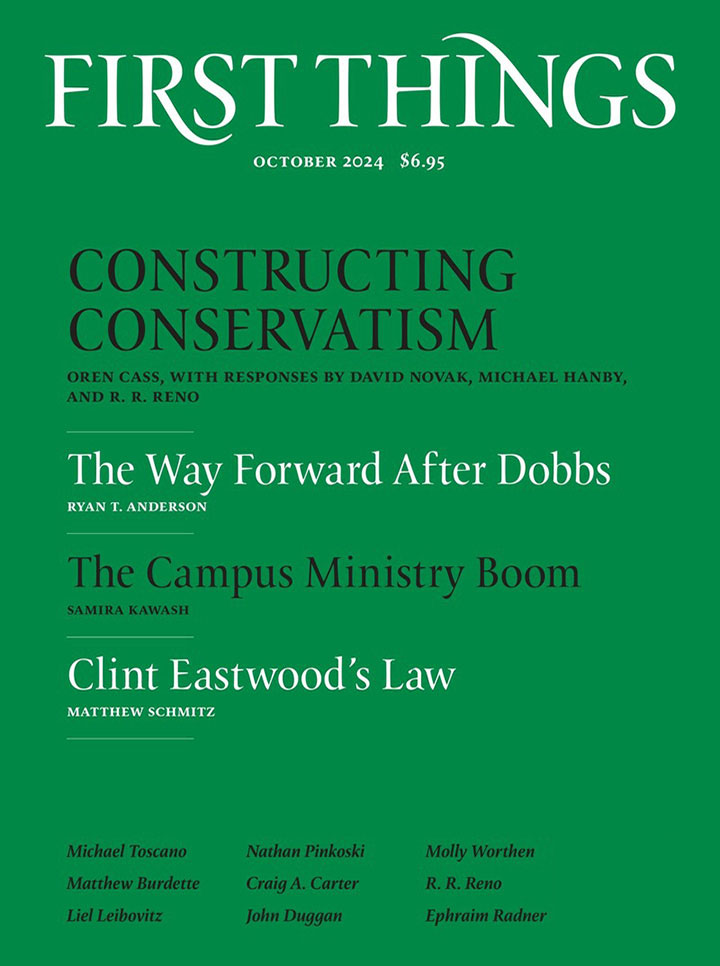
recently re-read The Vital Center: The Politics of Freedom. Penned by Arthur Schlesinger Jr. in the aftermath of World War II, the book is a marvelous combination of astute social analysis and political polemic. Schlesinger was very nearly the perfect embodiment of an established postwar figure: the partisan intellectual. I don’t disparage that role, for obvious reasons.
Born in 1917, Schlesinger came of age during FDR’s long tenure in the White House. The New Deal transformed the economic foundations of America, putting liberalism in the driver’s seat and giving it “a positive and confident ring.” The same liberal regime oversaw the American triumph in World War II. As he was writing in the late 1940s, on the crest of the American Century, Schlesinger could announce that liberalism stood “for responsibility and for achievement.”
The theme of a grown-up and “virile” liberalism runs throughout The Vital Center. Schlesinger’s main adversary is, by implication, the immature and naive progressive, whom he calls a “doughface” liberal. Show trials and campaigns of extermination had shown the Soviet Union to be an inhumane totalitarian regime, and the rise of fascism demonstrated modern man’s vulnerability to demagogues. “My generation,” Schlesinger observes, was reminded “rather forcibly that man was, indeed, imperfect, and that the corruptions of power could unleash great evil in the world.”
These two experiences—the positive achievements of New Deal liberalism and the looming peril of totalitarianism—shape the “vital center” that Schlesinger details through the 250 pages of his book. On the one hand, postwar liberals retained confidence in the capacity of social and economic experts. They proposed and implemented policies that aimed to improve the material and moral conditions of society. On the other hand, tutored by the horrors of tyrannical utopianism, the postwar liberals recognized that the essential task of our time is to defend “the ultimate integrity of the individual.” Social planning then and now must always be subject to a crucial test: Does it protect and promote freedom?
As the twentieth century was ending, Zygmunt Bauman coined the term “liquid modernity.” The basic insight had been formulated one hundred years earlier. In 1897, Émile Durkheim, one of the founders of modern sociology, published Suicide. He correlated the rise of suicide with the rapid industrialization and urbanization of society. The modernizing process had severely disrupted the thick, stable realities of agrarian life. Durkheim speculated that, deprived of strong norms and cast into an anonymous, rapidly changing commercial society, individuals became disoriented and distressed, a condition that tempted them to self-harm.
The analysis was deepened and extended by many social theorists in the early twentieth century. Schlesinger adapts it to explain totalitarianism. Industrialization and other modern trends have produced great benefits, he writes, but “at the expense of the protective tissue which had bound together feudal society.” The whirling wheel of technological change disorients. “Our modern industrial economy, based on impersonality, interchangeability and speed, has worn away the old protective securities without creating new ones.”
When individuals are deprived of a warm sense of belonging, freedom becomes a burden. “Man longs to escape the pressures beating down on his frail individuality; and more and more, the surest means of escape seems to be to surrender that individuality to some massive, external authority.” Thus the appeal of totalitarianism: “Against the loneliness and rootlessness of man in free society, it promises the security and comradeship of crusading unity.”
As John Owen explained in the last issue (“Liberalism’s Fourth Turning”), the leitmotif of the liberal tradition is freedom. What poses the greatest threat to liberty? How is freedom best promoted and protected? In Schlesinger’s telling, the anomie and atomization brought by modern technological change provide fertile ground for totalitarianism. The defenders of freedom must address this danger with economic management in order to moderate the dynamism of a capitalist economy. “We must somehow give the lonely masses a sense of individual human function, we must restore community to the industrial order.”
Schlesinger was aware of the paradox imposed upon his generation. There needed to be technocratic management to ensure social solidarity, but not so much as to usurp individual responsibility and smother individual freedom. Here’s one of his sweeping formulations: “We require individualism which does not wall man off from community; we require community which sustains but does not suffocate the individual.” He urges a defense of freedom that has the “virile” (he uses this term repeatedly) courage to take up the challenge of governing and guiding society in perilous times. There can be no set formula for attaining this goal. It requires a Goldilocks balance, enough technocratic management, but not too much—a “vital center.”
I admire Schlesinger and his cohort of postwar liberals. They were right about the unsettled condition of Western societies in the mid-twentieth century, which made them vulnerable to utopian politics of the left and right. They were correct to counsel against formulaic political programs. Politics is an art. We must identify the besetting diseases afflicting the body politic, which we can at best remediate and balance. The fall of man blocks any fantasy of a cure.
In Return of the Strong Gods, I argue that the vital center outlined by Schlesinger was unstable because it tilted in the direction of openness and deconsolidation. The postwar liberals recognized that we needed solidarity—trustworthy anchors in a modern world of accelerating change. But their anti-totalitarian consensus took a great deal for granted.
Schlesinger had the luxury of writing at a time when American society was swinging in a culturally conservative direction. Men returning from war married. There was a baby boom. Churches filled. New York governor Nelson Rockefeller’s political career was torpedoed when he divorced his wife in 1962.
Historians underestimate the signal importance of the strong moral consensus of those decades. The French speak of the three decades after World War II as the trente glorieuses, the “thirty glorious” years. Americans are less effusive. Race riots and Vietnam marred the 1960s. Nevertheless, those decades increasingly evoke nostalgia. It was a time of historically low income inequality. Politics was not rancorously partisan. A man working in a factory could buy a modest suburban home, support a family, and take an annual vacation to Atlantic City. Civic institutions were strong.
American stability, prosperity, and happiness during those years rested as much on cultural foundations as economic ones—perhaps more so. Those foundations have been eroded. Wave after wave of “liberation” has disintegrated the postwar middle-class consensus. That consensus has been derided as racist, patriarchal, homophobic, and xenophobic. As a consequence, the great majority of Americans are deprived of a solid, stable, and home-building moral and social consensus. Today, marriage is in tatters. Homes are broken. Our political culture is riven by bitter polarization. Our institutions are distrusted.
In the face of this disintegration, a new totalitarian temptation has emerged. It is not communist or fascist. Rather, it manifests in technocratic means of social control. Matthew Crawford recently reported on the British government’s schemes to blunt and suppress public hostility to mass migration. Jacob Siegel has documented the ways in which American elites and government officials have transformed the instruments used to prosecute the post-9/11 war on terror into a multifaceted domestic security state. The Covid lockdowns revealed that the people who are running things in the West have a strong appetite for social control.
It’s easy to become paranoid. I try to resist. But we must not be naive. In this tumultuous decade, we need someone like Arthur Schlesinger Jr., someone with the intelligence and imagination to explain to American elites that the cultural revolutions of recent decades have atomized our society, undermined solidarity, and disoriented the majority of Americans. We need a new vital center, a politics of moral and cultural reconsolidation that has the same courage to denounce the Human Rights Campaign that Schlesinger had in condemning the “doughface” liberals.
Dear Reader,
Can I be direct with you?
War abroad. Socialists on the rise. AI upending human life. Endless uproar online. The modern attention economy doesn’t want readers — it wants users enslaved to the tyranny of the present.
First Things is the antidote: literary excellence, timeless truths, and a fixed point of reference in a culture that has lost its bearings.
But we can’t do it without readers like you.
Our goal: Raise $150,000 by November 1 to sustain First Things in the year ahead.
Your gift anchors readers in the permanent things.
Make your Fall Campaign gift now using the button below.
If you have any questions or would like more information, please contact Giovanni Del Piero, Director of the Editor’s Circle, at gdelpiero@firstthings.com or 212-627-1985.


YOU MIGHT ALSO LIKE
Three TikToks in a Trench Coat
On today’s episode, Meagan O’Rourke joins Virginia and Germán. Reporting on Gen-Z trends has become trendy. It’s…
The Cold Beauty of Jan Morris
Jan Morris (1926–2020) was a writer of astounding gifts who not only recorded history but made it.…
The Survival of Evangelicalism
In the latest installment of the ongoing interview series with contributing editor Mark Bauerlein, Bonnie Kristian joins…
