
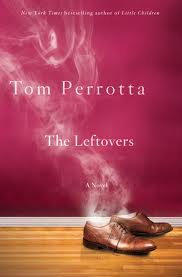
 I have a short book review of the interesting novel, The Leftovers, in the current First Things. Here it is for those who might be interested in reading a different kind of post “Rapture” novel. (no link):
No angel’s horn blew. The Risen Christ did not return with a shout. The dead remained in their graves. Instead, in the (sort of) Rapture of Tom Perrotta’s new novel, The Leftovers, millions of people suddenly and randomly evaporated—amusingly including Greta van Susteren—leaving emotional devastation in the wake of their silent and unexplained departure.
It’s a fascinating premise too often overlooked by most Rapture fiction authors who dwell (sometimes gleefully) on the sufferings of unbelievers left to face the Apocalypse. In contrast, the problem for the “leftovers” isn’t the Four Horsemen. It is that life banally goes on—and it is killing them.
How to cope? A tribe of neo hippies discard the “tune in” portion of Timothy Leary’s formula, and just turn on and drop out. “Holy Wayne,” a former UPS delivery man, becomes a world famous cult leader (with clay feet and other body parts) out of his empathetic ability to absorb his followers’ grief. Teenagers hollowly participate in sordid hook up parties. Meanwhile, the main protagonist, the mayor of a small town, strives earnestly to rebuild community normalcy by organizing holiday parades and soft ball leagues.
Perrotta’s most interesting creation is the “Guilty Remnant,” a band of unsmiling neo-monastics, who dress all in white, never speak, chain smoke (a funny bit), and grow increasingly radical to prevent people from forgetting that “God’s judgment is upon us.”
Yes, the book is written in an anti-religion font: Religious reactions to the disappearance become villainous. The town’s foremost pastor obsessively researches the most personal peccadillos of the disappeared to prove their unworthiness of being taken to heaven. In contrast, the book’s most principled character, the aforementioned mayor, loses his faith and shines
But the bashing is desultory. At its heart, The Leftovers is about the struggle to recover from irremediable loss. Most of his characters simply can’t. But a few manage to love. Perrotta is saying that even in the direst circumstances, love remains a fount of hope. When all else fails, love is the pathway home.
Dear Reader,
Can I be direct with you?
War abroad. Socialists on the rise. AI upending human life. Endless uproar online. The modern attention economy doesn’t want readers — it wants users enslaved to the tyranny of the present.
First Things is the antidote: literary excellence, timeless truths, and a fixed point of reference in a culture that has lost its bearings.
But we can’t do it without readers like you.
Our goal: Raise $150,000 by November 1 to sustain First Things in the year ahead.
Your gift anchors readers in the permanent things.
Make your Fall Campaign gift now using the button below.
If you have any questions or would like more information, please contact Giovanni Del Piero, Director of the Editor’s Circle, at gdelpiero@firstthings.com or 212-627-1985.

YOU MIGHT ALSO LIKE
The Church in the Age of Therapy
In 1966, Philip Rieff wrote in The Triumph of the Therapeutic that “Religious man was born to…
Canada’s Deadliest Blind Spot
On September 20, the Daily Mail ran a story with the provocative headline, “Our 83-year-old Christian grandmother…
The Faithful Joy of Dolly Parton and Fulton Sheen
Dolly Parton and Fulton Sheen seem to have had little in common. She favored rhinestones; he wore…
