
From the perspective of Israel and its (few remaining) friends, the Six Day War was—and remains—both just and necessary. Nothing in Michael Oren’s book calls this basic judgment into question. Yet thirty-five years after this seemingly decisive victory, Israeli citizens cannot ride a bus, stroll through a market, or stop in a café without placing their lives at risk. The improvisations of June 1967 have yielded not decision but—at least on the West Bank—an intractable conflict immune to resolution by conventional military means.
Arguing for war in 1967 and certain of victory, Ariel Sharon, personification of the audacious, hard-driving Israeli field commander, promised that “a generation will pass before Egypt threatens us again.” Sharon contributed mightily to the destruction of Nasser’s legions, but his prediction proved dead wrong. Within a half-dozen years, Egypt was back and another costly war ensued. In the end, the expectations of the much-abused Eshkol came closer to the mark: “Nothing will be settled by a military victory. The Arabs will still be here.”
In 2002, Sharon himself is also still here, now serving as prime minister. Israel today enjoys a greater-than-ever military advantage over its neighbors. But the question haunting Israel hardly differs from what it was in 1967: how to translate military strength into politically desirable outcomes—a challenge made all the more difficult by the continuing irresponsibility of Arab leaders like the execrable Yassir Arafat.
For Israel today, the legacy of June 1967 appears far more problematic than when after six dramatic days of fighting the IDF stood victorious on all fronts. Whether Ariel Sharon is capable of fashioning out of that legacy a coherent strategy that will at long last provide Israelis with some approximation of peace remains to be seen. But for the rest of us, the publication of this extraordinary book should dispel any lingering expectations that the mere fact of Israel’s military superiority will persuade those committed to its destruction to give up their cause.
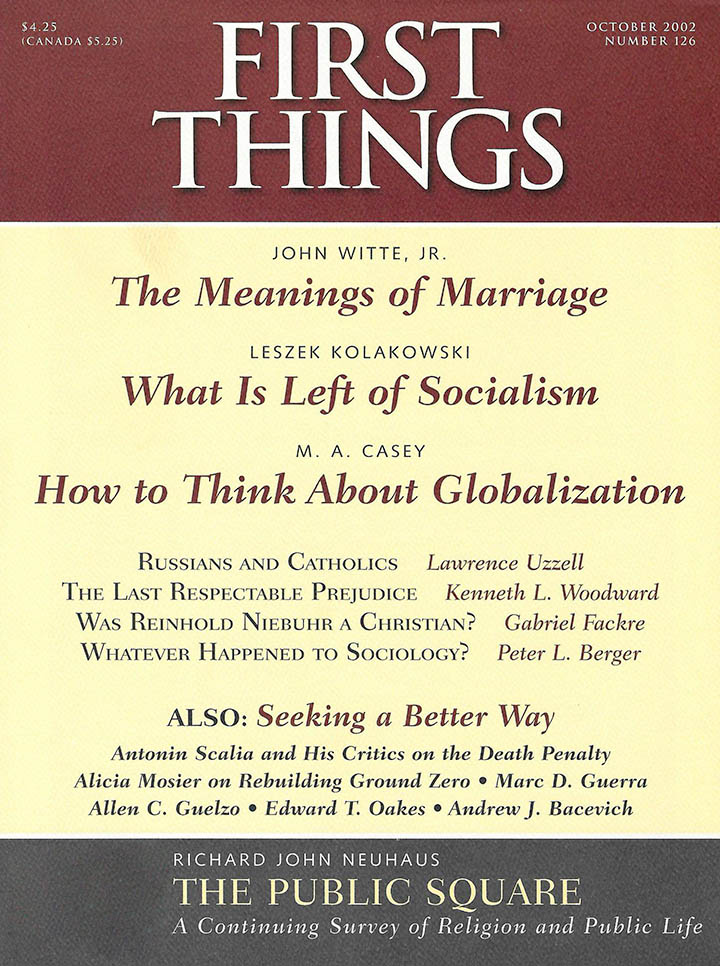
Andrew J. Bacevich teaches international relations at Boston University. His latest book, American Empire, will be published by Harvard University Press this fall.
Image by Wallpaper Flare licensed via Creative Commons. Image cropped.
Dear Reader,
Can I be direct with you?
War abroad. Socialists on the rise. AI upending human life. Endless uproar online. The modern attention economy doesn’t want readers — it wants users enslaved to the tyranny of the present.
First Things is the antidote: literary excellence, timeless truths, and a fixed point of reference in a culture that has lost its bearings.
But we can’t do it without readers like you.
Our goal: Raise $150,000 by November 1 to sustain First Things in the year ahead.
Your gift anchors readers in the permanent things.
Make your Fall Campaign gift now using the button below.
If you have any questions or would like more information, please contact Giovanni Del Piero, Director of the Editor’s Circle, at gdelpiero@firstthings.com or 212-627-1985.

YOU MIGHT ALSO LIKE
The Zone of Commitment
Neal climbs up to join me at the belay. Moving quickly, he kicks the front points of…
A Culture of Parricide
I learned a new word the other day: déploration. It’s the French, directly from the Latin, for “lament.”…
Job and Her
It is said that Job lost everything, but she has lost more. All her possessions—the money, the…
