
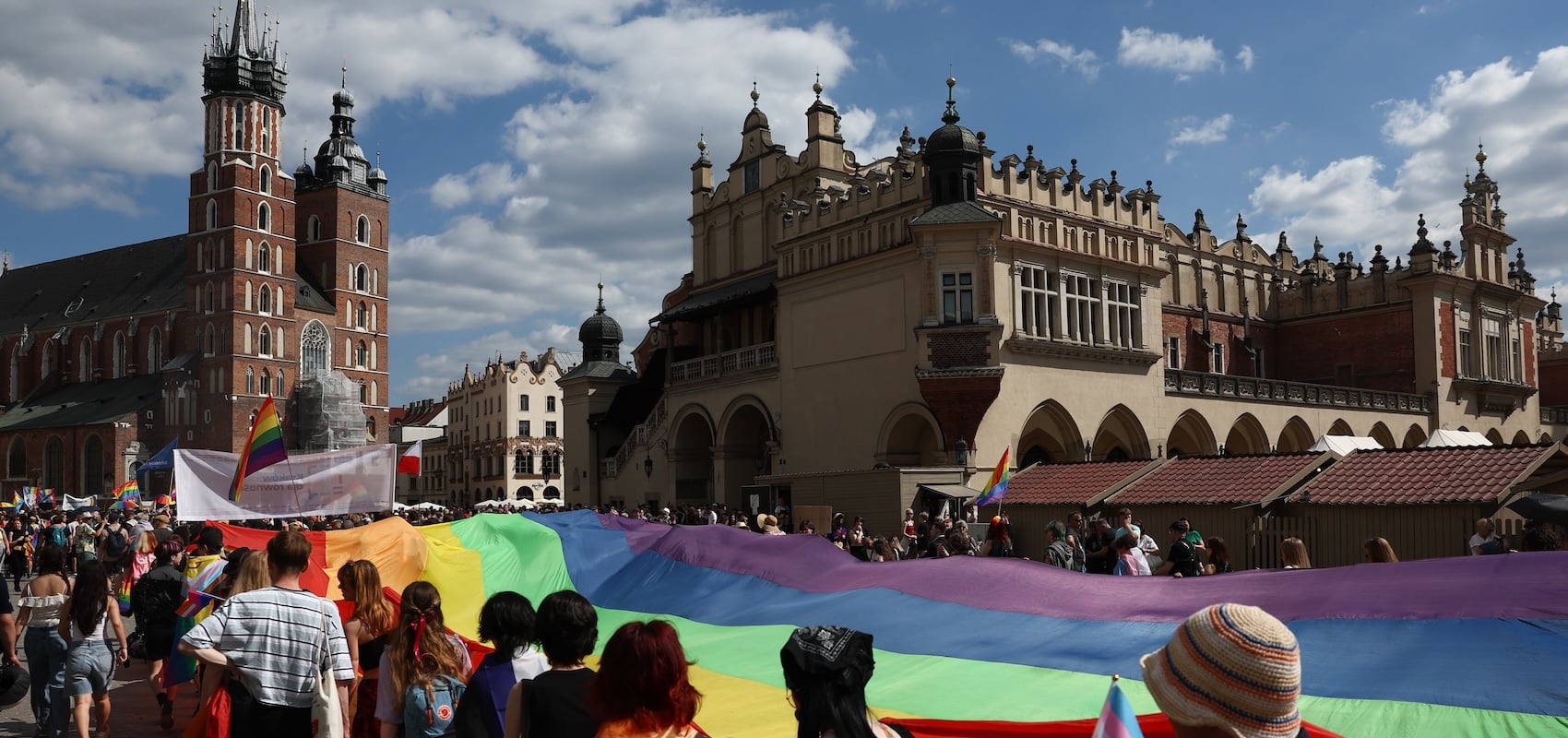
Until recently, Poland’s definition of marriage as a union between a man and a woman seemed inviolable, for at least two reasons. First, Article 18 of the Polish Constitution declares: “Marriage, being a union of a man and a woman, as well as the family, motherhood and parenthood, shall be placed under the protection and care of the Republic of Poland.” In 2005, the Constitutional Tribunal unequivocally interpreted this article, ruling that it defined marriage. The tribunal affirmed that “marriage, being the union of a man and woman, has acquired a distinct constitutional status within the domestic law of the Republic of Poland, on the basis of Article 18 of the Constitution. Any modification of this status would be possible only by the way of an amendment of the Constitution.”
Second, the European Charter of Fundamental Rights, being part of the European treaties that constitute the European Union, states in Article 9: “The right to marry and the right to found a family shall be guaranteed in accordance with the national laws governing the exercise of these rights.” The article, implemented in 2009, was meant to certify the sovereignty of E.U. member states despite mounting pressure from various groups and organizations over the past few decades.
These safeguards have proven insufficient. In 2025, the European Court of Justice considered the complaint of two men who married in Berlin under German law and sought recognition of their marriage under Polish law. The court ruled in favor of the applicants, citing “rights of movement and residence.” On May 14, the Polish Supreme Administrative Court incorporated the ruling, signaling that the Polish Constitution is not the highest legal authority and that the European judges’ decision supersedes it. The court ignored the Constitutional Tribunal’s ruling on the Constitution’s article on marriage and asserted that the article does not exclude the possibility of other types of marriage.
The European Court of Justice argued that a state may refuse to register a marriage certificate of a same-sex couple that was legally issued in another member state “where there are other means in the first Member State of ensuring that persons of the same sex are able to obtain recognition of their marriage by third parties.” However, it cannot refuse if no such means are available. Simply put, a state may refuse to recognize a same-sex marriage contracted in another country—but only if it recognizes such a marriage. This is not a legal distinction; it is a contradiction.
The judges reached this conclusion by ignoring Article 9 of the Charter of Fundamental Rights and adopting the absurd premise that freedom of movement and residence deprives the state of the protection of its fundamental institutions and moral norms. In this case, someone arriving from Germany to settle in Poland was given the power to compel Polish institutions to adopt parts of German law. Until now, the opposite principle applied: Those who exercised the right of movement and residence had to accept the institutions of the country they arrived in.
Defenders of this ruling argued that member states still retain the authority to define the institution of marriage, as the obligation arising from the European Court of Justice ruling concerns only the recognition of legal consequences within the context of E.U. law. The argument is vacuous, as the legal consequence is that same-sex marriages will now be recognized in Poland, while the Polish Constitution and Article 9 of the Charter of Fundamental Rights, which were intended to protect Poland from such consequences, have been rendered practically worthless.
In 2023, the European Court of Human Rights, hearing a different case, reached a similar conclusion regarding the need to recognize same-sex marriages in Poland, this time citing Article 8 of the European Convention on Human Rights: “Everyone has the right to respect for his private and family life, his home and his correspondence.” In issuing this ruling, the court implicitly recognized that the definition of family in this article also encompasses same-sex marriages, which was the central issue in the proceedings. This amounts to circular reasoning; the court treated its conclusion as a premise.
Invoking anti-discrimination provisions to challenge the exclusivity of marriage as a union between a man and a woman commits the same logical error. A general prohibition of discrimination cannot imply that the exclusivity of marriage as a union between a man and a woman constitutes discrimination against same-sex marriages, unless one assumes that there is such a thing as a universal right to marriage and that marriage is an open-ended concept.
We are witnessing a progressive degradation of law, and legal arguments are becoming increasingly sophistic. The E.U. zeal has transformed the European courts into tyrants who impose a leftist agenda on the E.U. member states. National constitutions—once thought sacred—are now set aside at the pleasure of European judges.
Photo by Jakub Porzycki/NurPhoto via AP

YOU MIGHT ALSO LIKE
Henry Hyde, A Pro-Life Hero
In 1976, a freshman congressman from Illinois named Henry Hyde attached a single sentence to the annual…
Lindsay Clancy and America’s Canadian Future
On September 4, the judge declared a mistrial in the Lindsay Clancy case, the result of one…
Canada’s Deadliest Blind Spot
On September 20, the Daily Mail ran a story with the provocative headline, “Our 83-year-old Christian grandmother…
