
 We hear constantly that people diagnosed as being persistently unconscious should be dehydrated to death because they are not “persons,” or are actually “dead”—and so should be available for organ harvesting. We hear that even if the family resists, futile care theory should permit bioethics committees to impose unilateral withdrawal. And we hear this even as repeated studies demonstrate that 40 or more percent of patients diagnosed as PVS really aren’t.
But the dehydrating lobby merely reply, “That’s even more reason to do it! Imagine the suffering!” Well, imagine you are in the locked in state (awake and aware but unable to communicate) and hear doctors telling your family to kill you. Now that is terror.
But there are abundant reasons to treat people with profound cognitive disabilities as fully human beings. First and foremost, because they are us. Second, because we don’t know enough about how the brain works to know that there won’t be some regeneration to permit eventual restoration of some function. But also, because there is always hope.
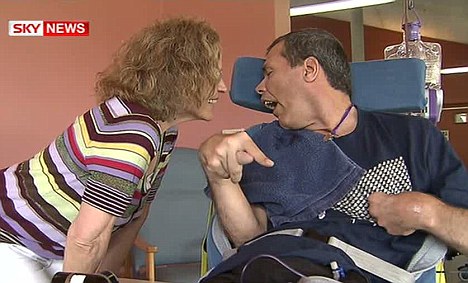
Case in point: We hear from time-to-time, for example, that a person in PVS awakened. And now in Belgium [NOTE, this corrects original post that incorrectly stated this happened in the UK], a man misdiagnosed as unconscious for 23 years is now telling how he was fully aware all along. From the story:
A car crash victim has spoken of the horror he endured for 23 years after he was misdiagnosed as being in a coma when he was conscious the whole time. Rom Houben, trapped in his paralysed body after a car crash, described his real-life nightmare as he screamed to doctors that he could hear them – but could make no sound. ‘I screamed, but there was nothing to hear,’ said Mr Houben, now 46, who doctors thought was in a persistent vegatative state. ‘I dreamed myself away,’ he added, tapping his tale out with the aid of a computer.
Doctors used a range of coma tests before reluctantly concluding that his consciousness was ‘extinct’. But three years ago, new hi-tech scans showed his brain was still functioning almost completely normally. Mr Houben described the moment as ‘my second birth’. Therapy has since allowed him to tap out messages on a computer screen.
Houben is here today only because he wasn’t dehydrated to death. There is no doubt he went through a horrendous experience, but thanks to treating him as a fully equal human being by caring for him all those years and giving him tests late into his disability—explicitly refused to Terri Schiavo—he is here today to tell tale and live the rest of his life.
And for goodness sake, whatever you believe about these issues, don’t talk in the presence of PVS or other apparently unconscious patients as if they aren’t there. Rather, always treat such people as if they can hear you, because sometimes they can.
Dear Reader,
Can I be direct with you?
War abroad. Socialists on the rise. AI upending human life. Endless uproar online. The modern attention economy doesn’t want readers — it wants users enslaved to the tyranny of the present.
First Things is the antidote: literary excellence, timeless truths, and a fixed point of reference in a culture that has lost its bearings.
But we can’t do it without readers like you.
Our goal: Raise $150,000 by November 1 to sustain First Things in the year ahead.
Your gift anchors readers in the permanent things.
Make your Fall Campaign gift now using the button below.
If you have any questions or would like more information, please contact Giovanni Del Piero, Director of the Editor’s Circle, at gdelpiero@firstthings.com or 212-627-1985.

YOU MIGHT ALSO LIKE
The Church in the Age of Therapy
In 1966, Philip Rieff wrote in The Triumph of the Therapeutic that “Religious man was born to…
Canada’s Deadliest Blind Spot
On September 20, the Daily Mail ran a story with the provocative headline, “Our 83-year-old Christian grandmother…
The Faithful Joy of Dolly Parton and Fulton Sheen
Dolly Parton and Fulton Sheen seem to have had little in common. She favored rhinestones; he wore…
