
In the twentieth century the messengers shot themselves. Most did so metaphorically, of course, though a few machos—Ernest Hemingway and Hunter S. Thompson come to mind—did literally blow their brains out. Whatever their methods, they took their lives just the same. In the United States, it was a string of troubled poets: Hart Crane, Sylvia Plath, John Berryman, Anne Sexton, Richard Brautigan. In England, poor neurasthenic Virginia Woolf, weighted with stones, went down in the welcoming water of the River Ouse. In Russia, the visionary Marina Tsvetaeva hanged herself in 1941, still guilt-ridden at having failed to save her daughter from starving to death in a Moscow orphanage two decades before. Nine years later, the influential Italian poet and novelist Cesare Pavese ended his life. And in Japan, a trio of irreplaceable geniuses: the enfant terrible Osamu Dazai, in 1948, by drowning; most sensationally Yukio Mishima, by seppuku, in 1970, having earlier that day delivered to his publisher the manuscript of his final masterpiece; and less than two years later, Mishima’s great rival Yasunari Kawabata—who beat him out for the Nobel Prize and was as old as the century—by gas.
Others, amid terror and upheaval, took their lives in foreign lands. In Spain, Walter Benjamin swallowed an overdose of morphine to escape forever the Gestapo into whose clutches he feared to fall; and in Brazil, seventeen months later, the Austrian novelist Stefan Zweig did the same with barbiturates, alongside his wife—their own deliverance from Europe unable to assuage the despair he felt concerning the continent they had left behind. Of those who survived persecution and displacement, many were walking wounded, prematurely posthumous. In 1987, forty years after his Auschwitz memoir, If This Is a Man, was published, Primo Levi stepped into the air of the stairwell in his apartment building in Turin, thirty feet up. No account of last century’s letters can escape these numbing facts. We are not permitted to look away from the litany of loss.
Among those who stared steadily into the century’s dark heart before succumbing to it was the poet Paul Celan. A Romanian Jew and, like Levi, a Holocaust survivor, Celan—who knew Hebrew and other languages but wrote natively in German—spent decades tallying the traumas. “Count the almonds, / count what was bitter and kept you awake, / count me in,” he wrote. These deceptively simple lines, laden with survivor’s guilt, characteristically do several things at once: They echo the Hebrew pun in Jeremiah 1:11–12 that connects an almond tree with a watch or vigil (shaked and shoked, respectively), and so almonds with eyes; they remind us of prisoner head counts in Nazi camps, and bitterly of those Nazi victims who can no longer keep watch; and they express the poet’s own urgent need to number the lost—including his parents—as well as his tortured desire to be one of their number, reunited with them in death. “I looked for your eye,” he proclaims in the next line, and ends with a plea: “Make me bitter. / Count me among the almonds.” In 1970, around Passover, he dove from a Paris bridge and drowned in the Seine. In a late poem, he had written of “leap-births” and “leap-deaths.”
In the unedifying roll call of the dead, those who endured historical atrocities or escaped mortal danger only to commit self-slaughter in the end seem especially tragic. Yet it is not Celan’s bitter death that resonates, but his living words, which retain the power to wake us still, decades after his passing. “There remained amid the losses,” he said, “this one thing: language.” But that language was fraught, a blessing and a curse. The Nazis had made German both Muttersprache und Mördersprache, he said: “mother-tongue and murder-tongue.” Hence the “black milk” of his most famous poem, “Death Fugue,” is not mere surrealism. It is precisely meant: The mother’s milk of German had curdled, soured, spoiled in a project of extermination. One sees it flecked like spittle, congealing on the blackened lips of so many dead, their last words framed in the language they shared with the people, the country, that killed them:
Black milk of daybreak we drink you at night
we drink you at noon death is a master from
Germany
we drink you at sundown and in the morning we
drink and we drink you
Toward the end, searching for an unspoiled idiom, Celan transposed into a poem some lines from the German mystic Meister Eckhart’s medieval version of Isaiah. Elsewhere Celan speaks of his efforts to “salvage the word”; and the word he salvages—or, in Michael Hamburger’s translation, saves—the word with which he ends that poem, is Yizkor, Hebrew for “May He remember.” The word denotes a Jewish memorial service for deceased relatives. Or martyrs. Occupying a line by itself at the close of a verse written in wrenched Deutsch, Yizkor gives victims the last word.
Languages came easily for Celan. Born in 1920 as Paul Antschel—later Ançel, then the anagram Celan, which accompanied his first published poems—he grew up in Czernowitz, today a city in Ukraine but then newly minted as Romanian after the collapse of the Austro-Hungarian Empire. Multilingual from an early age, he spoke High German at home but attended first a Hebrew and then a Romanian school; later, during the Soviet occupation, he learned Ukrainian and Russian. In a city with tens of thousands of Jews, Yiddish was also in the air—and by twenty the boy was translating Shakespeare. This was the polyglot milieu that prepared him later to assail the limits of the sayable.
Jewish identity was not then in tension with European culture. Celan’s beloved mother was passionate about the German classics and passed on to him a wealth of fairy tales and songs. As a student he read with uncommon absorption the works of Goethe, Schiller, and Nietzsche, as well as Hölderlin, Trakl, and Rilke, the lyric poets whose dazzling tradition he would one day extend. Rilke was his favorite, a poet whose transcendental yearnings and stylistic innovations straddled Romanticism and modernism, and whose influence on Celan’s wistful, melancholy early verse is palpable. Though he might capably have composed poems in Romanian or French (and would, to make a living, later translate Osip Mandelstam, Georges Simenon, and others), Celan stayed faithful to his mother’s speech, even as, after Auschwitz, he compulsively unpicked its threads and rewove it into an intensely personal idiom—the only writerly tongue possible for the poet’s “true-stammered mouth.”
The Stalinist takeover of Czernowitz in June 1940 complicated Celan’s life and constrained his studies. But there was worse to come: When the Nazis wrested control of the city from the Red Army in July 1941, they burned the Great Synagogue, killed thousands, and forced the surviving Jews—badged with yellow stars—into a ghetto. Tens of thousands were later taken away to camps in an extended nightmare of predawn Gestapo raids, tortures, and weekly deportations. A six-hundred-year-old Jewish community was being liquidated. Celan’s family escaped the ghetto and dodged several rounds of removals, until the night of June 27, 1942, when, for reasons that are unclear—possibly an argument with his father—Celan spent the night away from home. He returned the next day to find the house sealed shut and his parents gone.
Celan was soon press-ganged into manual labor and spent much of the war years in a series of harsh work camps, shifting rocks and building roads under the watchful eyes of Romanian soldiers and German engineers. “There was earth inside them”—a poem from his collection Die Niemandsrose (1963)—marries the muscle memory of this relentless toil to the “No-longer” of his ancestral home, to time’s woeful “it was.”
There was earth inside them, and
they dug.
They dug and they dug, so their day
went by for them, their night. And they did not
praise God,
who, so they heard, wanted all this,
who, so they heard, knew all this.
They dug and heard nothing more;
they did not grow wise, invented no song,
thought up for themselves no language.
They dug.
The numbing repetitions of “dug”—German gruben—sound through Celan’s lines like a shovel gouging dirt. One translator, John Felstiner, has written of the “grim energy verging on elation” he feels in coming to grips with Celan’s dark, incantatory poems. He notes that “There was earth inside them” consciously inverts the Psalms, such as Psalm 98: “O sing unto the Lord a new song; for he hath done marvellous things.” Yet the poem’s single-minded digging, monotonous as the beat of a telltale heart, also reflects a stark reality. At a time when “undesirables” lived or died on the basis of their fitness for work, there was scarcely time for musical diversion or linguistic innovation. Celan’s parents had been taken by airless cattle car to Transnistria in Nazi-occupied Ukraine. Made to perform backbreaking labor, they proved unfit. His father died of typhus in the fall of 1942; soon after, Celan learned that his mother, too weak to go on, had been shot in the neck. The poet was haunted for the rest of his life by the thought that he could have saved them.
The turn that comes in the final stanza—an Atemwende or “breath-turn,” as Celan would title his 1967 collection—discloses the difficult, searching nature of Celan’s art:
O one, o none, o no one, o you:
Where did the way lead when it led nowhere?
O you dig and I dig, and I dig towards you,
and on our finger the ring awakes.
To express a valid utterance after the Shoah, said Celan, the German language—blighted as it was—“had to pass through its own answerlessness, pass through frightful muting, pass through the thousand darknesses of deathbringing speech.” (Recall Hitler’s mad dream of a Thousand-Year Reich.) However cryptic, elliptical, and paradoxical his verse had to become, Celan was determined to make the passage. On the far side of the unspeakable, he embarked on a poetic project akin to the theological via negativa, in which God and the ineffable are described in terms not of what they are but of what they are not: “O one, o none, o no one, o you: / Where did the way lead when it led nowhere?” The final recondite image of a waking ring—wedding band, ring of the Nibelung, or something else—admits of several readings without losing its polyvalent power.
Celan spent the late 1940s adrift in Paris, at a low ebb, writing little. Struggling to make ends meet as a language tutor, interpreter, and factory worker, he feared his gift had deserted him. “My ambition seems so great, it shackles my hands,” he confided in a letter. A few lines written in 1951 express a deeper reason for the stateless refugee’s malaise: Of what use were thinking and writing at a time when nothingness, undisguised, indigestible, “steps forth in its own form”?
Celan’s linguistic skepticism ran deep. Immured in a foreign country, he became more acutely conscious of “that qualitative change” whereby an ordinary word in German became a word in one of his poems. But in the same letter, he spoke of the word’s “arrogance,” of its pretense—seductive for the poet—to “believing it can represent the whole of language, can give check to the whole of reality.” In one of Celan’s poems, words are themselves the dead that must awaken, or be made at least to point to something beyond them:
A word—you know:
a corpse.
Come let us wash it,
come let us comb it,
come let us turn
its eye heavenward.
He wrote these lines in 1952. That December he married Gisèle de Lestrange, a graphic artist. “I am so sure of loving you,” he wrote to her. “Nothing can make me absolutely afraid anymore.” She would later contribute etchings to some of Celan’s poetry collections. Gisèle gave birth the following fall to a son, François, but he died in infancy, as if to show his survivor-father that there is no bottom to human suffering—and raising the specter of both ends of his family tree severed. (A second son, Eric, born in 1955 and named after Celan’s mother, Friederike, survived him.)
By 1959, Celan had obtained a permanent post teaching German language and literature at the École Normale Supérieure. He had also gained French citizenship but remained essentially homelandless. “His true native land is his language,” remarked Jean-Pierre Wilhelm, who translated Celan into French. As well as reading works on Jewish mysticism by Martin Buber and Gershom Scholem, Celan was immersing himself in a loner’s library of great solitaries and half-mad geniuses: Nietzsche and Trakl, Hölderlin and Heidegger and Gerard Manley Hopkins, the last of whom he read in English. Polyglot and cosmopolitan as he was, Celan envied the French poet Yves Bonnefoy for his at-homeness in the native scene. “As for me,” he said, “I am on the outside.”
It was a feeling he never got over. To express his alienation (and his yearning for connection) in verse, he strained syntax, broke words across lines, reached for neologisms. German, more than English, is amenable to noun-compounding, affording Celan a kind of alchemic power to join multiple interpretations in one field of force. The resulting poems can be deeply affecting in translation, but a loss of meaning is suffered:
World to be stuttered by heart
in which
I shall have been a guest, a name
sweated down from the wall
a wound licks up.
Celan’s first line, Die Nachzustotternde Welt, is rendered by Felstiner as “World to be stuttered after”—a different take on the poet’s richly ambiguous compound. Whichever we might prefer, in both English versions not only the sense but the style is altered. Often, Celan’s translators themselves must either unpack a condensed German word or phrase as wordier, windier English or else coin compounds that cannot help but appear to English-native eyes and ears as wholly bizarre, where Celan’s German, though unusual (and unusually charged), is not morphologically beyond the pale.
Besides negation, Celan also works by agglutination, clumping together biblical allusions, historical references, personal material, nature imagery, and other verbal matter in arcane amalgams. With this technique, he refuses to let the precarious and even contradictory meanings that emerge collapse into a straightforward aboutness. Shimmering between states, rising like roses from the interstices of language, these variant readings coexist rather than cancel each other out. His poems say too much and not enough, are overloaded with import even as they withhold their essence. In public readings, Celan had a soft, hypnotic way of reciting his work—an “urgent whisper,” his voice “psalmodic.” On the page, too, his poems are often not so much heard as overheard.
We have seen such eloquent paradoxes before. They can be found in Exodus, where God chooses as his mouthpiece the stammerer Moses, slow of speech and tongue; and in Matthew, where Jesus tells his disciples that whoever wants to save his life will lose it, but whoever loses his life for his sake will find it. Caught between the pure or “absolute” poetry championed by the elder German poet Gottfried Benn and the engagé verse of more political writers, Celan’s work does more than hover in place. It is in febrile motion, constantly “making toward something.”
Toward what? By 1958, he had an answer: “Perhaps toward an addressable Thou, toward an addressable reality.” If bitter irony gets the better of him at times, if he is balked of his objective by doubt and difficulty, if words, however concatenated—Eliot’s “shabby equipment always deteriorating”—fail him, his search is no less sincere for that. “Isn’t poetry a progression toward the Real, working amid what surrounds and seizes us?” Celan wrote in 1962. “To engage oneself—isn’t that, above all, to answer back?”
A German literary critic once described Celan as “operat[ing] in the void,” like an astronaut on a spacewalk gone wrong, untethered, alone. The void was familial, cultural, spiritual, and linguistic. “I know very well how hard life is for you,” Gisèle would tell him, “I know the weight of suffering that is your lot and I revolt often, believe me, against this injustice.” Yet, as if adapting to an alien environment, like the small life that survives without oxygen in the dense brine of deep ocean basins, Celan became acclimated to the void. In the absence of reliable touchstones, the void itself became the one reliable thing, one half of a dipole in which his memory of what had vanished supplied the other. At the same time, and for that very reason, the void was something to struggle against. In Economy of the Unlost, her book about Celan and the ancient Greek poet Simonides of Keos, Anne Carson writes, “Memory depends on void, and void depends on memory, to think it. Once void is thought, it can be cancelled.” To cancel void is a positive negation.
One of Celan’s most famous poems, “Psalm,” is a work of profound religious feeling leavened with a painful, and specifically Jewish, irony. He gives us a photo negative of orthodoxy, a sort of X-ray hymn of praise and thanksgiving. The first three stanzas:
No one molds us again out of earth and clay,
no one conjures our dust.
No one.
Praised be your name, no one.
For your sake
we shall flower.
Toward
you.
A nothing
we were, are, shall
remain, flowering;
the nothing-, the
no one’s rose.
Martin Buber, whom Celan read closely, once remarked that the atheist gazing from his attic window “is often nearer to God than the believer caught up in his own false image of God.” Just so, Celan took God more seriously in his agonized yearning than do millions of casual believers. Negation was his way to stay near to God while confessing to feeling godforsaken; even seeming blasphemy served to keep the name of the Most High in his mouth. In the early 1960s, around the time of “Psalm,” he taught a seminar on Christian mysticism at the École. Recovering from the Third Reich, the German cultural establishment often preferred to see in Celan’s work either poetic fantasy, “purely lexical” in nature, or gestures of reconciliation. But reconciliation to the Nazi past was never possible for the poet. He remained conflicted about his readership. “Now and again they invite me to Germany for readings. Even the anti-Semites have discovered me.”
Celan’s century, he knew, was a chorale of ghosts, a host of voices speaking in the dark. Later he looked askance at his young son’s enthusiasm for pop music and radical politics; the former surely seemed to him too bright and cheerful, the latter too dangerously naive. The child soldiers of Marxism–Leninism had their own voids they aimed to cancel, but they were not those of Celan and his cohort. “I do not know how to rid the world of evil,” the poet Ingeborg Bachmann wrote to him, “or whether one is simply supposed to endure it. But you are there and are having an effect, and the poems have an effect of their own and help to protect you—that is the answer and a counterbalance in this world.”
A counterbalance requires heft, as Celan knew. He sought to secure that heft for both himself and others: “the words / I address to you, shadow, / to give you weight.” It was a perilous undertaking, the outcome always uncertain. In January 1967, after locking himself in his home office, he drove a knife into his chest, severely damaging his left lung. Two and a half years later he listened to the moon landing on the radio, and chided his communist son that such a feat was “not nothing,” despite the persistent problems plaguing the wretched of the earth.
“Those who truly learn to see,” Celan remarked, “draw close to what is unseen.” The unseen may be shadowed or invisible or buried deep under the earth. Celan shied from none of these aspects. His later poems seem to grope mole-like toward meaning, snuffling and digging in the dark. The problems of translation they present are manifold. Here is “Threadsuns,” from Atemwende, in a version by Pierre Joris:
Threadsuns
above the grayblack wastes.
A tree-
high thought
grasps the light-tone: there are
still songs to sing beyond
mankind.
Joris’s ending is, to my ear, superior both to Hamburger’s—“there are / still songs to be sung on the other side / of mankind”—and to Felstiner’s, which is identical to Joris’s version except that it ruins the sound and scansion by making the final word “humankind.” But what of the action performed by Celan’s “tree-high thought”? Joris says it “grasps the light-tone,” Felstiner that it “strikes the light-tone,” as though it were a hammered dulcimer. The issue here is that “tone” can mean a sound but can also refer to a color: a hue or tint. Hamburger clears this up with “tunes in to the light’s pitch.” Though a bit clunkier and narrower—for “tone” encompasses not only pitch but also quality and strength and feeling—it has the added felicity of suggesting a willed union. Celan wrote elsewhere of “the light and the Light.” Freighted with metaphysical meaning, tuning in to the light’s (or Light’s) pitch would appear to be quite different from striking or grasping its tone.
We have hardly begun to speak of meaning. The “tree-high thought” recalls both Eden and Calvary, either the tree of knowledge or an arboreal world apart from us, like that of Wallace Stevens’s “palm at the end of the mind” in “Of Mere Being,” in which a “gold-feathered bird” sings “without human meaning, / Without human feeling, a foreign song.” Felstiner connects this image to the opening of Rilke’s Sonnets to Orpheus: “A tree ascended there. Oh pure transcendence! / Oh Orpheus sings! Oh tall tree in the ear!” Celan, too, associated height with Orphic song, as we find in a letter to his ten-year-old son Eric: “Poetry is something very high, very harsh.” For a thinker-in-verse like Celan, who wrote “to sketch out reality” for himself, thoughts were apt to be tree-high. (“In the air, that’s where your root remains,” he begins another poem, “In the Air.”) Tree-high, but not star-high. Yet if Celan cannot grasp the celestial realm itself, he can at least tune in to its pitch, beyond the hearing of a flawed humanity which laid waste to his home.
Celan’s own need to be heard—the chief driver of his vocation—clashed with the inner necessity plunging him deeper into a private word-world where readers could not follow. Though he hoped his son would do so, once his German was up to snuff: “You will see . . . or rather: we will continue to see, together, what I do, what you do.” He inscribed a copy of Die Niemandsrose to Hamburger: “Not in the least hermetic.” From then on, however, his poems grew shorter yet more opaque, the fluent musicality of old giving way to a compact diction packed like dynamite with ambiguities, their vocabulary drawn from both archaic and specialized sources. (Celan kept on hand reference texts on human anatomy, psychiatry, zoology, botany, mineralogy, and more.) Symbols recur: eyes, almonds, roses, stones. Breath and snow. The risk that these “messages in a bottle” (as Celan called his poems) might not be understood, that they might not even be picked up, “was as necessary to them as the need to communicate,” says Hamburger. Small wonder that Celan’s friend and fellow postwar Jewish poet Nelly Sachs was awarded the 1966 Nobel Prize in Literature, not him.
Yet for all his withholding, the silences and caesuras that mark his gnomic, challenging verse, Celan has definite news (“news that stays news” was Pound’s definition of literature) to impart. He is a witness more involuted, more enigmatic than most, but a witness nonetheless. Often, his testimony works on our nerves before being apprehended by our minds. In “Once,” the urgency, the metaphysical pressure, is immediately apparent:
Once
I heard him,
he was washing the world,
unseen, nightlong,
real.
One and infinite,
annihilated,
ied.
Light was. Salvation.
Linguistically, the strangest part of this poem is the fragmentary penultimate line: “ied.” Set in lowercase, it looks like the ending of a past-tense verb such as “cried.” But ichten (the word rendered as “ied”) is Celan’s invention, derived from the personal pronoun ich, thus making it, as he told Hamburger, “the third person plural of the imperfect tense” of another neologism, the verb ichen (to I). The poet has sought and found a verb—perhaps the only verb—appropriate to a Being whose every action is a radiant fullness of self-expression: the Lord who identified himself to his servant Moses as I am that I am. This same language brings God into communion with the lyric self of Celan’s poems, which are, he said, “an I clarifying itself in the process of writing.”
One does not picture Edmund Spenser or Alexander Pope penning their epics for survival’s sake, versifying at the edge of a personal abyss. By the twentieth century, however, poets were playing for keeps; stanzas were flung like rope bridges across a chasm, crossed so as to get the next poem written—and the poem after that. Celan knew this grueling game. His poems, he wrote to a friend in Israel, “allow me for moments, precisely when I am reading them, a possibility to exist—to stand.” But where? An in-between place: what one critic called “the no man’s land between language and no-longer-language.”
Even as his international presence grew—a Berlin reading in December 1967 produced a newspaper headline calling him “King of the Poem”—the bridge or tightrope Celan spun for himself, like a spider’s gossamer, grew thinner, finer, and his footing more tenuous. By then he was spending more time in his office at the École than at home. Since he and Gisèle now lived apart, home was a nearby rathole. (“Twenty years of Parisian life,” he griped on his forty-seventh birthday, “to end up in a ‘studio’-kitchen, furnished, without any place for my books.”) It is dismal to read him in his letters asking Gisèle to send him clothing from his wardrobe, or wondering if he might drop by for some other essential. Battling depression, driven to the last post, he had himself hospitalized, and then required a medical release to return to teaching. “All that is in my power to do for you to have a free life again will be done,” Gisèle wrote him. “I think that not only have I not been able to help you, but even more that, so close to one another, we were hurting each other.” Literally and metaphorically, his no man’s land narrowed.
Then, almost miraculously, it opened. Invited by the Hebrew Writers Association, Celan flew to Israel in October 1969. He gave readings to large audiences in Jerusalem, Haifa, Tel Aviv, and delivered a talk in which he spoke of “Jewish loneliness” but also of the “force for truth” he had encountered in that renewed Jewish homeland, where old friends from Czernowitz welcomed him and found him surprisingly light of heart. Poetry, Celan had told his thirteen-year-old son the year before, “is always in search of truth.” He visited Bethlehem, the Church of the Nativity, the Mount of Olives. The Christian holy sites seem to have affected him. Among the several poems he laid down like a clutch of eggs upon returning to Paris, and which hatched, after his death, in the posthumous Zeitgehöft (1976), is “Die Posaunenstelle,” translated by Hamburger as “The trumpet part”:
The trumpet part
deep in the glowing
lacuna
at lamp height
in the time hole:
listen your way in
with your mouth.
Felstiner makes the lacuna a “text-void” (another Celanian void) and sets it at “torch height.” But Hamburger notes that Celan’s use of Fackel, “torch,” goes back to Luther’s German Bible, which renders the lamp of Revelation 8:10—“And the third angel sounded, and there fell a great star from heaven, burning as it were a lamp, and it fell upon the third part of the rivers, and upon the fountains of waters”—as a torch instead. What Felstiner gains in alliteration is lost in allusion, critical in this case to the apocalyptic tonality Celan’s verse acquired near the end. Readers attuned to the scriptural sources will expect “lamp,” not “torch.” Just so, Posaune technically means a trombone. But both Hamburger and Felstiner call it a trumpet because the Lutheran Bible hands not seven trumpets but seven trombones to the seven desolating angels of Revelation.
This poem is almost too rich to unpack. But I should note two further points. First, in Israel, Celan spoke and wrote Hebrew, and heard his work translated into that tongue—listening his way in, listening with his mouth into a Jewish community such as he had not known for decades. Second, the immensely suggestive “time hole,” whether historical tragedy or personal loss, seeming to unite Christian and Jewish contexts, cries out to be filled. The final lines suggest that it can and will be. Even here, negation is not all.
Backward and downward in time, said Celan—“a bit anachronous, a bit catachronous”—is the poet’s mode of motion. Compared with the ordinary soul’s drab dailiness it is an intenser life. Left open on his desk on the day of his death was a biography of Hölderlin, Nietzsche’s favorite poet, who had once written of God that he is “Near by / and hard to grasp.” Celan had underlined the following passage: “Sometimes this genius goes dark and sinks down into the bitter well of his heart.” From Hölderlin to Nietzsche to Celan: All struggled with their sanity; all fell into shadow. (In late 1965 Celan was confined to a psychiatric hospital and diagnosed with “delirious melancholy,” after having attacked his wife in a fit of delusion.) In the book on Hölderlin, he neglected to underline the rest of the sentence: “but mostly his apocalyptic star glitters wondrously.”
Yet if this was Celan’s final, it need not be his definitive statement. The extraordinary poems endure, as do his translations of Mandelstam, Emily Dickinson, and others; and there are the profuse, passionate letters he wrote to Gisèle (whom he frequently addressed as “You,” with a capital Y: “My love my love my love—what extraordinary luck to have met You”). The recently published Letters to Gisèle (1951–1970), including many of her letters to him as well as Celan’s fatherly correspondence with Eric, fairly throbs with tenderness. A missive of March 1954 enjoins Gisèle: “Do not deprive Yourself of anything, my love, work and think a bit of me! I will love You all my life.” And she, more than a decade on, is apt to sign off: “I kiss you, my darling. Write to me whenever you can.” She was his cheerleader, his chief partisan. If love in any form is a form of grace, then Celan, for the last two decades of his life, despite his travails, was touched by grace.
All literature as perennial inheritance exists in the unfolding Now of time present. As last things, too, are ever-present in the here and now. A great writer loads his grave with resurrections. And so it was for this poet, whose work sought an addressable Thou. In thus seeking, he progressively stripped his speech of ornament and metaphor, his poems assuming a faltering and fractured character—as though the long breath units and running lines of his early verse had slowed to a walk, to a hobble, and finally to an anguished yet determined crawl, like that of a penitent. In his body of work, we see the bones of an uncanny skeleton jutting, one which astonishes us with its endurance in crossing, however haltingly, such inhospitable terrain. A decade before his death, this poet had underlined in a book by Buber the following: “Every name is a step toward the consummate Name, as everything broken points to the unbroken.” By this standard, Celan’s poetry is one of the truest compasses I know.
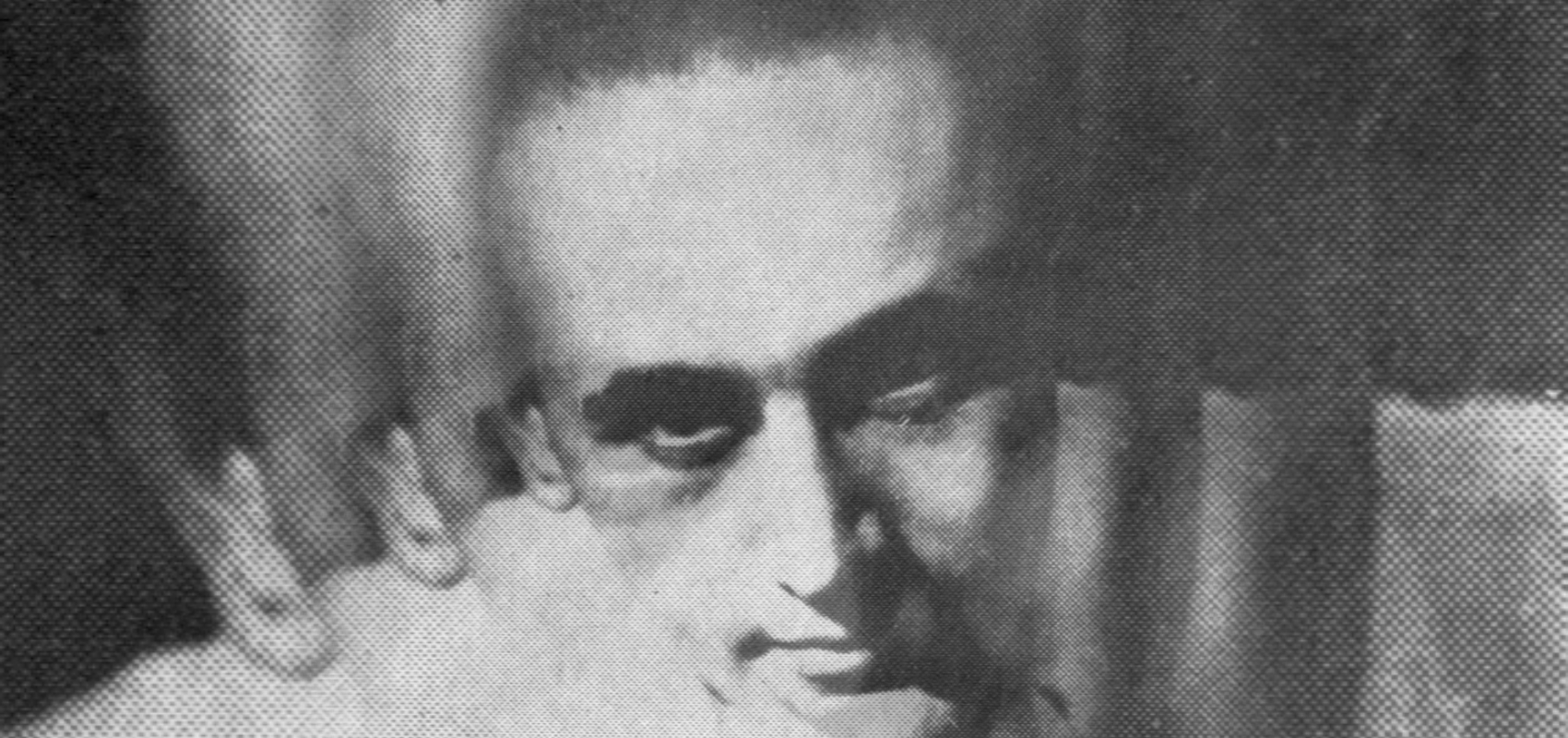
Image by Petre Solomon, from the public domain. Image edited.

YOU MIGHT ALSO LIKE
Serial Liar, Serial Comma
How would you write a public letter that you know will become front-page news? Would you write…
Shakespeare Under Stalin’s Shadow
”We wish that we could pass this play over, and say nothing about it. All that we…
Roger Scruton’s Eternal Youth
In this episode, First Things senior editor Dan Hitchens joins R. R. Reno on The Editor’s Desk…
