
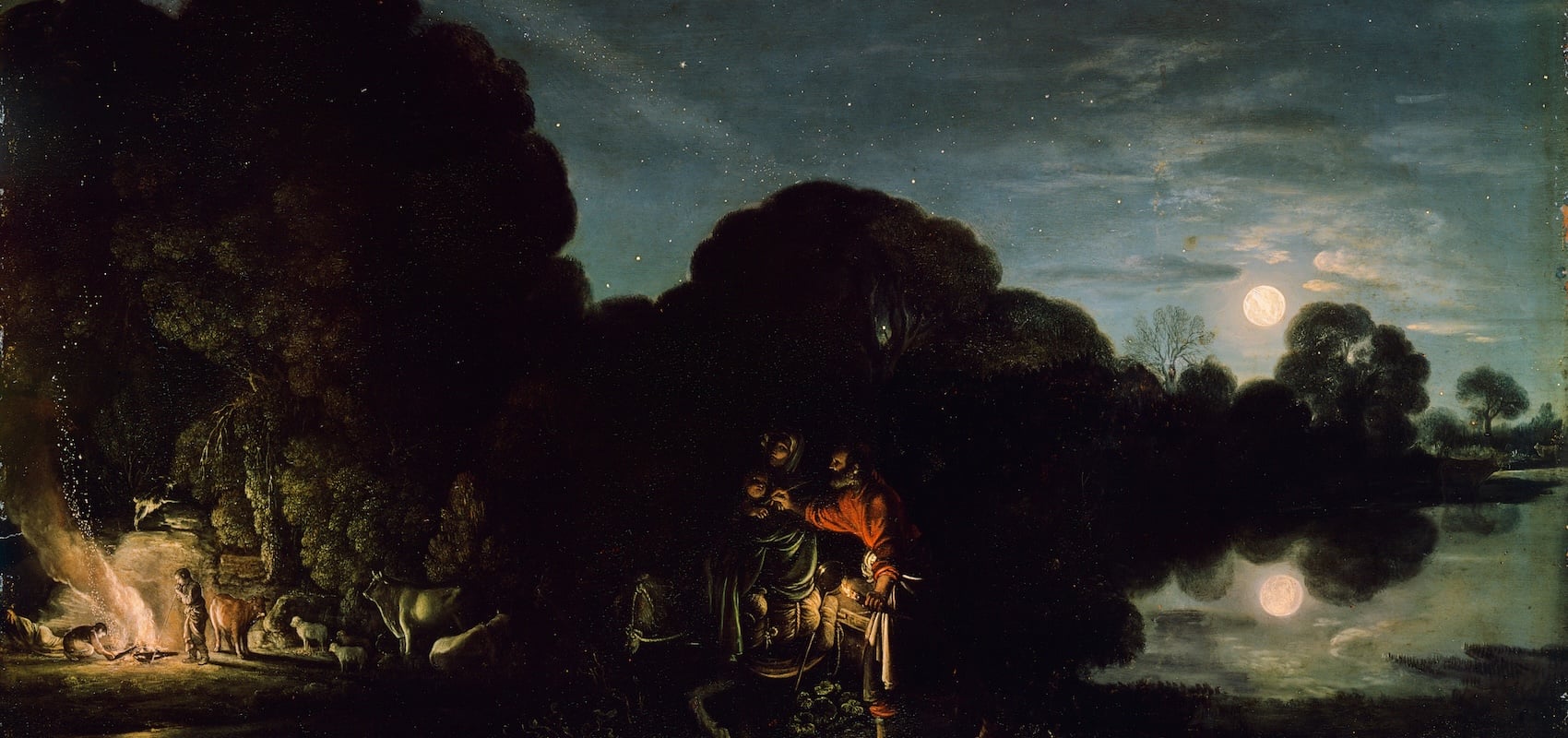
The Department of War recently released dozens of files, dating back to the 1940s, of UFO sightings. There’s more to come, but there are no real revelations here. Everything remains unclear. That’s as it should be.
Speculation about aliens began in earnest in the seventeenth century, and in some ways nothing much has changed in our attitudes since. What if there are other beings on other planets? What if they are rational? Are their lives analogous to ours, or different? What does that mean about us? Telescopes zooming in on distant worlds, new theories about the planets and the stars, sentiments about distance and even infinity all percolated through the intellectual communities of early modern Europe. Amid these discussions arose questions and fantasies, as well as natural possibilities that threatened to disturb established theological commitments.
The list of writers involved in these discussions—science fiction or philosophical fabulism?—is surprisingly long: Giordano Bruno, John Wilkins, Cyrano de Bergerac, Margaret Cavendish, John Milton, Bernard Le Bovier de Fontenelle, even Thomas Paine. If there are plural worlds, why not many beings inhabiting them? Yet if this is so, the great schema of salvation history is set on a novel footing. Most writers, Protestant and Catholic, approached this challenge in either of two ways, or in some combination: Only the earth (and its Adam) is fallen, and thus only one savior (Jesus) is necessary for this unique race; or, every world is fallen, but Jesus somehow suffices for them all (he is the Logos of all creation, after all). Milton, among others, viewed Earth’s (and Adam’s) sin as unique. De Bergerac and Paine, implicit and explicit critics of Christianity, assumed that all worlds were imperfect and hence in need of redemption. But that made the uniqueness of Jesus’s incarnation problematic—unless one hypothesized infinite Advents. Science fiction, here, proved a good tool to skewer the Church.
But the problem of many worlds and many fallen creatures was a real one. Giordano Bruno was executed in 1600 in part for his speculations on this front. (The charges, it must be admitted, were not all that well-founded; and his own writings were somewhat murky.) It was all a bit of a mess, and theology likes to keep things in good order. We still follow versions of these paradigms: Everything is good and interesting out there (extraterrestrials will help save us); or everything is bad and dangerous (cosmic pandemics, tyrannous blobs). Both excitement and fascination abound. We even have our versions of de Bergerac and Paine. Lurking behind the UFOs lies some truth that will overturn our sacred shibboleths: God is so different than we ever imagined! He created frightening intelligences lodged in giant centipedes. Tear down the churches!
One of the few outliers to all this was Blaise Pascal. Pascal’s own groundbreaking experiments on atmospheric pressure and the vacuum—the “void”—his mathematical reflections on the infinite, and his knowledge of recent astronomic discoveries shaped his own extraordinarily vivid sense of cosmic extension and mystery. His ruminations on being lost in a universe of infinite breadth and divisibility are famous. So much out there; so little understood. Thinking about other worlds ought to bring us to our knees.
Pascal’s own Pauline and Augustinian baseline was human lostness. The existence of a bunch of aliens could hardly have made things worse than they already are for the children of Adam. Indeed, our lostness includes our thinking, our grasp of things. Not that Pascal was against practical reason: He had himself set in motion Paris’s first public transportation system. Nothing fancy here, just some carriages and regular routes and schedules. But scanning the skies for strange objects; imagining better ways of calculating infinity; untangling new modes of travel: This really was science fiction in his judgment, a set of elaborate diversions to avoid the facts of our own sin and death, the “appalling alternative of being annihilated or wretched throughout eternity.” In any case, in the face of this reality of lostness and incapacity, our only hope is in God; in God’s grace, in the intrusion into our midst by divine love, penetrating our hearts and wills. Some science fiction writing today, it is true, has its own religious yearning, but it is only yearning. The Cross, by contrast, contains the fullness of time travel and warp speeds, of divine life and providence.
Not many will follow Pascal’s lead in treating fascination with extraterrestrials as a symptom of human misery—our own alienation from God. It would be less fun. We would miss out on E.T. or even a new monster invasion. Telling us to give that up would be like telling us to put down our iPhones. So I pray for the grace to ignore the files altogether.
Dear Reader,
Can I be direct with you?
War abroad. Socialists on the rise. AI upending human life. Endless uproar online. The modern attention economy doesn’t want readers — it wants users enslaved to the tyranny of the present.
First Things is the antidote: literary excellence, timeless truths, and a fixed point of reference in a culture that has lost its bearings.
But we can’t do it without readers like you.
Our goal: Raise $150,000 by November 1 to sustain First Things in the year ahead.
Your gift anchors readers in the permanent things.
Make your Fall Campaign gift now using the button below.
If you have any questions or would like more information, please contact Giovanni Del Piero, Director of the Editor’s Circle, at gdelpiero@firstthings.com or 212-627-1985.


YOU MIGHT ALSO LIKE
Why the Death Penalty Is a Sore Point for Papal Authority
Pope Leo XIV marked World Day Against the Death Penalty, observed on October 10, with the following…
Forget Odysseus. Aeneas Is the True American Hero.
Who is our Odysseus? Or more precisely, who is the most Odyssean hero of American film? Matt…
Foucault’s Idol of Nothingness
Today marks the 100th anniversary of the birth of Michel Foucault. He was influential in his lifetime,…
