
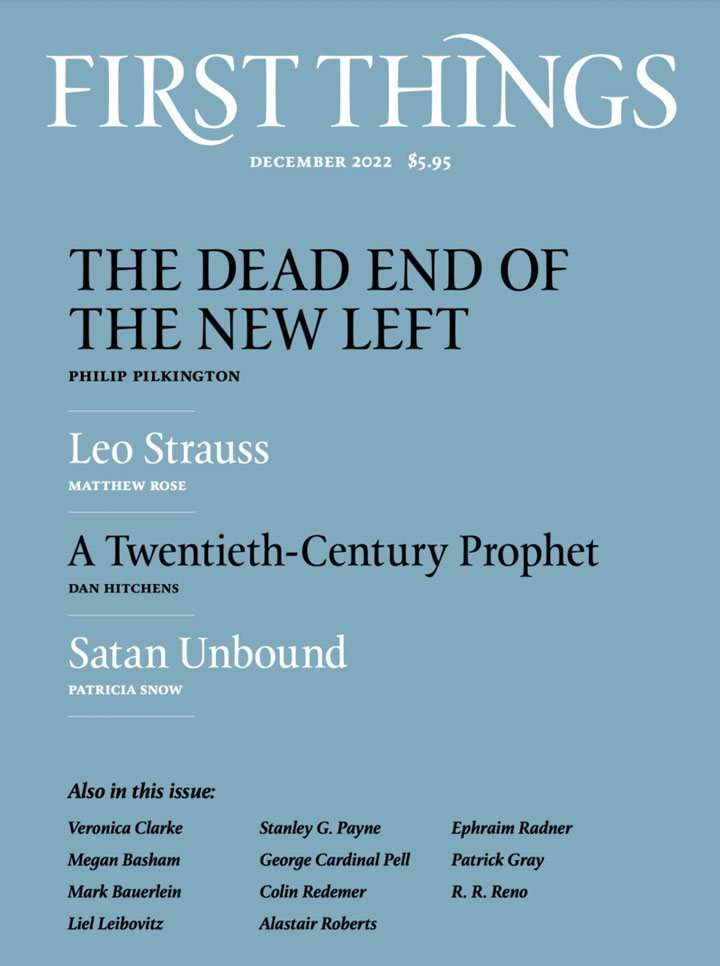
I’ll venture a definition of liberalism: It’s the ambition to organize society around a shared love of freedom. “Illiberalism” is a muddier concept, which is not surprising since it functions as a negation. For my purposes, I will define it as a vision of society ordered toward shared loves of many substantive goods rather than of freedom alone. As Matthew Rose suggests in his meditation on Leo Strauss in this issue (“Leo Strauss and the Closed Society”), the deepest paradox of liberalism rests in the fact that it requires illiberalism in order to thrive.
The ends sought by loves other than a love of freedom are many and various. Here’s a short list, which simply describes a traditional society. We are tutored toward a love of matrimonial union and family loyalties. Local and regional pride flourishes. We are taught to relish the beauty of our native language and cherish the great books of our tradition. A patriotic sentiment takes hold. Those with a talent for speculation are romanced by philosophy and feel the lure of transcendence. A broad consensus encourages religious piety.
In each instance, we are encouraged to develop loyalties that empower us to say “no” to whatever undermines or contradicts our loves. In the power of “no,” we attain the freedom of doing what we truly want rather than what others command us to do. We live in accord with truths whose authority we affirm and endorse, rather than in accord with our fickle, ever-changing desires—or the demands of commerce, mass culture, and ideology. Perhaps the single most powerful force resisting political polarization is familial love, which refuses to allow opinions about Black Lives Matter or January 6 to dampen our domestic affections.
What I have adumbrated accords with traditional conservatism. This view, which is perhaps more cultural than political, insists that a just society proposes a substantive vision of human goods to its members, and especially to the young as they are educated. Moreover—and this additional conviction makes liberals nervous—a just society must vest appropriate power in the authorities entrusted to promote and protect those goods. Parents, not children, properly rule the household; teachers have authority over students; clergy defend the boundaries of orthodoxy.
Let me dwell on the religious aspect, for it bears upon controversies surrounding “integralism.” No matter what one’s view of Church and state, we ought to be able to agree that worship is a fundamental good, and political authorities ought to encourage it. This does not mean that politicians should lead church services or that clergy should govern. Christianity utterly rejects the former, and in many traditions and during certain eras it has had misgivings about the latter. Nevertheless, a consensus has obtained: Governmental power should be used to promote and protect the virtue of religiosity. This happens already in the United States. To the dismay of those who seek a more purely liberal regime, the American constitutional right of free exercise of religion accords special rights to people who are religious. (It’s a grave mistake to redefine free exercise as a general right of conscience.) There are also small ways in which our regime encourages religion. For example, immigration law makes it especially easy for non-native clergy to work in the United States. In my youth, a variety of Sabbath laws fenced off Sundays from the invasion of commerce and the dominion of Mammon.
It’s no longer 1965, but clergy tell me that the proliferation of Sunday morning games for youth sports leagues poses a new threat to church attendance. This suggests the need for local jurisdictions to impose limits on the American fixation on sports by prohibiting youth leagues from scheduling practices and games on Sunday mornings. Doing this would not be unconstitutional. On the contrary, it would follow a long American tradition of governmental encouragement of religious observance. This encouragement has a liberal character; it does not impose or require religious belief. But using the power of law to protect religious institutions from today’s sports mania is, strictly speaking, illiberal, for it reflects the conviction that something other than freedom plays a crucial role in sustaining a good society.
I like our American tradition, which as I note above can seem too loose and ad hoc to those who have worked out theories of one sort or another, and I count myself a liberal conservative who favors encouragement over compulsion. We should not rule out the latter. When it comes to the good of marriage, we need to repeal no-fault divorce and restore the legal principles that compel most people to remain married. But when possible, nudges are better than commands.
I also counsel tolerance of the inevitable plurality of the goods promoted in a society as vast and heterogeneous as our own. Someone well versed in theology will notice that I have commended the good of worship, not true worship. Aren’t some religions false, or at least defective in grave ways? Yes. But never let the perfect be an enemy of the good. Our society would be better off promoting religious observance in general, even of traditions I deem misguided, rather than not promoting it at all. And I certainly urge caution in the degree of power backed by state sanctions accorded to the cultural, moral, and religious authorities that are custodians of substantive goods. The great nineteenth-century liberal Lord Acton was right about the perils of power. But abusus non tollit usum: Abuse does not invalidate use.
So, count me skeptical of “principled” pronouncements, whether they are coming from liberal theorists or their adversaries. The task of governance requires prudence, and prudence means discerning what can and cannot be done, given human and historical realities. But of this I am certain: A genuinely liberal society, one capable of sustaining a culture of freedom, must prize substantive goods such as marital fidelity and religious observance—and empower the authorities (a fright phrase for liberals) that form us to love them. Put simply, without the leaven of something that participates in the illiberal spirit of honoring authority and devoting oneself to something other than freedom, liberalism fails.
In my estimation, our Christian heritage encourages us to love freedom. That’s certainly true of our country. But to sustain that love, we must share other loves. And we must order our society to honor, promote, and protect those loves. If we’re to taste the sweetness of freedom, we need the salt of what today’s liberals are far too quick to dismiss and deride as “illiberal.”
Dear Reader,
Can I be direct with you?
War abroad. Socialists on the rise. AI upending human life. Endless uproar online. The modern attention economy doesn’t want readers — it wants users enslaved to the tyranny of the present.
First Things is the antidote: literary excellence, timeless truths, and a fixed point of reference in a culture that has lost its bearings.
But we can’t do it without readers like you.
Our goal: Raise $150,000 by November 1 to sustain First Things in the year ahead.
Your gift anchors readers in the permanent things.
Make your Fall Campaign gift now using the button below.
If you have any questions or would like more information, please contact Giovanni Del Piero, Director of the Editor’s Circle, at gdelpiero@firstthings.com or 212-627-1985.


YOU MIGHT ALSO LIKE
Foucault’s Idol of Nothingness
Today marks the 100th anniversary of the birth of Michel Foucault. He was influential in his lifetime,…
Forget Odysseus. Aeneas Is the True American Hero.
Who is our Odysseus? Or more precisely, who is the most Odyssean hero of American film? Matt…
The Last Statesmen?
In the latest installment of the ongoing interview series with contributing editor Mark Bauerlein, Steven B. Smith…
