
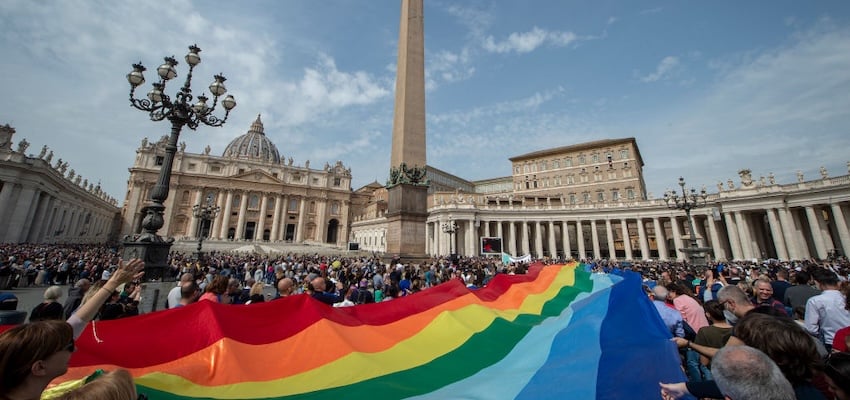
According to Washington auxiliary bishop Roy Campbell, Catholics should stand up for Diversity, Equity, and Inclusion—DEI—because DEI also means “God” (as in, Dei).
That insulting association of the Divine Name with a divisive political social policy appeared in an essay the USCCB accidentally published on its website in recent days. It has since been taken down. According to The Pillar, the USCCB has not yet officially sanctioned the essay. It “is a draft of a personal reflection from Bishop Campbell that is yet to be discussed and given to a definitive publication plan,” spokesperson Chieko Noguchi said. The essence of the essay was more or less contained in the same bishop’s homily during 2025 Black History Month. That homily occurred within a month of Donald Trump’s inauguration, an administration the bishop accused of “want[ing] to erase Diversity, Equity, and Inclusion from the American conscience.”
There are two big problems with the essay.
First, DEI is arguably fundamentally incompatible with Catholic thought. In practice, DEI treats racism not as intrinsically evil, but only sometimes evil, depending on who is being discriminated against. Justice Clarence Thomas already highlighted this problem in his concurrence in Students for Fair Admissions v. Harvard: Colorblindness—the ignoring of race as a criterion for decisions—has morphed into color sensitivity, resulting in so-called “good discrimination” and “bad discrimination.” Reverse discrimination is nonetheless discrimination.
DEI also victimizes innocent persons today by denying them opportunities in the name of earlier, historical victims, transferring those opportunities to modern beneficiaries whose only commonality with those past victims is race.
Bishop Campbell’s defense of DEI policies clings to the stated theoretical foundations of Diversity, Equity, and Inclusion: They encourage more seats at the table and incorporation of different viewpoints and life experiences. But in sticking to those superficial claims, Campbell ignores the case DEI opponents make about its practical consequences for real persons here and now in the name of historical victims from times past. The bishop may think that redress of past wrongs is a matter of social justice. But it is at least just as arguably a matter of social justice that concrete persons today should not endure consequences for wrongs done by other persons in the past, in which they had no part. How is that not trans-historical racial collective guilt? Catholic teaching is antithetical to the perpetuation of grievance. Old wounds should not become new injustices.
Some Catholics may disagree about DEI as a political policy and whether those policies comport with Catholic principles. A bishop should not, however, leave the impression that one personal political viewpoint reflects Catholic teaching. In fact, it is a serious misuse of his office to do so.
The second and greater problem with this essay—what should be deemed absolutely out of bounds, especially for a bishop—is to play semantics games that suggest Diversity, Equity, and Inclusion and God (Dei) are some serendipitous harmony of politics and Trinitarian theology. The Holy Name of God ought not to be used to promote a political agenda.
That the bishops themselves seem ambivalent about this tactic is reflected in the rapid deletion of the Campbell statement from the USCCB website. Whether there was any nexus between that essay and the bishops’ September 10 decision to convert their Ad Hoc Committee Against Racism into a permanent subcommittee is unclear. As noted, a case can be made that DEI as much fosters as fights racism. In any event, it raises serious questions: To what degree are bishops addressing indisputable moral questions? And to what measure are they endorsing political positions about which there can (and should be) legitimate debate?
Pulling God’s name into those debates only confuses and aggravates the issue. It reduces him whose Name is sacred to a partisan. A devout Jew never writes out the name of the Divine in full. He will normally write “G-d” to show respect for the Holy Name. Some of our bishops might learn something from our elder brothers in the faith.
Image by Godong, via Getty Images.
Dear Reader,
Can I be direct with you?
War abroad. Socialists on the rise. AI upending human life. Endless uproar online. The modern attention economy doesn’t want readers — it wants users enslaved to the tyranny of the present.
First Things is the antidote: literary excellence, timeless truths, and a fixed point of reference in a culture that has lost its bearings.
But we can’t do it without readers like you.
Our goal: Raise $150,000 by November 1 to sustain First Things in the year ahead.
Your gift anchors readers in the permanent things.
Make your Fall Campaign gift now using the button below.
If you have any questions or would like more information, please contact Giovanni Del Piero, Director of the Editor’s Circle, at gdelpiero@firstthings.com or 212-627-1985.

YOU MIGHT ALSO LIKE
Foucault’s Idol of Nothingness
Today marks the 100th anniversary of the birth of Michel Foucault. He was influential in his lifetime,…
Forget Odysseus. Aeneas Is the True American Hero.
Who is our Odysseus? Or more precisely, who is the most Odyssean hero of American film? Matt…
Why the Death Penalty Is a Sore Point for Papal Authority
Pope Leo XIV marked World Day Against the Death Penalty, observed on October 10, with the following…
