
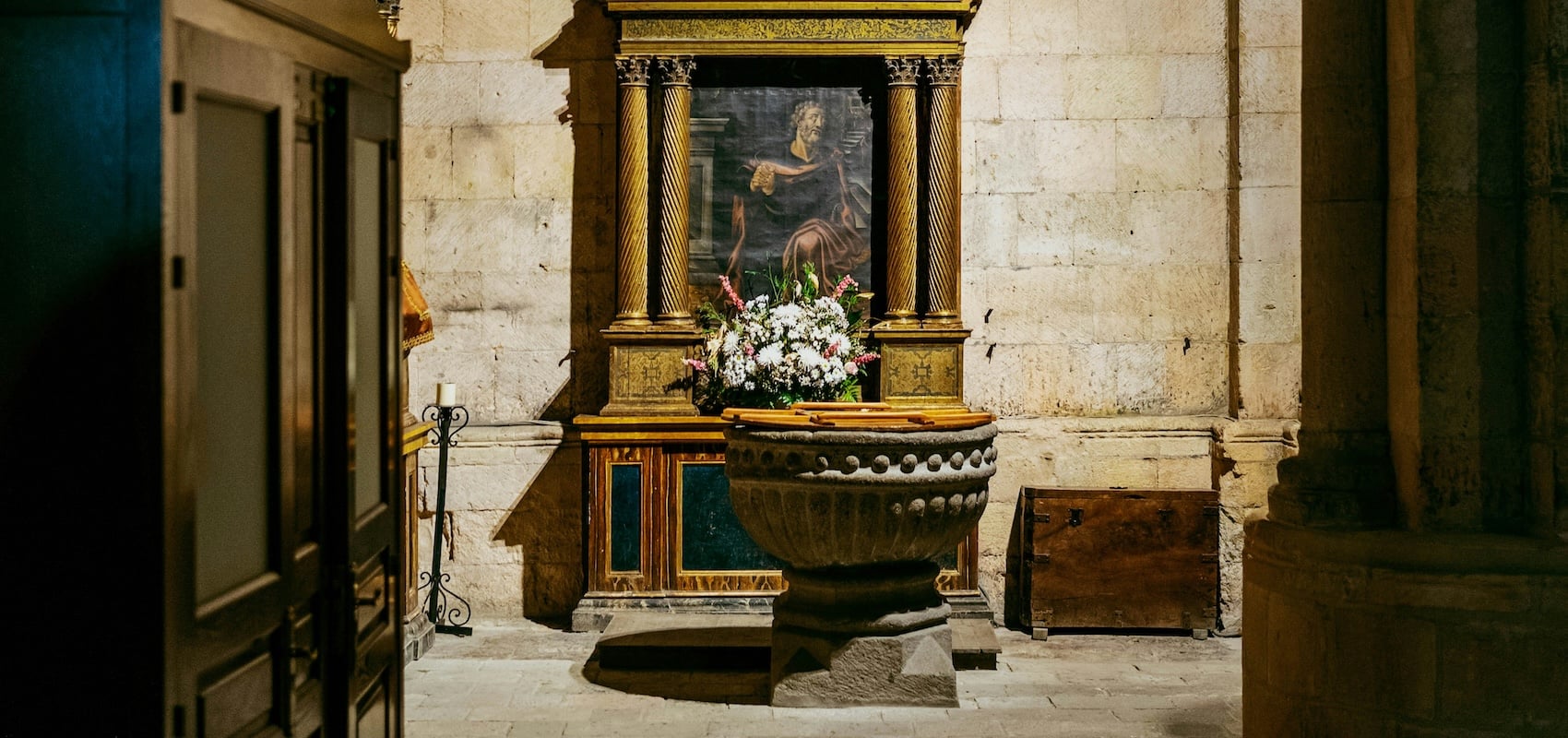
Is baptism an irreversible spiritual and ontological change or a piece of recorded personal data to be deleted on demand? That is the question currently before the European Court of Justice. Invoking the “right to erasure” under the E.U.’s General Data Protection Regulation, a Belgian non-practicing Catholic wants his name stricken from church baptismal records. The Diocese of Ghent refuses.
The broad consensus within Europe until the sixteenth century was that baptism is unique, unrepeatable, and indelible. In some sense, the question of whether baptism could be undone was previewed in the Donatist controversy over the readmission of apostate Christians during Roman persecution. The fact that the Church acknowledged there could be post-baptismal reconciliation meant one’s Christian identity could not be erased.
The question of the permanence of baptism was thrown into stark relief within the first decade of the Reformation, with the rise of Anabaptism in Switzerland and Ulrich Zwingli’s initial wobbling on infant baptism. Anabaptists might have debated whether the “baptism” of an infant was, in fact, a valid baptism, but even they did not deny it was a historical fact. Martin Luther’s 1528 treatise Concerning Rebaptism clarifies that, whatever other divisions might exist, the mainstream Christian position on baptism was that it is unique, unrepeatable, and final: “One cannot say about baptism, ‘See, baptism was there but is no longer present.’ No, it remains, for the command of God remains, and what is done according to his command stands and will ever remain.” One might become a bad or a lapsed Christian. One could not become un-Christian.
A ruling for the plaintiff in the case before the Court of Justice would fundamentally abridge the right of Christians in Europe to be Christians. The historical fact of a baptism is undeniable; what that fact means and entails is none of the state’s concern. State involvement in such matters would ultimately interfere with a Christian’s right to practice his faith.
For example, the Catholic Church holds that a marriage between two Christians is a sacrament. Altering baptismal records would therefore invite sacramental sacrilege, since it would obscure whether a potential spouse is or is not a Christian, and thus whether the marriage is sacramental. The state has no right to demand ecclesiastical amnesia on the part of the Church vis-à-vis those who seek sacramental marriage.
What the Belgian citizen wants is to reduce European society to the “state” and “individuals,” with any relations to other individuals—individually or collectively (as a church)—subject to state regulation. Such a model of social relationships has no room for intermediate or independent institutions.
But there is another idea at work here, one that very much bedevils modern life: the idea that freedom means “keeping one’s options open.” It rests on the belief that everything is always tentative, always subject to revision or rescission, always indeterminate. It stands in opposition to the Judeo-Christian understanding of freedom as a tool that serves the good.
Indeterminacy finds its intellectual champion in Mary McAleese, former Irish president, who in 2018 denounced infant baptism not because babies are too young to make a faith commitment (the Anabaptist objection) but because it makes people permanent “conscripts who are held to lifelong obligations of obedience,” denying modern understandings of freedom. The same commitment to indeterminacy assumes a more callow form among those “spiritual” types who put off their children’s baptism so that they will one day make their own choice.
None of those same parents would put off their child’s education and socialization so he can decide at eighteen whether Harvard is “right” for him. Parents do not normally postpone giving a child a language, a family, a history, or a moral vocabulary until the child is old enough to choose among them. None of us ordinarily makes choices ex nihilo; most choices emerge from a long trajectory, a chain of decisions and commitments that inclines us in a particular direction.
“Keeping one’s options open” doesn’t make a person free; it leaves him unmoored, and therefore lost. A person lost in a forest looks to the sun to find his way. At night, he looks to Polaris. Without a fixed point, every direction remains open. There is no clear path out.
Baptism is a fixed point. It is, theologically, adoption as a child of God. A child of God may abandon God, just as a natural child may flee his parents. Juridically, a court might even cancel parental rights. But no court can cancel parental facts: The parent-child relationship cannot be erased. The same is true of our adoptive relationship with him “from whom all fatherhood in heaven and on earth takes its name” (Eph. 3:14–15).
Dear Reader,
Can I be direct with you?
War abroad. Socialists on the rise. AI upending human life. Endless uproar online. The modern attention economy doesn’t want readers — it wants users enslaved to the tyranny of the present.
First Things is the antidote: literary excellence, timeless truths, and a fixed point of reference in a culture that has lost its bearings.
But we can’t do it without readers like you.
Our goal: Raise $150,000 by November 1 to sustain First Things in the year ahead.
Your gift anchors readers in the permanent things.
Make your Fall Campaign gift now using the button below.
If you have any questions or would like more information, please contact Giovanni Del Piero, Director of the Editor’s Circle, at gdelpiero@firstthings.com or 212-627-1985.

YOU MIGHT ALSO LIKE
Foucault’s Idol of Nothingness
Today marks the 100th anniversary of the birth of Michel Foucault. He was influential in his lifetime,…
Why the Death Penalty Is a Sore Point for Papal Authority
Pope Leo XIV marked World Day Against the Death Penalty, observed on October 10, with the following…
Forget Odysseus. Aeneas Is the True American Hero.
Who is our Odysseus? Or more precisely, who is the most Odyssean hero of American film? Matt…
