
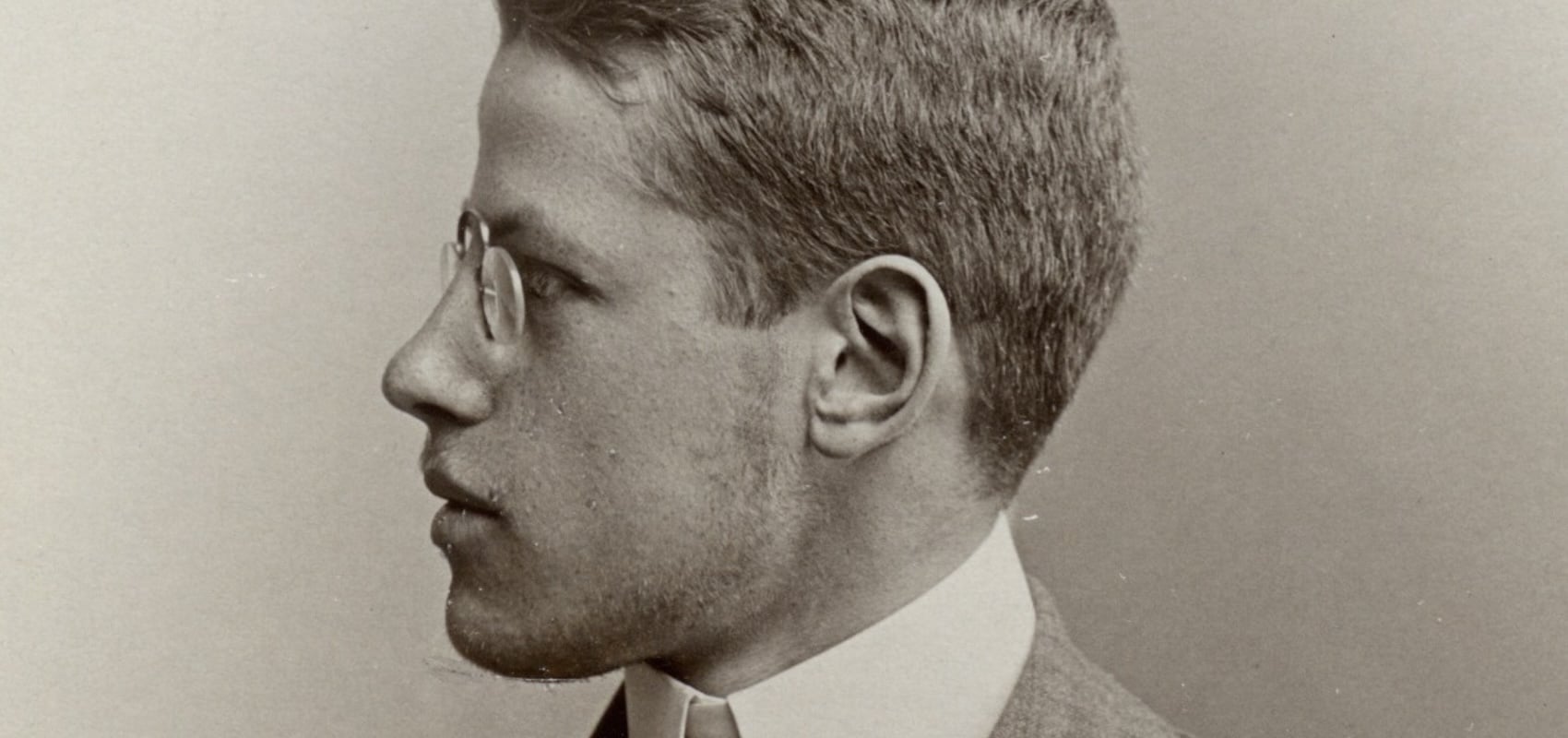
Love Is Strong as Death:
A Biography of Franz Rosenzweig
by paul mendes-flohr
university of chicago, 192 pages, $25
Jews familiar with Franz Rosenzweig (1886–1929) probably know him first as a hero, only then as a German-Jewish philosopher. His life and death are the stuff of legend. Born to an assimilated Jewish family, Rosenzweig resolved at age twenty-seven on conversion to Christianity, a step already taken by close friends. On Yom Kippur he found his way to an Orthodox synagogue in Berlin, after which he decided that it was “possible” for him to remain Jewish—and therefore, he asserted, necessary.
During his World War I service on the Balkan Front, he drafted his major work, The Star of Redemption. After the war he declined to stand for a university professorship, instead becoming director of an experiment in Jewish adult education, the Frankfurt Lehrhaus. This effort flourished for several years and influenced many contemporary adult education programs. Not long afterward, the newly married Rosenzweig was diagnosed with ALS. Getting him out of bed and through breakfast took several hours each day. Through the last eight years of his short life, the paralyzed philosopher continued to speak and write, letter by letter, by blinking his eyes in the direction of a rudimentary keyboard, in a way that some—and eventually only his wife—could interpret. During these years he produced, among other things, translations of Yehuda Halevi’s poetry and most of the idiosyncratic translation of the Hebrew Bible on which he collaborated with Martin Buber.

Until about 1970, Rosenzweig’s life and thought were known, in English, primarily through his disciple Nahum Glatzer’s Franz Rosenzweig: His Life and Thought. In the early seventies, when a new Hebrew translation of the Star was published, I rushed to buy it based on what I knew of Rosenzweig and his reputation as a premier Jewish proto-existentialist.
The man I was eager to study was identified with a few salient ideas. Despite having written his thesis on Hegel, he favored the tangible over philosophical idealism. He centered his faith on revelation rather than liberal reason (“God gave us the Torah, not ethical monotheism”). Though his theology of revelation was closer to liberal theology than to Orthodoxy, he took religious practice seriously (unlike Buber) and thus seemed a kindred spirit to others similarly situated. His remarkable ideas in the Star about the relationship between Judaism and Christianity aroused much discussion.
The structure of the Star is extraordinarily complicated. Rosenzweig introduces God, humanity, and the world, first as isolated entities, then as standing in dyadic relations to each other (God created the world; God revealed himself to man; and man’s task is to redeem the world). Finally, Rosenzweig describes a stage of triple relationship among God, man, and world. This triple relationship takes two phenomenological forms: Judaism and Christianity. Christianity is engaged with history: The Christian is “on the way.” Judaism stands at the goal. The mission of Jewish people, for Rosenzweig, is not one of change and development. Like a star, Judaism represents a religious endpoint, whereas Christianity offers the pathway for redemption.
Much of the third part of the Star is devoted to a detailed comparison of Judaism and Christianity. The three great festivals—Passover, Shavuot, and Sukkot—reenact the creation of the Jewish people, divine revelation, and the eschatological vision: past, present, and future. These holidays correspond to Christmas, Easter, and Pentecost. Note that Rosenzweig does not discern a Christian parallel to Yom Kippur. Yom Kippur, like Judaism, stands for eternity. Likewise, liturgical scriptural reading, for the Jew, takes place in the center of the synagogue, where individual Jews are called up to read a portion. For the Christian, Rosenzweig noted, God’s word is communicated from the front of the church, by the cleric or minister. This observation captures Rosenzweig’s insight that one is a Jew by virtue of being born into the Jewish people, who read the Torah rather than preach it, whereas Christian revelation, especially in its Protestant form, comes from the pulpit—that is, from the outside.
Some earlier traditional Jewish thinkers had assigned Christianity a positive role in bringing monotheistic religion to the world, without granting Christian dogma any kind of truth value, and certainly without analyzing Christianity and its institutions sympathetically. Rosenzweig did both. For this reason, he seemed to offer a way forward that would validate Christianity, from a Jewish perspective, without compromising Judaism.
This was the inspiring image of Rosenzweig I discovered as a student and conveyed to my students in turn. The late 1980s brought revision to the biography. Eugen Rosenstock-Huessy was a Jewish convert to Christianity. Rosenzweig’s exchanges with him, beginning in 1913 and available as Judaism Despite Christianity, are essential to understanding Rosenzweig’s reversion to Judaism. But Rosenzweig also exchanged thousands of letters with Rosenstock-Huessy’s wife, Margrit (“Gritli”). The precise extent of the relationship is not clear, but their letters are unquestionably love letters, some of them passionate.
The relationship continued during Rosenzweig’s marriage, and even during his illness, when his wife’s services were necessary to maintain it. Upon learning of her son’s irregular relationship with the wife of his closest friend, Rosenzweig’s mother attempted suicide. His wife eventually destroyed Gritli’s letters to Franz. The surviving letters from Franz coincide with his intense work on the Star. They are invaluable for reconstructing his thinking, though it may be disconcerting to read the passages on love in their autobiographical context. The affair also discloses a far moodier, more vulnerable Rosenzweig than the canonical philosopher-hero. One can imagine the strain it placed on the Rosenzweig family.
Paul Mendes-Flohr, who died in 2024, taught at the Hebrew University in Jerusalem and was also associated with the University of Chicago. His scholarly career was devoted to German-Jewish thought of the early twentieth century, with a concentration on Rosenzweig and Martin Buber. The posthumous biography before us is rooted in the Rosenzweig Mendes-Flohr encountered in his youth. It presumes some degree of familiarity with the chronology of Rosenzweig’s life and his intellectual environment, even as it includes the more recently disclosed material.
In addition to being an intellectual historian, Mendes-Flohr must be identified as a public intellectual. Some consider him a belated embodiment of the German-Jewish renaissance he studied. Whereas Buber, a maverick Zionist at the Hebrew University of the 1940s, advocated a binational Jewish-Arab state in Mandatory Palestine and continued to encourage dialogue between Jews and Arabs—and Mendes-Flohr involved himself in similar attempts—Rosenzweig had no such practical political profile. As a young man, he was a German patriot and soldier, and any interest he had in Jewish life in the Land of Israel was from a distance. All the same, he represents a distinctive symbiosis between German culture and Judaism, which resonates with his biographer.
How are we to assess and appropriate Rosenzweig’s legacy today, a century after his death and more than half a century since he attracted my youthful attention and Mendes-Flohr’s? On this subject, I can speak only for myself, and my perspective is that of an Orthodox Jew.
One point on which Rosenzweig’s relevance has been challenged is his understanding of Jewish history and fate. As we have seen, Rosenzweig places Judaism outside of history. Other nations are defined by territory, by worldly laws, by a living language. Judaism, by contrast, has no land of its own; its laws are God-given rather than a vehicle for contingent historical expression; the Hebrew language flourishes eternally in liturgy but not in the everyday world. In effect, Rosenzweig views exile as the “normal” state of the Jew, rather than a misfortune. The return to Zion reclaims the ancestral fatherland, at the risk of reentering history. It risks a legal evolution that undermines the divine constitution of the Torah and aims to revive Hebrew as a mutable secular tongue. So although Rosenzweig valued much in the Jewish return to Israel, finding more of the atmosphere of the Sabbath in secular Tel Aviv with its shops closed on the day of rest than in the rigorous Orthodox enclaves of Frankfurt, he remains outside the Zionist movement.
Classical Jewish thought contains strands that appreciate the positive contribution of exile for the Jewish people and for the divine economy, making the best of the constraints imposed by exile, most notably the lack of political sovereignty. Rosenzweig goes beyond these appreciations in idealizing a Judaism bereft of Israel and of national institutions.
The problem with the theological peculiarity of Rosenzweig’s de-historicized Judaism became sharper after his death. In practical terms, Rosenzweig’s idea of a Judaism outside history presupposes that this form of national existence is viable. What would he have said, what could he have said, after the twentieth century proved the dream of persistence at the margin of worldly historyto be an illusion? From a post-Holocaust vantage point, Rosenzweig is not only theologically dubious but extraneous to Jewish survival in the real world.
Rosenzweig, particularly in his dialogue with Buber, favored maximal adherence to halakhah, to Jewish practice and custom, as a response to the Jewish encounter with God. One attraction of this position is that it promises a rich religious life based on free acceptance of the Torah’s mitzvot as what Rosenzweig called Gebot (bidding) rather than Gesetz (imposed law). This understanding of religious obedience is well suited to those from “outside” the traditional community who are finding their way into the observant life. In fact, it corresponds to the attitude of many rabbis and educators who expect searching individuals to take on the obligations of religious existence gradually, at their own pace. In this respect Rosenzweig’s model remains pertinent to many individuals, but perhaps fewer than before.
For several decades I offered a course at Yeshiva University on twentieth-century Jewish intellectual history. In the later years, students increasingly wondered why Buber and Rosenzweig figured so prominently. Why, they asked, devote considerable time to individuals who may have accurately voiced their private religious feelings but did not speak authoritatively for the classical tradition, as articulated in Talmud and normative practice? In part, this question reflects a desire to build theology on canonical traditions; in part, an unease with subjectivity. Hence I am not sure whether Rosenzweig’s personal story provides my students with the inspiration it imparted in my youth.
Similar questions may be raised concerning the appeal of Rosenzweig’s theories about Judaism and Christianity. Rosenzweig’s allure, for those who see value in both Judaism and Christianity, is that he seems to promise a separate but equal theology with a neat division of labor between Judaism at the goal and Christianity “on the way”—between the self-enclosed Jewish “star of redemption” and the cross pointing upward. Such an irenic reading may be compatible with the complex prose of Rosenzweig’s Star. The author himself did view the two religions as committed to conflicting truth claims and regarded the religion to which he had not converted as false. The anticipated synthesis turns out to be less stable than hoped.
Even for Jewish thinkers who want to believe that Christianity contributes to the realization of God’s plan for humanity, it is not at all evident that we require a grand narrative of theological history such as Rosenzweig provides. Classical rabbinic education is strongly oriented to our duties and ethical aspirations in the present. Maimonides, whose preoccupation with halakhic obligations and values is combined with rationalistic philosophical tendencies, discourages eschatological speculation. His disinclination to center religion on messianic hopes characterizes many of his contemporary followers, for whom this disinclination is reinforced by skepticism about the messianic scenarios on offer.
From this observation point, Rosenzweig is a brilliant outlier in the firmament of modern Jewish philosophy. His dazzling and often obscure insights, whether they cohere with conventional Jewish teaching or strike remarkable individual notes, will continue to engage students and scholars. As scholars increasingly recognize, he is utterly inseparable from his time—from an age that esteemed Goethe, Nietzsche, Kierkegaard, Hermann Cohen, and Harnack, among others, and looked ahead to Barth and Heidegger. Academic scholarship on Rosenzweig is increasingly attentive to this context, the same early-twentieth-century German and German-Jewish intellectual milieu that nurtured Buber, Walter Benjamin, and Gershom Scholem. Mendes-Flohr, with one foot in the twentieth century and the other in the twenty-first, has given us a valuable introduction to the man and his work.
Image by Monozigote, licensed via Creative Commons. Image cropped.
Dear Reader,
Can I be direct with you?
War abroad. Socialists on the rise. AI upending human life. Endless uproar online. The modern attention economy doesn’t want readers — it wants users enslaved to the tyranny of the present.
First Things is the antidote: literary excellence, timeless truths, and a fixed point of reference in a culture that has lost its bearings.
But we can’t do it without readers like you.
Our goal: Raise $150,000 by November 1 to sustain First Things in the year ahead.
Your gift anchors readers in the permanent things.
Make your Fall Campaign gift now using the button below.
If you have any questions or would like more information, please contact Giovanni Del Piero, Director of the Editor’s Circle, at gdelpiero@firstthings.com or 212-627-1985.

YOU MIGHT ALSO LIKE
Why the Death Penalty Is a Sore Point for Papal Authority
Pope Leo XIV marked World Day Against the Death Penalty, observed on October 10, with the following…
The Myth of St. Francis
At the beginning of his 2020 encyclical, Fratelli Tutti, Pope Francis speaks of “an episode in the…
Job and Her
It is said that Job lost everything, but she has lost more. All her possessions—the money, the…
