
The pope entombed in the crypt under St. Peter’s Basilica on January 5, 2023 was without doubt an extraordinary man. As a friend observed, “We’re not likely to see anyone half as well-educated or a tenth as wise anytime soon.” I think he’s right. Ratzinger was a deeply learned man. Something of a theological wunderkind, he served as an advisor during the Second Vatican Council, a role that put him at the center of twentieth-century Catholicism’s defining event. As a young professor, he experienced firsthand the student uprisings of 1968 and glimpsed the nihilism that underlay the political idealism and ardent moralism of that time. Working closely with Pope John Paul II and then as John Paul’s successor, for decades Benedict XVI shaped Catholicism in the aftermath of Vatican II.
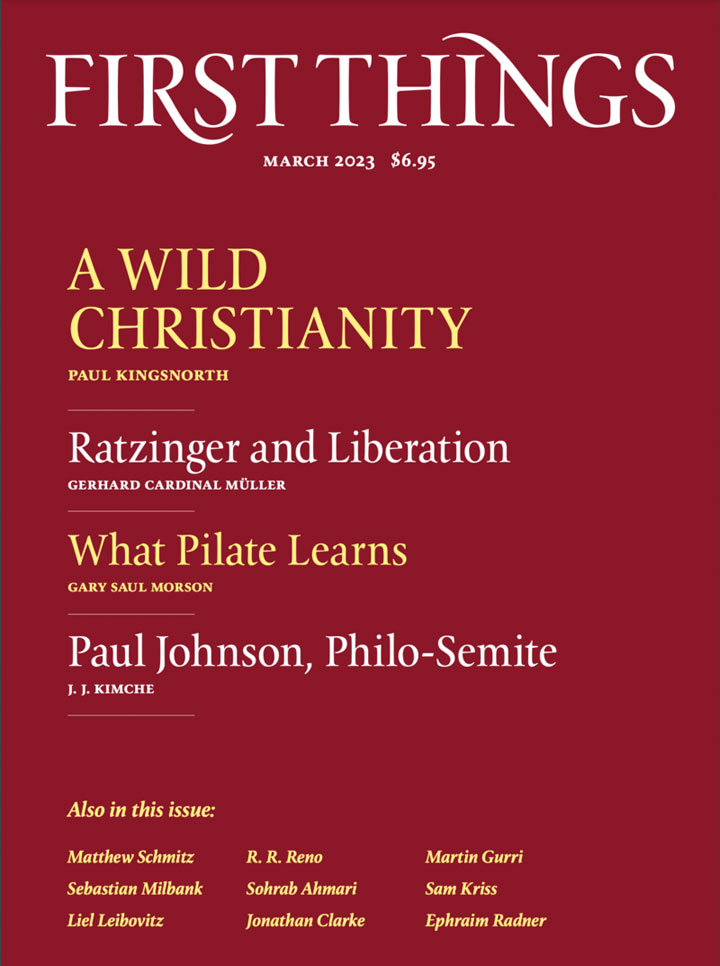
Others have written about his achievements as a theologian. I commend Christopher Ruddy’s survey for Commonweal, “Benedict’s Theological Legacy,” as well as Gerhard Cardinal Müller’s reflections in these pages (“Ratzinger and the Liberation Theologians”). It will be interesting to see which of this great man’s many publications find readers in future generations. In my opinion, his encyclicals, though theologically rich, are too diffuse and long-winded to endure as touchstones in the way that Leo XIII’s Rerum Novarum has and as John Paul II’s Veritatis Splendor will. Fr. Robert Imbelli has written warmly about the young Ratzinger’s theological textbook, Introduction to Christianity. My students found it tough sledding when I assigned the book in my introductory classes. By contrast, The Spirit of the Liturgy sings, and I’m sure it will be read for decades to come, as will his essays and addresses, in which his vast learning is often synthesized and expressed in plain, accessible theological language.
All that said, I believe that when future historians look back and write about modern Catholicism, Benedict XVI will be remembered less for what he wrote (here I respectfully differ from Cardinal Müller) and more for two acts of ecclesiastical governance that will have consequences for a long time to come.
The first was the 2007 papal directive Summorum Pontificum, which liberalized rules concerning the celebration of the traditional Latin Mass. By this act of administrative fiat, Benedict XVI entrenched the celebration of a rite that had defined Catholicism for centuries before Vatican II. It was a concrete expression of his view that the Second Vatican Council must be interpreted and implemented with a “hermeneutic of continuity.”
The ongoing celebration of an ancient liturgy has no direct logical implications for our interpretation of Vatican II’s teaching on dogmatic topics, nor does it bear upon moral theology. Nevertheless, there is a fundamental truth often repeated by the Church Fathers: Lex orandi, lex credendi—the law of prayer is the law of belief, or more colloquially, as we pray, so we believe. Benedict issued Summorum Pontificum under the assumption that the regular celebration of the traditional Latin Mass could and should function in harmony with the new vernacular Mass. That assumption has been vindicated in numerous dioceses, where an upsurge of enthusiasm for the Latin Mass, often among the young, brings spiritual vitality to the whole church. These on-the-ground experiences put paid to any “hermeneutic of discontinuity.”
The present pontiff has issued his own executive order, Traditionis Custodes, which reverses Summorum Pontificum. Pope Francis backs up his new restrictions with the strong language of censure. But this pontificate has failed to curtail celebration of the old rite. The reason is simple: We live in an era that champions permission and ignores prohibition. The widespread noncompliance with Humanae Vitae, which reiterated the traditional Christian prohibition of artificial birth control, provides an obvious illustration.
In the age of permission, traditional strictures can be maintained. John Paul II and Benedict demonstrated this with respect to abortion, homosexuality, and the sexual revolution more broadly. They had to be careful; the slightest whisper of “yes” makes any future “no” largely ineffective. Pope Francis is being steamrolled by this very powerful social reality. He issued a “yes” when he intervened to ensure that a Vatican document on marriage and family life equivocated on the possibility of divorced and remarried Catholics receiving communion. Immediately afterwards, the German Church began a process designed to turn that narrow opening into a wide-open door to the many “yeses” of the sexual revolution. Unfortunately, short of a massive purge, it is likely impossible for Francis to stop what is afoot in Germany. Once the “yes” is said, a subsequent “no” will be an empty letter. Traditionis Custodes is suffering the same fate.
No doubt the Bavarian pope, who coined the memorable phrase “dictatorship of relativism,” knew that in the twenty-first century permissions granted cannot easily be rescinded. Benedict granted capacious permission to celebrate the traditional Latin Mass, in all likelihood knowing that once the “yes” gained a foothold, only Herculean efforts by ecclesiastical authorities would eliminate the new freedom. The consequences are wonderful. Benedict’s “liberalization” of rules concerning the Latin Mass has created and will continue to create a barrier to theological, moral, and liturgical programs of discontinuity, which means that liberal Catholic dreams of reinventing the faith to make it more congenial to our present age will not succeed. Benedict XVI was a church politician of greater wile than he let on.
Benedict’s resignation stands as the second act of governance that will go down in history. For all intents and purposes, Benedict XVI invented the office of pope emeritus. In itself, this new office is innocuous, since the single requirement of the holder of this position seems to be to remain silent and invisible. But the implications are significant for the present pope and future popes.
Resignation was Benedict’s choice. It will be so for other occupants of the papal office. But choices do not take place in a vacuum, especially not the choices of a pope—who, although nominally possessed of supreme authority, is subject to countless pressures. Is it impossible to imagine an embassy of influential cardinals meeting with a future pope to convey an informal vote of no confidence? Am I being too Machiavellian if I predict that a future pope will be induced to resign when a group of cardinals guarantee that they will vote for a particular man in the ensuing conclave, promises that would amount to allowing a sitting pope to choose his successor?
I admired Joseph Ratzinger the theologian. It was always foolish to call him “conservative.” He participated in the deep transformations of Catholic theology that took place in the mid-twentieth century. He was in that regard an “innovator,” always to the end of enriching the Church’s constant teachings. I can now see that as supreme pontiff, Pope Benedict ruled in a similarly innovative way. He “liberalized” liturgical strictures in order to buttress the Church’s conviction that what is fitting and new for Catholic witness in our age is entirely in accord with that which came before. And he pioneered a new way to bring a pontificate to an end, a novelty that the Holy Spirit may use in unexpected ways.
WHILE WE’RE AT IT
♦ Yiddish proverb: Truth never dies, but it leads a miserable life.
♦ Over the last few years, Canada has rolled out a program of doctor-assisted suicide. Originally restricted to those facing “reasonably foreseeable” natural death, in 2021 it was expanded to those whose illnesses need not be terminal. The Canadian government is considering an expansion of this program to cover “mature minors,” including those as young as twelve, who are deemed “fit” to make a decision to end their lives. These policies are widely popular. Polling suggests that 86 percent of Canadians approve of a “right” to die. We should not be surprised. As Leila Mechoui explains in Compact magazine (“Euthanasia Is Liberalism’s Endgame”), “State-administered euthanasia on-demand is the logical endpoint of a society built on secular humanism and utilitarianism. These frameworks preclude any appeal to an absolute authority beyond the individual. The ultimate expression is as a state-protected ‘right’ to a ‘dignified’ death.” The future of the West: a culture of death under the sign of choice.
♦ Moderate statements about the importance of renewing patriotic bonds and reconsolidating our country’s unity have earned me accusations of promoting “blood and soil” nationalism, or at least of failing to be sufficiently ardent in opposition. I’m not surprised. Anyone who fails to cheer “diversity” and other multicultural slogans eventually gets denounced as a racist, as I note above in my discussion of Matthew Crawford’s analysis. The accusations are surreal. Land acknowledgements, so favored by those who adhere to multiculturalism and its platitudes, seem to be pure expressions of “blood and soil” nationalism. Here’s an example: “The Denver City Council honors and acknowledges that the land on which we reside is the traditional territory of the Ute, Cheyenne, and Arapaho Peoples.” Blood has mixed with the soil, and it makes metaphysical demands.
♦ I was saddened to hear of George Cardinal Pell’s death in January. George Weigel, who knew him well, penned a wonderful tribute (“Cardinal George Pell: The Encourager”). “He was a courageous man who ‘en-couraged’ others—who gave others courage, or, perhaps better, drew out of others the courage they did not know lay within them.” May he rest in peace.
♦ The Pillar asked Archbishop Charles Chaput why Pope Benedict XVI and Cardinal Pell were seen as polarizing figures. His answer: “Speaking the truth is polarizing. It got Jesus killed. Bad people with bad ideas dislike good people trying to do good things. And that accounts for the contempt, resentment, and outright lying directed at both men over the years, including from people who describe themselves as Christians; people within the Church herself.”
♦ National Review writer Nate Hochman reported on the ways in which powerful progressive business interests in South Dakota have succeeded in blocking socially conservative legislation in that state. One moral of the story: Big Business is the enemy of socially conservative voters. The other moral: It does not cost very much to buy the South Dakota governor and state legislature.
♦ The Priestly Fraternity of Saint Peter (FSSP) is a society of apostolic life that seeks, among other things, to celebrate the traditional Latin Mass. It is interesting to note that during a fundraising campaign launched by the Archdiocese of Los Angeles, St. Vitus in San Fernando, an FSSP parish, was the largest source of donations, outstripping larger and wealthier parishes. A mid-November report on the campaign’s progress shows that the parish had donated more than three times the parish goal set for it by the archdiocese. In view of this generosity, a tangible sign of vitality, it is not hard to see why so many American bishops are less than enthusiastic about implementing Pope Francis’s strictures to limit the celebration of the traditional Latin Mass.
♦ The Huns are invading! Florida governor Ron DeSantis has appointed six new board members at New College, a small, quirky liberal arts school founded in 1960 that is part of the Florida university system, and the new appointees are—gasp—“conservative.” Among the barbarians is First Things contributing editor Mark Bauerlein, who holds the dangerous view that education ought not be a course of study in how to be a social justice warrior.
♦ New College is troubled. Student enrollments are disappointingly low. Which is why the uproar over Mark’s appointment sent me back to C. P. Cavafy’s “Waiting for the Barbarians.” The poem depicts a city’s elite preparing for the arrival of rough marauders. But the barbarians do not come, and their non-arrival creates a despairing confusion that is perhaps worse than the previous dread. “Now what’s going to happen to us without barbarians? / Those people were a kind of solution.”
♦ More than one thousand subscribers receive First Things on their Kindles. They do so by subscribing through Amazon. Unfortunately, the e-commerce behemoth is dropping First Things (and many other publications). No new subscriptions or renewals will be allowed after March 1, and the monthly subscription service will be shut down by September 2023. The company wants customers to pay a monthly fee for Kindle Unlimited, which provides access to its entire library. We’re not sure that First Things will be invited to be on the menu. Therefore, if you are a Kindle reader, please secure access directly through firstthings.com/subscribe.
♦ Last month, I spoke of Christmas as the feast of the Incarnation. A reader sent an incredulous note: “Does Rusty Reno believe that the Incarnation of our Lord took place at the birth of Christ?” Your humble scribe is properly shamed, doubly so because he has an advanced degree in theology and should not be making basic mistakes of this sort. Christmas celebrates the nativity of our Lord, and though we “see” the Incarnation for the first time in the swaddled Christ Child, the Word becomes flesh in the womb of the Virgin Mary at the Annunciation.
♦ Robert Todd and Lester Prosper of Bloomington, Indiana, would like to form a ROFTERS group. You can join by getting in touch with Mr. Todd at r.todd1@mac.com.
♦ Clyde Taylor is the new leader of the Chicago ROFTERS group, which is always eager to welcome new members. You can reach him at clydeataylor@gmail.com.
Dear Reader,
Can I be direct with you?
War abroad. Socialists on the rise. AI upending human life. Endless uproar online. The modern attention economy doesn’t want readers — it wants users enslaved to the tyranny of the present.
First Things is the antidote: literary excellence, timeless truths, and a fixed point of reference in a culture that has lost its bearings.
But we can’t do it without readers like you.
Our goal: Raise $150,000 by November 1 to sustain First Things in the year ahead.
Your gift anchors readers in the permanent things.
Make your Fall Campaign gift now using the button below.
If you have any questions or would like more information, please contact Giovanni Del Piero, Director of the Editor’s Circle, at gdelpiero@firstthings.com or 212-627-1985.


YOU MIGHT ALSO LIKE
Why the Death Penalty Is a Sore Point for Papal Authority
Pope Leo XIV marked World Day Against the Death Penalty, observed on October 10, with the following…
The Myth of St. Francis
At the beginning of his 2020 encyclical, Fratelli Tutti, Pope Francis speaks of “an episode in the…
Job and Her
It is said that Job lost everything, but she has lost more. All her possessions—the money, the…
