
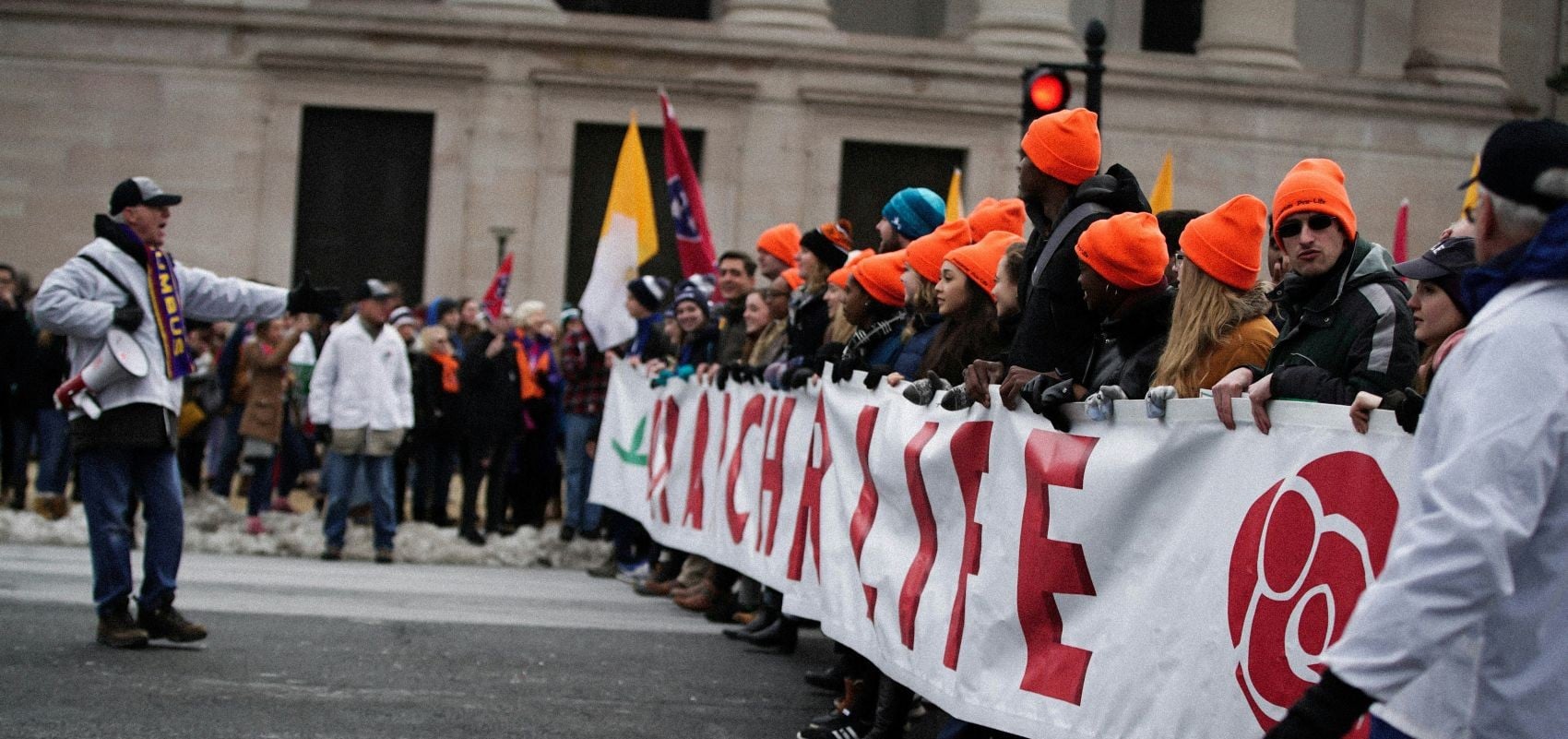
Jonathon Van Maren’s First Things article offering a post-midterm reckoning for the pro-life movement is a must-read. Anyone should agree with his core diagnosis: We got killed in ballot measures in Virginia (62.4 percent) and Nevada (63.4 percent), and we once again lost Missouri by ten points. At the same time, previously pro-life Republicans who abandoned the position, as Mike Rogers did in Michigan, managed to both lose badly and compromise their core values.
But while Van Maren suggests a recovery plan for a partisan instrument, I continue to believe that pro-lifers need to creatively ride the current wave of political disruption and realignment as we figure out what the 3.0 version of the movement will look like.
This version should refuse to give up on working for basic justice by fiercely arguing for equal protection for all human beings. In a new book that will be published this January, for instance, I make the case that we need legislation and regulation to protect disabled newborns from what is essentially the return of infanticide in the developed West. But the classic and good reflex of our movement to focus on equal protection of the law ought to be paired with other strategies, including (as I argued with Van Maren and Monica Snyder of Secular Pro-Life) a focus on addressing the structures and systems that produce the dramatic rates of unwanted and coerced abortion, especially in an age of dangerous proliferation of abortion drugs.
The bad losses at the midterm polls show that large majorities simply aren’t with us. If we are to fend off the massive threats to human dignity in the coming years—the diabolical and ridiculously named Women’s Health Protection Act, renewed pushes for physician-assisted killing, the exploitation and discarding of millions of tiny human beings through eugenic embryo screening—we must find new and creative ways to make the case for our vision of the dignity of the human person in the public sphere.
Significantly, a substantial majority of Americans now hold, implicitly or explicitly, a functionalist and/or will-based account of moral and legal value. If the prenatal or neonatal entity is wanted, she is a “baby.” If not, she is a “fetus” and may be legally killed. Many folks also want to make distinctions between different kinds of prenatal or neonatal humans: If they have certain functional capacities—feeling pain, demonstrating self-consciousness—then they may count as having significant objective moral value, but if they don’t, well, then they can be discarded like trash.
For those looking around for creative ways to challenge this false anthropology, it is now clear that the pro-life movement has a tremendous opportunity to engage the AI revolution. Politics surrounding this revolution will dominate at least the next two years, and likely the next two decades. For pro-lifers who wish to avoid knee-jerk or resigned fealty to whatever placeholder counts as the Republican Party at this moment of disruption, it matters that the politics of AI do not fit into our lazy and largely incoherent left-right imaginary. Bernie Sanders and Steve Bannon, for instance, spoke back to back against the AI and tech oligarchs recently at the Future of Life Institute’s Pro-Human Assembly. The main obstacle to working across political lines on AI has been the massive influence of tech-bro money in the current administration, but the dramatic rebuke of the midterms has set things on quite a different and far more skeptical path for AI—as the recent and massive tech sell-off in the markets has made clear.
The most important contribution of Pope Leo’s great encyclical, Magnifica Humanitas, is the beautiful and moving anthropology it proclaims over and against the false vision of the functionalists and transhumanists. Our value comes from being embodied and ensouled creatures God created. It does not come from our level of consciousness, computational speed, cognitive capacities, or level of efficiency. On the contrary, Pope Leo is at pains to turn the functionalist vision on its head. Humanity’s magnificence, revealed by Christ, comes through our limitations, our finitude, our vulnerability, our being made for relationships with each other and with God. Indeed, in a statement that would have been seen in the ancient world as wildly countercultural, our Lord explicitly tells us that we must be like simple little children if we want to enter the Kingdom.
This stands in stark contrast to the anthropological vision that dominates the AI and tech revolution. As I recently wrote in the Washington Examiner, technologies like Jack Dorsey’s new Dessa audiobot and Anthropic’s Claude chatbot have functions designed to interface with us as if they were persons. The power of this technology to imitate the functional equivalent of human written text, spoken human speech, human reasoning, and even human emotion is already extraordinary. Tragically, significant minorities of (especially vulnerable) human beings have already and understandably been tricked into thinking that they have real relationships with these bots, sometimes with deadly consequences. These already very bad outcomes are likely to get even worse as AI gets exponentially better at imitating human beings.
Happily, there is a broad backlash beginning to form. Overwhelming majorities want tech companies to pause and pivot away from the kind of reckless and foolhardy pursuit of AI that would make Leeroy Jenkins blush. Indeed, a June 2026 poll found that 77 percent of registered voters believe that AI should always be treated as a tool controlled by humans rather than an entity that could be granted legal rights or personhood.
Folks who have these intuitions may not be able to put them into anthropological terms, but pro-lifers stand ready to enter the public discourse on this topic and articulate the necessary vision. AI cannot be a person because it isn’t an embodied soul. Moral value doesn’t come from functional capacities like computational speed, level of consciousness, or efficiency. It comes from being a creature, made in the image and likeness of God. And those human beings whose functional capacities are diminished by youth or old age, illness or disability, in some ways deserve more moral consideration and legal protection, not less.
Pope Leo reminds us: Mysteriously, it is through the moments when our functional limitations are most fully on display that we most clearly encounter the presence of the Lord. This understanding of human dignity is not only objectively true but also helps explain the powerful intuitions of so many critically confronting the AI and tech revolution.
It’s time for pro-lifers to enter the fray.

YOU MIGHT ALSO LIKE
The Pro-Life Movement’s Midterm Reckoning
"It’s impossible to sugarcoat it,” Marjorie Dannenfelser of Susan B. Anthony Pro-Life America wrote in a memo…
Aaron Sorkin’s Facebook Fumble
In 2014, Aaron Sorkin published an op-ed in the New York Times arguing that journalists should refuse…
AI and Evangelization
During a Gaudium et Spes 22 podcast on the encyclical Magnifica Humanitas this past June, I said…
