
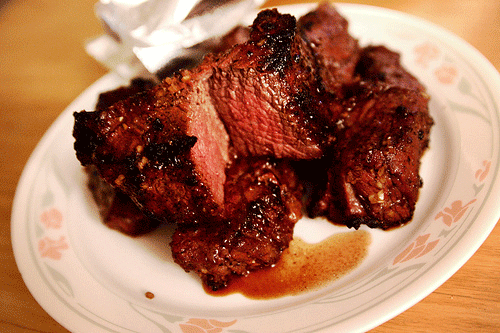
 Eating meat is as natural to human beings as walking upright. Evolutionary theory has found a good reason why: It made our brains bigger allowing us to become, to quote myself, exceptional. From the story:
Our earliest ancestors ate their food raw — fruit, leaves, maybe some nuts. When they ventured down onto land, they added things like underground tubers, roots and berries. It wasn’t a very high-calorie diet, so to get the energy you needed, you had to eat a lot and have a big gut to digest it all. But having a big gut has its drawbacks. “You can’t have a large brain and big guts at the same time,” explains Leslie Aiello, an anthropologist and director of the Wenner-Gren Foundation in New York City, which funds research on evolution. Digestion, she says, was the energy-hog of our primate ancestor’s body. The brain was the poor stepsister who got the leftovers. Until, that is, we discovered meat. “What we think is that this dietary change around 2.3 million years ago was one of the major significant factors in the evolution of our own species,” Aiello says.
And this made us much smarter:
As we got more, our guts shrank because we didn’t need a giant vegetable processor any more. Our bodies could spend more energy on other things like building a bigger brain. Sorry, vegetarians, but eating meat apparently made our ancestors smarter — smart enough to make better tools, which in turn led to other changes, says Aiello.
But raw meat was still inadequate because it isn’t easy to eat. So, the steak barbecue was created:
And cooking is what he thinks really changed our modern body. Someone discovered fire — no one knows exactly when — and then someone got around to putting steak and veggies on the barbeque. And people said, “Hey, let’s do that again.” Besides better taste, cooked food had other benefits — cooking killed some pathogens on food. But cooking also altered the meat itself. It breaks up the long protein chains, and that makes them easier for stomach enzymes to digest. “The second thing is very clear,” Wrangham adds, “and that is the muscle, which is made of protein, is wrapped up like a sausage in a skin, and the skin is collagen, connective tissue. And that collagen is very hard to digest. But if you heat it, it turns to jelly.”
So, meat eating led to human exceptionalism, which , ironically, eventually led some to want to outlaw meat eating in the name of denying human exceptionalism. Why one could think that the meaningless universe has a sense of humor.
HT: Humanewatch
Dear Reader,
Can I be direct with you?
War abroad. Socialists on the rise. AI upending human life. Endless uproar online. The modern attention economy doesn’t want readers — it wants users enslaved to the tyranny of the present.
First Things is the antidote: literary excellence, timeless truths, and a fixed point of reference in a culture that has lost its bearings.
But we can’t do it without readers like you.
Our goal: Raise $150,000 by November 1 to sustain First Things in the year ahead.
Your gift anchors readers in the permanent things.
Make your Fall Campaign gift now using the button below.
If you have any questions or would like more information, please contact Giovanni Del Piero, Director of the Editor’s Circle, at gdelpiero@firstthings.com or 212-627-1985.

YOU MIGHT ALSO LIKE
The Church in the Age of Therapy
In 1966, Philip Rieff wrote in The Triumph of the Therapeutic that “Religious man was born to…
Canada’s Deadliest Blind Spot
On September 20, the Daily Mail ran a story with the provocative headline, “Our 83-year-old Christian grandmother…
The Faithful Joy of Dolly Parton and Fulton Sheen
Dolly Parton and Fulton Sheen seem to have had little in common. She favored rhinestones; he wore…
