
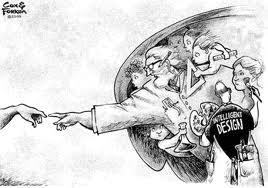
 Sigh. So many big brains seem to spend so much time pondering the likelihood and consequences of a pending human immortality. Not. Gonna. Happen.
But I want to focus on one aspect of this issue and demonstrate how it points to human exceptionalism. Over at Huffington Post Science, George M Young asks, “Do You Want to Be Immortal, Really?” Here’s the human exceptionalism part:
He believes that our current lifespan of up to 90 or, in extreme instances, slightly over 100 years, is not cast in stone or fixed in nature but an evolutionary stage out of which we are now emerging. Genetic engineering, replacement of natural organs with artificial instruments, nanotechnology, and other developing technologies could now extend our lives well beyond today’s assumed limits. He proposes that a 200-year-old person is a present possibility, and a person who could live at least as long as a 2,000-year-old redwood tree is certainly imaginable. Such longevity will be self-propelling. New discoveries during the 200-year (or 2,000-year) lifespan would make what Vishev calls “practical immortality” a fairly safe bet.
By “practical” he means “realizable” but not absolute. People could still die, accidentally or otherwise, but eventually techniques of “practical resurrection,” toward which today’s cloning is a primitive first step, would be able to restore life to those who somehow lose it. Vishev’s philosophy, which he calls “practical immortology,” is an attempt to shift our entire culture and worldview from one based on the certainty of human mortality to one based on the prospect of human immortality. This shift requires radical new directions not only in science and technology but in economics, politics, morality, ecology, art — everything. Not easy, of course, but he thinks it’s possible.
No. But here’s the point. All of this effort and thought isn’t evolutionary. Natural selection requires death to work. Moreover, it is supposedly random and undirected toward a goal.
No, the immortality project is intelligent design, of which, only we are capable. Only humans have a foot outside of natural processes and have ceased to be totally at its effect. Only we have the capacity to mold nature in our image, and that capability is inherent in our natures. We are exceptional.

YOU MIGHT ALSO LIKE
The Church in the Age of Therapy
In 1966, Philip Rieff wrote in The Triumph of the Therapeutic that “Religious man was born to…
Canada’s Deadliest Blind Spot
On September 20, the Daily Mail ran a story with the provocative headline, “Our 83-year-old Christian grandmother…
The Faithful Joy of Dolly Parton and Fulton Sheen
Dolly Parton and Fulton Sheen seem to have had little in common. She favored rhinestones; he wore…
