
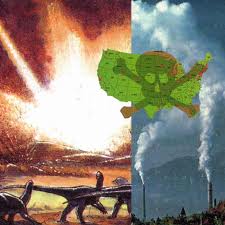
 Environmentalism has taken on a distinctly anti human hue in recent years—which is why I got interested in discussing it here. Latest example: We are supposedly calling a mass extinction event. From the story:
Mankind may have unleashed the sixth known mass extinction in Earth’s history, according to a paper released by the science journal Nature. Over the past 540 million years, five mega-wipeouts of species have occurred through naturally-induced events. But the new threat is man-made, inflicted by habitation loss, over-hunting, over-fishing, the spread of germs and viruses and introduced species, and by climate change caused by fossil-fuel greenhouse gases, says the study. Evidence from fossils suggests that in the “Big Five” extinctions, at least 75 percent of all animal species were destroyed.
Unless we have a nuclear war, I truly doubt we will cause 75% of the species on earth to disappear.
But here’s the point that I would like all you human unexceptionalists out there—and you know who you are—to ponder: If we do cause a mass extinction and we thrive anyway—so what? What difference does it make if we kill off species if they don’t do us any material good? It just means more earth for us.
You could say that such extinction would cause an environmental imbalance. True, but the earth will be fine in the long run. New life will emerge from the ashes—as it has 5 times before. Indeed, it could open a path for tremendous evolutionary events!
You could say that it would harm humanity, that we depend on a diverse ecosystem. True. But that means what impacts us is what matters most, at least implying human exceptionalism. Ooops.
You could say we will have destroyed something of undefinable beauty and infinite preciousness. True! But that isn’t rational. Beauty, awe, propriety, probity, humility, respect—these are mere moralistic sensibilities—and I have been hearing in another thread that such considerations can’t be measured and thus, aren’t legitimately imposed upon a libertarian society.
So, what is your answer to the question posed above? Mine is human exceptionalism. Our mere humanity imposes the human duty upon us to be good conservators of nature. Causing a mass extinction would be to violate one of our raisons d’ etre-whether we evolved randomly, were designed, or are the product of divine creation. Living properly on the earth is a profoundly moral issue that can’t be rationally measured but arises from the intrinsic nature of our species. Indeed, if being human alone doesn’t give rise to that duty, what does?
And if being human does give us that duty—name one other creature that has a responsibility to sometimes put its own thriving aside to protect other species. Can’t think of one? Me neither. That makes us exceptional.
Dear Reader,
Can I be direct with you?
War abroad. Socialists on the rise. AI upending human life. Endless uproar online. The modern attention economy doesn’t want readers — it wants users enslaved to the tyranny of the present.
First Things is the antidote: literary excellence, timeless truths, and a fixed point of reference in a culture that has lost its bearings.
But we can’t do it without readers like you.
Our goal: Raise $150,000 by November 1 to sustain First Things in the year ahead.
Your gift anchors readers in the permanent things.
Make your Fall Campaign gift now using the button below.
If you have any questions or would like more information, please contact Giovanni Del Piero, Director of the Editor’s Circle, at gdelpiero@firstthings.com or 212-627-1985.

YOU MIGHT ALSO LIKE
The Church in the Age of Therapy
In 1966, Philip Rieff wrote in The Triumph of the Therapeutic that “Religious man was born to…
Canada’s Deadliest Blind Spot
On September 20, the Daily Mail ran a story with the provocative headline, “Our 83-year-old Christian grandmother…
The Faithful Joy of Dolly Parton and Fulton Sheen
Dolly Parton and Fulton Sheen seem to have had little in common. She favored rhinestones; he wore…
